
Landlord Basics: Tenant Screening Don’ts in Massachusetts
By Kimberly Rau, MassLandlords, Inc.
This installment of our Landlord Basics series looks at tenant screening laws in Massachusetts. Tenant screening involves reviewing renter applicants to see if they qualify to rent from you.
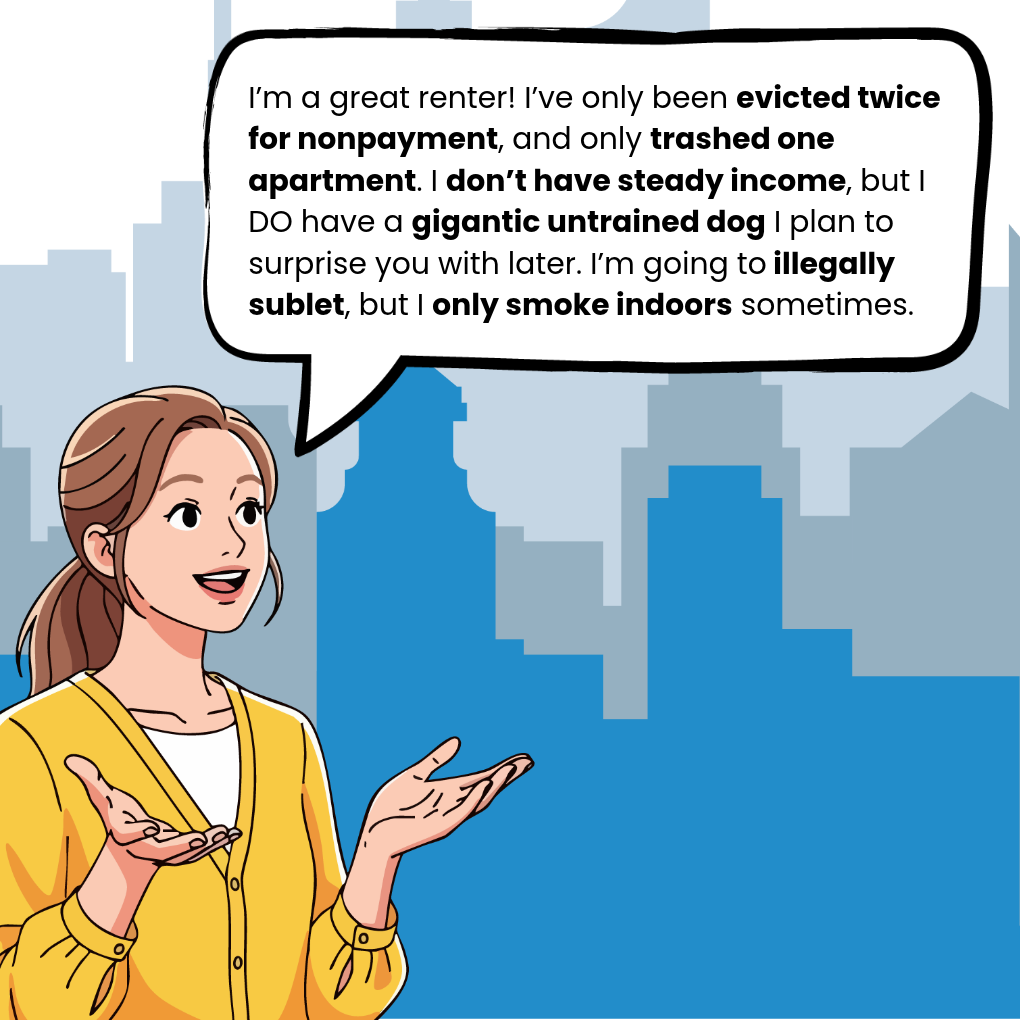
Your applicants won’t tell you why they’re a bad fit for your apartment. Tenant screening can help you lessen the risk of problem renters. (Image License: CC BY-SA 4.0 MassLandlords, Inc.)
A qualified tenant should have a way to pay the monthly rent. Besides paying the rent, there are other things you may want to consider when approving applicants, as well as things you cannot do.
You should screen renters’ backgrounds for credit, criminal history and evictions. You also need to make sure they will follow house rules. Tenant screening allows you to look at an applicant’s background, as well as ask important questions. Do they smoke? Do they have pets? Would their previous landlords rent to them again?
This article provides an overview of some of the most important things to remember when screening potential renters.
You Cannot Charge Renters for a Background Check
First and foremost, while we strongly recommend you conduct a background check, this is not a cost you can pass on to your potential tenants. MGL Chapter 186, Section 15b, allows landlords to charge new renters for first and last months’ rents, a security deposit not more than the first month’s rent, and the actual costs of re-keying the unit.
Therefore, any background check costs must be paid by you. You can search court databases and the state sex offender registry for free, but that’s not likely to be enough. In-depth credit checks, nationwide criminal background checks and other screening tools are not free.

Checking on criminal background, credit score, income and references can help you properly screen renter applicants. (Image License: CC BY-SA 4.0 MassLandlords, Inc.)
Zillow background checks: proceed with caution
Some landlords advertise their rentals on Zillow. Renters who apply through Zillow have the option to pay the platform (not you) for their application. Be careful. This is noncompliant. A landlord cannot have a renter pay for anything other than first, last, security and locks.
We’re not sure how much you lose by taking your own application instead of the Zillow application. In our MassLandlords Members Only Facebook group, one member reported in June 2026 that their applicant had a clean rental history according to Zillow’s report, but masscourts.org revealed an eviction for nonpayment.
Don’t Discriminate Against Protected Classes in Massachusetts
The federal government and state of Massachusetts have a list of characteristics called “protected classes.” It is unlawful to deny someone housing based on belonging to any of these classes.
In Massachusetts, you cannot reject a housing application on the basis of race, color, religion, sex, national origin, family status, disability, sexual orientation, gender identity, age, ancestry, veteran or armed forces status, receiving public assistance, or hair styles normally associated with race.
Massachusetts also prohibits discrimination based on genetic information. It was probably added to the law to prevent employment discrimination, but it applies to housing providers as well.
You don’t have to accept an unqualified candidate because they are a member of a protected class. You can deny anyone for any business reason. But you cannot deny someone because they are part of a protected class.
Some protections are obvious. For example, you can’t refuse to rent to someone who is a different race. But other protections are more subtle. You can read more about discrimination laws on our site. That page also includes links to more detailed articles on how to avoid discrimination based on specific protected classes.
The applicable Massachusetts law is found in MGL Ch. 151b, Section 4.
You may have heard that landlords who owner-occupy small residential buildings are exempt from some portions of the law. You can read more about the so-called “Mrs. Murphy” exemption. We recommend you forget it.
There is one protected class that deserves special mention in this article, and that’s public assistance.
Screen Applicants for Ability To Pay, Including Public Assistance
You should make sure that your applicant can afford the rent comfortably. An applicant who has members of the household who work can provide pay stubs or bank statements to prove that they make enough income over the course of a year.
Other renters may need to use their housing voucher, or subsidy, to qualify. Programs include Section 8 and the Massachusetts Rental Voucher Program (MRVP). These programs guarantee the rent will be affordable as long as the renter is part of the program. MRVP, which is funded by the state, functions nearly identically to Section 8, which is federally funded.
Rejecting a tenant because they participate in a state- or federally funded housing program is against the law. If they are otherwise unqualified, you can reject them on those grounds, but you cannot say “I don’t take Section 8” or something similar.
You cannot apply an “income to rent ratio” with Section 8 the way you would with pay stubs. If the renter cannot afford the apartment, the program will pay the difference.
RAFT is different from MRVP and Section 8.
Some applicants may have funds from the Residential Assistance for Families in Transition (RAFT) program. This is not the same as an ongoing subsidy. Participants are limited to a maximum of $7,000 in a 12-month period. You should not approve someone with RAFT funds if they do not have a way to pay the rent for the duration of the agreement.
Add RAFT to their other abilities to pay.
You Can Screen for Criminal History, but Not Arrests
When you screen for criminal background, whether you use iCori yourself or go through a screening service, you must be careful.
It is unlawful to reject someone based on their arrest record. An arrest is not a conviction, and our justice system operates on the presumption that people are innocent until proven guilty.
You can reject an applicant based on criminal convictions. Your policy must be business-relevant.
Base any decision on the facts surrounding a conviction. You should consider the nature and severity of the crime, as well as when the incident occurred.
For example, a 20-year-old conviction for possession of an ounce of cannabis should not be viewed the same as a more recent conviction for a very violent crime.
If your policy were to reject everyone with a criminal record, that would include people convicted for possession of cannabis. But possession of cannabis has been declared lawful. So this type of conviction is no longer considered relevant.
Key Takeaways
It’s important to find a renter who will pay the rent on time, not disrupt other renters and follow the rental agreement. There are plenty of ways to do this. Just make sure you follow the law.
The easiest way to make sure you are in compliance with state and federal laws is to treat all applicants fairly and apply the same standards to everyone. Our forms can help.
The easiest way to avoid a lengthy eviction is to do everything you can to prevent one in the first place.
- Learn how to reject applicants for non-discriminatory reasons.
- Learn how to screen for eviction under eviction sealing.
- Learn how to use our applicant qualifier.