
Landlord Basics: Rental Assistance in Massachusetts
By Kimberly Rau, MassLandlords, Inc.
At some point in your landlording career, you may get applicants who have Section 8 vouchers or other forms of rental assistance such as MRVP or RAFT. What do those acronyms mean, and how should you proceed?
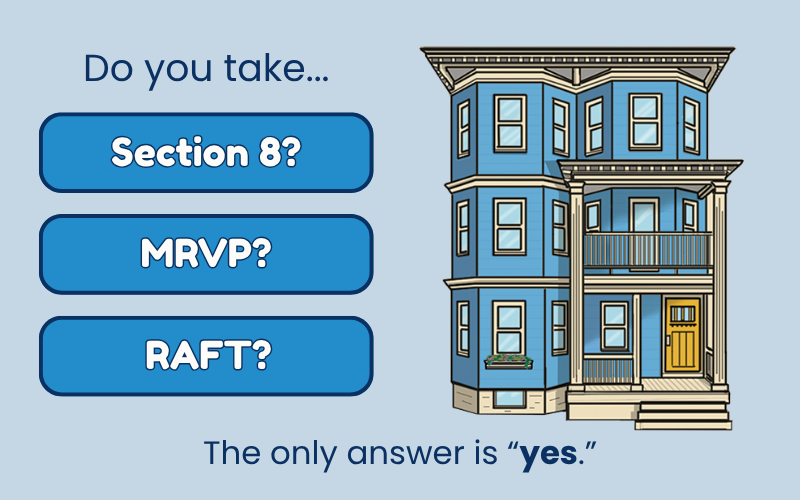
You should still screen applicants with rental assistance like you would any other potential renter, but you cannot deny them simply because they participate in Section 8, MRVP or RAFT. (Image License: CC BY-SA 4.0 MassLandlords, Inc.)
Rental assistance in Massachusetts can be permanent or temporary, and each program will have different requirements for landlords and renters. In this article, we’ll give a brief overview of the main programs you may encounter, with links to more comprehensive articles for further reading.
You might think you can skip this article because you don’t want, or plan, to participate in rental assistance programs like Section 8, but you cannot. We’ll discuss that as well in a later section.
Rental assistance programs in Massachusetts are managed through local housing authorities (LHAs). Regional housing authorities (RHAs) sometimes manage Section 8 as well. You can use the state website to see what housing authorities serve your area.
Permanent Rental Assistance: Section 8
The Section 8 Housing Choice Voucher Program (HCVP) is a federally funded program that provides permanent rental assistance by paying a portion of the rent for the tenant. Maximum rents are established based on the local market and published by the Department of Housing and Urban Development (HUD).
The program looks at a renter’s income and determines how much the program will pay and how much the renter is responsible for paying. The renter will pay around 30% of their income toward rent. The program will pay the rest.
You should still screen renters with a Section 8 voucher, just like any other applicant. However, because of the way the program is set up, these renters will usually get full points on the income portion of the screening.
If you approve an application for a renter with Section 8, the housing authority administering their voucher will inspect the apartment to ensure it meets state and federal housing requirements. You will receive the Section 8 portion of the rent from the LHA and your renter’s portion from your renter.
You and your renter will be required to regularly (usually every year or two) re-certify. They will have to provide income and asset information. You will have to have your rental re-inspected. The LHA will pay their portion of the rent, but it will not evict your renter for you if you have issues. You will still have to go through the court for that.
For more information, read our in-depth article on Section 8 rental assistance.
For renters, it can take a very long time to be awarded a Section 8 voucher, and as of January 2025, the wait list in Massachusetts is closed. If a renter says they have applied for Section 8, landlords should screen them like any market applicant without Section 8. If they do not qualify, invite them to reapply when they have their voucher.
Permanent Rental Assistance: Massachusetts Rental Voucher Program (MRVP)
The Massachusetts Rental Voucher Program operates like Section 8, but is state-funded. Like Section 8, renters receive a voucher that can be used for any apartment that is within the rent guidelines and passes inspection.
Under MRVP, renters pay 30% of their income toward rent, and the program pays the rest. Like Section 8, this means renters with valid MRVP vouchers will likely get full points on the income portion of your tenant screening process.
Renters must be under a certain income threshold to qualify for the program, and as with Section 8, there is a long waitlist for vouchers. Like Section 8, landlords should require an applicant hoping to use MRVP to qualify to already have the voucher in hand.

Residential Assistance for Families in Transition (RAFT) is a form of temporary rental assistance that can keep families from experiencing homelessness. (Image License: CC BY-SA 4.0 MassLandlords, Inc.)
Temporary Rental Assistance: Residential Assistance for Families in Transition (RAFT)
The Residential Assistance for Families in Transition (RAFT) program is state-funded and designed to offer short-term assistance for families at risk of homelessness. Applicants must be at risk of losing their housing, either due to nonpayment or other health- or safety-related reasons, and must meet certain income requirements.
Renters who get awarded RAFT can get up to $7,000 in a rolling 12-month period. These funds can be used for rent, utilities and moving costs. This means a renter applicant could use RAFT funds to pay all or some of their move-in costs if you approve them for your rental.
If you have an existing renter who is unable to pay the rent for some reason, encourage them to apply for RAFT. You must usually issue a notice to quit for nonpayment before they can apply. Note that if you do pursue the eviction in court, the process will be paused until they either receive RAFT funding or are denied.
We offer an in-depth article about RAFT for further reading.
All Forms of Rental Assistance: No Discrimination Allowed
In Massachusetts, source of income is a protected class. Rental housing providers are not allowed to reject otherwise qualified applicants because they have a housing voucher.
For example, if a renter asks if you accept Section 8, your only response should be “yes, of course I do.”
Screen renters with Section 8 or a housing voucher just like everyone else, but when it comes to income, remember that a portion of the rent will be paid by the housing agency supplying the benefit. The screening procedures for RAFT vs. Section 8 are different, and are taught in more depth at our Crash Course in Landlording.
Want to know more about screening renters who receive rental assistance? We have additional articles on how to properly income screen renters with permanent rental assistance like Section 8, as well as temporary sources of income such as RAFT.