The Rent Control Compromise Line by Line: What Does It Mean for Landlords and Renters?
. Posted in News - 0 Comments
By Kimberly Rau, MassLandlords, Inc.
A proposed rent control compromise that went before the state legislature in June 2026 stood to keep rent control off the November ballot, but would still negatively impact mom and pop landlords, as well as renters.
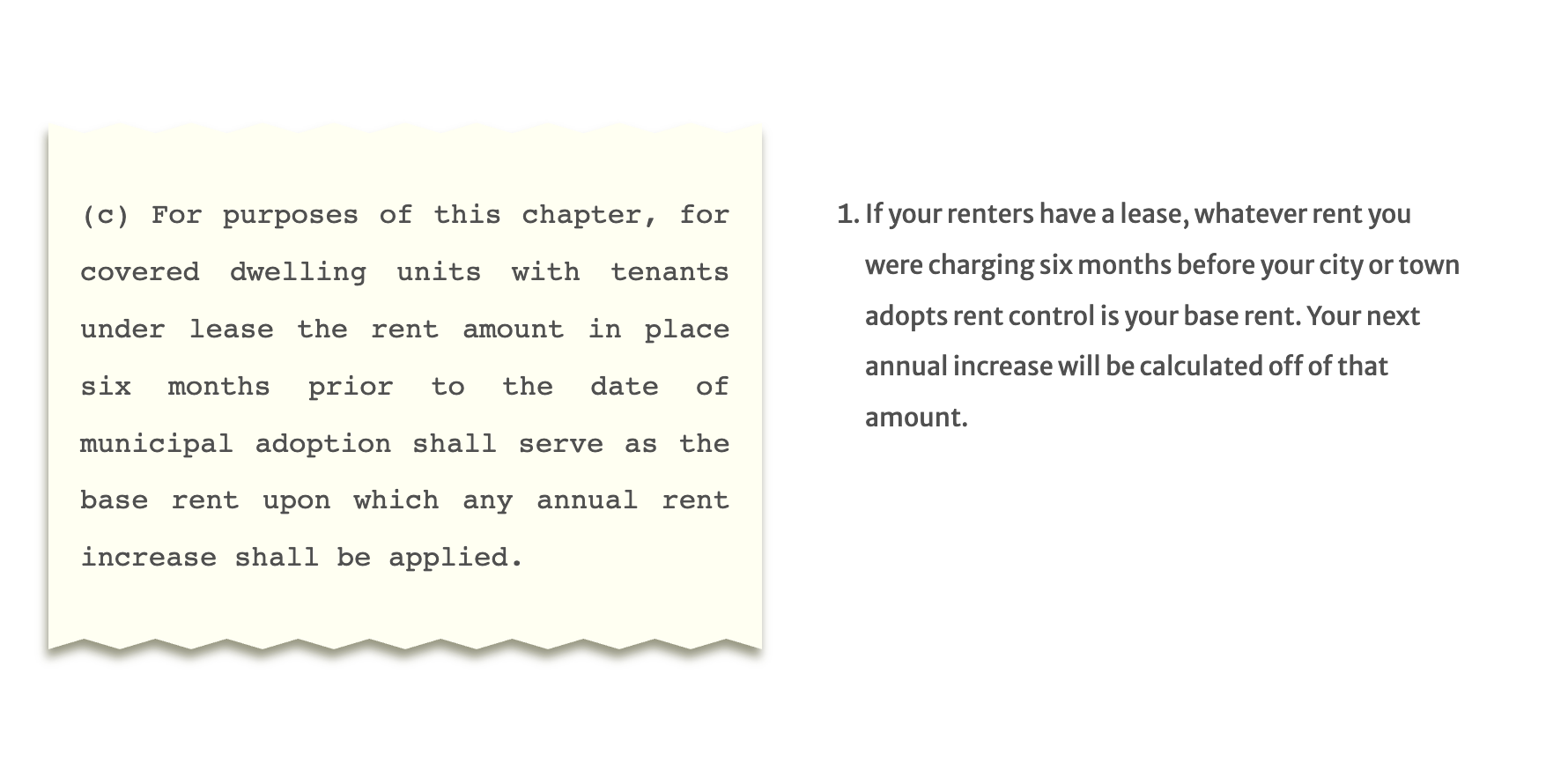
What does the proposed rent control compromise really say? Our line-by-line explainer breaks it down into plain language so everyone can understand the implications of this flawed policy. (Image License: CC BY-SA 4.0 MassLandlords, Inc.)
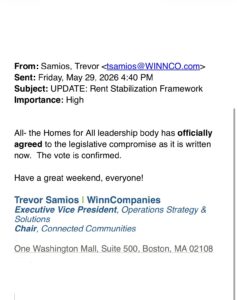
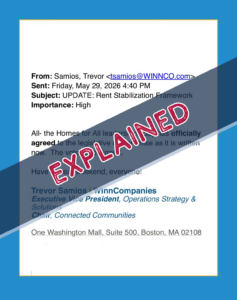
Just before close of business on Friday, May 29, Trevor Samios of megacorporation WinnCompanies sent an email to undisclosed recipients. The subject read “UPDATE: Rent Stabilization Framework.” The email went on to announce “All – the Homes for All leadership body has officially agreed [emphasis theirs] to the legislative compromise as it is written now. The vote is confirmed. Have a great weekend, everyone!”
This came as a surprise to MassLandlords, as well as other small landlord representatives, who had not been part of any discussion. It also came as a surprise to legislators, many of whom did not know a compromise was headed their way.
Carolyn Chou of Homes for All, the official sponsor of the rent control ballot question, which stands to impose one of the strictest statewide-mandated rent caps, said the group would remove the question from the ballot if the legislature agreed to the compromise by July 1. (As of our publication deadline, the legislature had not voted on the compromise. We will update this article online as necessary.)
Confusion followed, and not just because it appeared Homes for All had buddied up with the same megacorporations it had promised their ballot question would keep in check.
MassLandlords was one of the first to publish anything about the compromise. There were reports that different versions of the compromise were circulating, and what the media received may have differed from what senators and representatives were sent. (The document we received says “final” at the top, implying we have the same draft the legislature received.)
After immediately publishing a press release about the compromise, we went through the compromise line by line and explained online, in plain language, how the document would hurt smaller landlords and protect major corporations, who have much deeper pockets to withstand rent board red tape and just-cause evictions. Our explainer details exactly how the compromise differs from the ballot question, and why it is still harmful to mom-and pop landlords, as well as renters.
Here are just a few examples.
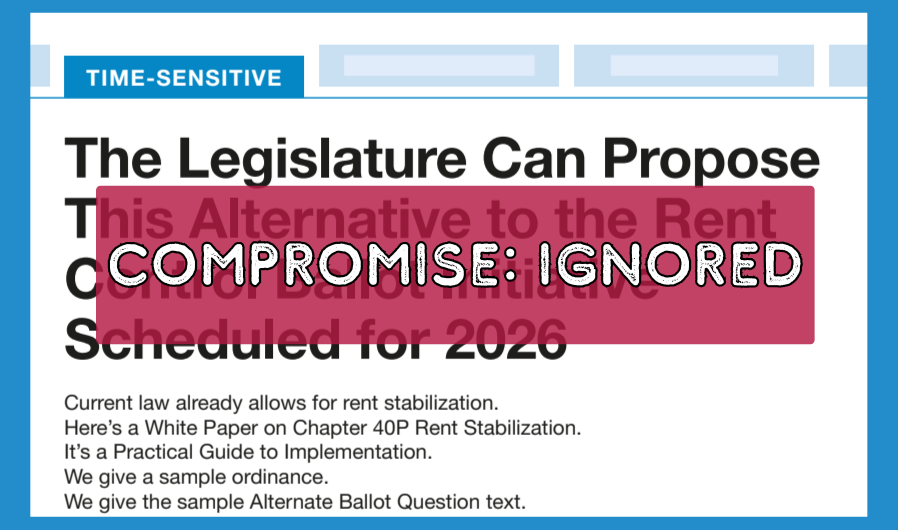
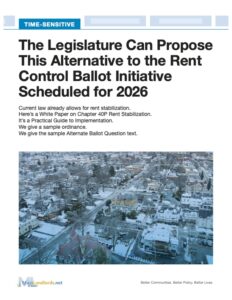
Lawmakers have been calling for compromise on the issue of rent control, but our attempt went unacknowledged. (Image License: CC BY-SA 4.0 MassLandlords, Inc.)
Key Points in Rent Control Compromise
It became clear Homes for All was ready to give up a lot in the name of pushing a compromise through. Instead of a statewide mandate, the compromise calls for a local option for rent control. Instead of an aggressive cap of inflation or 5%, whichever is lower, the compromise allows for inflation plus 5%, with a maximum annual increase of 10%.
Instead of prohibiting market resets when a tenant moves out, the compromise allows for vacancy decontrol. This means landlords could raise the rent after a renter moved out as long as they left voluntarily or were evicted for a lawful reason.
These concessions would further weaken the few benefits rent control has for some tenants. For example, any rent cap essentially guarantees that landlords will raise the rent as much as they are allowed every year. Under the ballot question, that would cap at a maximum of 5%. Under the compromise, it doubles. A renter paying $2,500 a month could find their rent increasing by $250 at renewal. Moving out would cancel any benefits, because vacancy decontrol means most available units would still be at market.
That sounds better for landlords, but is so much worse for renters. Rent control advocates repeatedly call for strict rent controls because renters on fixed or declining incomes often struggle to pay even modest rent increases. A $250-a-month increase means an additional $3,000 a year must be set aside.
Instead of dividing and conquering with strict rent controls, we should adopt a solution that allows for absolute rent freezes without unintended consequences. See our white paper, which we published in January 2026.
Rent control boards are back if compromise is accepted; no-fault evictions are banned.
Worse, the compromise allows for rent control boards. The last time Massachusetts had rent control, the board in Cambridge wreaked havoc. Evictions were delayed. Rent increase approvals stagnated. Buildings literally fell apart, and landlords risked arrest for living in their rentals instead of renting them out.
When we got rid of rent control, there was never a formal process to also get rid of the rent control boards. This means if the compromise is signed, cities like Cambridge potentially could immediately revive their dormant boards.
There are a number of reasons why a landlord can lawfully evict under the compromise, including if a renter refuses to accept a lawful rent increase, but compromise also prohibits no-fault/no-cause-stated evictions for any city that opts into rent control. No-fault evictions are often a last-ditch effort for mom-and-pop landlords who need to remove a bad renter, because proving lease violations in court can be difficult, expensive and time-consuming.
Neither rent control boards nor just-cause evictions would greatly affect major corporate landlords, who have the political pull to finesse regulatory boards and deep enough pockets to stay in court as long as necessary to evict a renter. They would be very damaging to smaller renter housing providers, and not beneficial to renters.
The compromise offers greater perks to developers.
Another major distinction that benefits corporate landlords far more than any other rental housing provider is the extended exemption for new construction. The ballot question gives a 10-year exemption for new construction; the compromise offers 15. Neither amount of time may ultimately lead to new housing, as we’ve seen in Montgomery County, Md., and St. Paul, Minn., but it’s certainly a perk that will only help those with deep enough pockets to build.
MassLandlords, Others Left Out of Negotiation
A popular refrain from rent control advocates involved in the compromise is that they came to the table with rental housing providers, but this is misleading. A true compromise would involve all interested parties, but small property associations like MassLandlords were left in the dark until negotiations were complete. This is concerning. The fact that advocates don’t see a difference between WinnCompanies and MassLandlords shows they are not prepared to craft statewide, long-term policy that is good for everyone.
As a result, this proposed compromise is bad for mom-and-pop landlords, and cold comfort for renters. Our white paper proposing a version of rent control that would comply with existing law went ignored. When legislators called for compromise at a hearing for the ballot question, we again reached out to call attention to our proposed compromise. We were called greedy. After the current compromise was announced, we reached out to Caroyln Chou in good faith, hoping to find a way forward that worked for renters as well as rental housing providers. As of publication, we have not received a response.
We agree there is a housing crisis, and we need to find a solution for it. But the solution cannot lie in trying what has already failed, and it cannot come from a meeting that involved none of the mom-and-pop landlords who provide naturally occurring affordable housing in Massachusetts. MassLandlords represents about 10% of the rentals in the state. Associations like ours need a place at the table in order to find a solution that benefits everyone.