Understanding the Rent Control Ballot Question Compromise: Full Text Explained
|
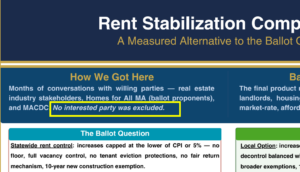
The full text of the rent control ballot question compromise is explained here. This compromise between WinnCompanies (on the board of the Greater Boston Real Estate Board) and Keep Massachusetts Home excluded MassLandlords. It creates rent control boards with the authority to regulate access to the courts.
The rent control ballot question proposed for fall 2026 has serious problems. The so-called “compromise” is no less ruinous for what it does to mom and pop landlords, who are providers of our naturally occurring affordable housing: we need to be able to enforce our rental agreements. The compromise adds another layer of delay and uncertainty, and for this reason alone, should be viewed as a disaster of the first order. All rent control reduces housing supply, especially with the hard cap that exists in both the ballot text and the compromise. But if we were to add to it a rent board with the authority to regulate a landlord’s access to the courts, we would start down the slippery slope that we were on in the ’80s and early ’90s. Landlords in rent-controlled towns had to request permission from the rent board to file a court case. Hearing delays resulted in constructive denial of justice. This compromise leaves us exposed to that exact scenario. History shows that public bodies imbued with purpose necessarily advocate for more resources and greater scope in order to carry out that purpose. This is where rent boards took us once before. The Cambridge rent control board went badly off the rails. By the time rent control was finally repealed, housing operators had been convicted of misdemeanor offenses for living in their home, not living in their home, holding units vacant and/or renting them too slowly. On top of all this, no one could file for an eviction without permission from the rent board. Why should we create rent boards when what we’re talking about is supposed to be a simple inflation-indexed formula? As first reported by MassLandlords, the compromise text comes from Greater Boston Real Estate Board-affiliated corporations who have done this kind of thing before. See the unfunded eviction moratorium declared by WinnCompanies in 2020, eviction sealing endorsed by the Greater Boston Real Estate Board in 2023, and the unsuccessful effort to pass rent control in Boston in 2021, over which MassLandlords has recently won judgment. The ballot “compromise” will lead to the end of naturally occurring affordable housing in Massachusetts, just like it ended housing opportunity in Cambridge once before. And should it be surprising, when MassLandlords was held away from negotiations? We are calling on all members and the legislature to reject a return to rent control boards and the proposed compromise. No compromise is legitimate unless MassLandlords and the perspectives of our 2,600 members and 70,000 to 100,000 rental units are included in the discussion. Even the official ballot opposition campaign was not included. The compromise is particularly corrupt in the way it exempts the kind of properties and financial arrangements held by parties to the negotiation at the expense of others excluded from negotiations. |
|
|
An Act enabling cities and towns to stabilize rents and protect tenants. |
Any law in housing should protect tenants and housing providers both. |
|
Be it enacted by the Senate and House of Representatives in General Court assembled, and by the authority of the same, as follows: |
If the state Legislature (senators and representatives) votes for this compromise, this is what will become law. The ballot question will not appear on the November 2026 ballot. |
|
SECTION 1. Chapter 40P of the General Laws, as appearing in the 2022 Official Edition, is repealed. |
Under current law, Chapter 40P prohibits rent control unless it is compensated by the city or town that enacts it. If the Legislature approves the compromise, Chapter 40P will no longer exist. The ballot question was also trying to get rid of Chapter 40P. |
|
SECTION 2. The General Laws are hereby amended by inserting after chapter 40Y the following chapter:- CHAPTER 40Z LIMITATION OF ANNUAL RENT INCREASES AND RELATED TENANT PROTECTIONS |
The compromise creates a new chapter, Chapter 40Z, for the new rent control law that will replace Chapter 40P. The new wording for Chapter 40Z follows. |
|
Section 1. A city or town may accept this chapter in its entirety in the manner provided in section 4 of chapter 4 of the General Laws. |
Section 1. Cities or towns can choose to adopt rent control. If they do, they must accept all of the law as written. They cannot pick and choose which terms to adopt. |
|
The acceptance of this local option by a municipality shall take effect no later than 180 days after adoption. A municipality that accepts this section shall adopt an ordinance or bylaw which effectuates the provisions of this chapter no later than 180 days after acceptance. |
If a city or town chooses to adopt rent control, they have six months to enact it and create a local bylaw or ordinance to administer it. |
|
Section 2. A city or town accepting this chapter may, by local charter provision, ordinance, by-law, majority vote of its governing body or through a local binding ballot measure impose a limit on the size of annual rent increases for certain dwelling units within the municipality, and related eviction protections for all housing accommodations in the municipality. |
Section 2. This explains how a city of town can enact rent control if they want. They can simply enact a local ordinance allowing it. The city or town council can approve it by majority vote. Or they can put it on the ballot as a local question in an election. Injustice warning!
This section is what empowers the rent board to require a certificate prior to any landlord filing an eviction in court. This was required in Cambridge under rent control in the ‘80s and early ‘90s. The blanket language covers all housing (no exemptions). A broad interpretation is specifically reinforced by reference elsewhere to needing to determine whether an eviction is for just cause. |
|
Section 3. Exemptions. (a) For the purposes of this chapter, covered dwelling units shall not include: |
Section 3. This section explains what kinds of housing units would not have to follow rent control laws. |
|
(i) Dwelling units in owner-occupied buildings with four or fewer units. |
|
|
(ii) Dwelling units whose rent is subject to regulation by a public authority. Occupancy by a tenant with a mobile housing voucher does not exempt an otherwise covered dwelling unit. |
|
|
(iii) A unit in a licensed facility, for which the primary purpose is the diagnoses, cure, mitigation, and treatment of illnesses. |
|
|
(iv) A unit in an assisted living facility or nursing home. (v) A school dormitory. |
|
|
(vi) A facility operated solely for religious purposes. |
Note: Religious purpose is not religious ownership. One major loophole we foresee is landlords declaring that they have found new faith as a rental housing provider and claiming bogus exemptions. |
|
(vii) A unit primarily provided to transient guests for a period of less than 14 consecutive days. |
|
|
(viii) Units in facilities operated solely for non-profit purposes. |
Note: Non-profit ownership is not required. Any for-profit landlord could set up a nonprofit to operate their property for non-profit purposes. Non-profit does not mean non-salary. Remember the exemption for religion? Most religious institutions are non-profit, at least on paper. It’s strange they carved out a special exception for religion when “non-profit” would cover most of them. If you are for-profit religion, should you be allowed to dodge rent control? Apparently so. |
|
(ix) Units currently under a binding affordable housing legal restriction, including deed restrictions, use agreements, subsidy contracts, or other legal covenants, that limit the rent to be paid or the income of the permitted occupants. |
Corruption warning!
If a megacorporation real estate firm had income-restricted affordable housing, they could be free to raise rents as fast as they wanted. This exemption should be removed. |
|
(x) Projects financed through the federal or state Low Income Housing Tax Credit Program. |
Corruption warning!
If a megacorporation real estate firm had LIHTC projects, they could be free to raise rents as fast as they wanted. This exemption should be removed. |
|
(xi) Projects owned, operated, ground-leased, or financed, in whole or in part, by a public housing authority, the executive office of housing and livable communities, or a state or local housing finance agency, including mixed-income buildings, provided that at least one of the following two conditions are met: |
Corruption warning!
If a megacorporation real estate firm receives any public funding for any of the operations at that facility, they could be free to raise rents as fast as they wanted. This exemption should be removed. These are the conditions for such places to be exempt: |
|
(1) At least 60% of the units are deed-restricted, at an affordable rent determined by the public financing source, and limited to households with incomes not exceeding an average of 60% of Area Median Income (AMI); or |
11-1. At least 60% of the rental units on the property are permanently restricted to a certain rent that was set by the public agency that operates it. The households living in those units cannot have an income that is higher than 60% of the average income for the area, which is set by the state. These properties would be exempt from rent control, even the units that are not restricted. OR |
|
(2) At least 40% of the units are deed-restricted, at an affordable rent determined by the public financing source, and limited to households with incomes not exceeding an average of 30% of Area Median Income (AMI). |
11-2. At least 40% of the rental units on the property are permanently restricted to a certain rent that was set by the public agency that operates it. The households living in those units cannot have an income that is higher than 30% of the average income for the area, which is set by the state. These properties would be exempt from rent control, even the units that are not restricted. |
|
(xii) Projects that are not owned or financed by a government agency, but are deed restricted provided that, for the duration of the new construction exemption or the deed restriction, whichever is longer, at least one of the following two conditions are met: |
Corruption warning!
If a megacorporation real estate firm has deed restricted property, they could be free to raise rents as fast as they wanted. This exemption should be removed. Here are the conditions: |
|
12-1. The whole property is exempt as long as at least 60% of the rental units on the property are restricted to certain residents paying a certain affordable rent (it’s not clear what determines “affordable” here). Those residents cannot make more than 60% of the average rent for the area, as determined by the state. OR |
|
12-2. The whole property is exempt as long as at least 40% of the rental units on the property are restricted to certain residents paying a certain affordable rent (again, it’s not clear what determines “affordable”). Those residents cannot make more than 40% of the average rent for the area, as determined by the state. |
|
(xiii) Newly-constructed dwelling units shall be exempt from this chapter for a period of 15 years from the date at which the first residential certificate of occupancy was issued. |
|
|
(xiv) Dwelling units in an existing building for which no residential certificate of occupancy was in place for the prior 5 years, if the owner conducts substantial, permanent renovations that enhance the value of the building and cost an amount equal to at least 40% of the value of the building, as assessed by the municipal or state tax assessor, shall be exempt for a period of 15 years from the date at which such first residential certificate of occupancy was issued. |
Note: This exemption would apply even if someone were living in a condemned unit and the owner were collecting rent. This creates a perverse incentive to have properties condemned and then re-rent them on the black market. This exemption should be reworded. |
|
(b) Where dwelling units are exempt, a notice of exemption must be provided with the lease for all tenancies. If there is no written lease for such dwelling units, the tenants-at-will must be provided with a written notice of exemption prior to the acceptance of the initial rent payment. |
Note: Just like in the security deposit law, your failure to complete the paperwork correctly may subject you to triple damages as if you were rent controlled. This is true even if the mistake was in good faith and you really are exempt from rent control. |
|
Section 4: Annual rent increase cap |
Section 4: Rent increase limits for non-exempt properties |
|
(a) The municipality may, pursuant to section 1(b), impose a limit on annual rent increases for covered dwelling units not exempt by section 3(a), which shall be equal to the annual rent increase limit to be published annual by the executive office of housing and livable communities. |
Note: The law is silent as to whether the town can require advance notice. During the rent control years, requirements for advance notice were often used to delay rent increases indefinitely. |
|
The annual rent increase cap shall be calculated to be an amount equal to the annual change in the Consumer Price Index plus 5 per cent, or a cap of ten per cent, whichever is lower. |
This is higher than the ballot question, which limited rent increases to inflation or 5%, whichever is lower. This law caps rent increases at inflation plus 5%, or a total of 10%, whichever is lower. This is not helpful for renters, who could see increases of $250 a month on a “cheap” Boston apartment that rents for $2,500 at lease signing. Like the ballot question, the compromise does not state which inflation index will be used to determine the starting number. |
|
(b) Owners and landlords of covered dwellings may not impose annual rent increases above the allowable rent increase amount, but may impose rent increases below the allowable increase amount. |
|
|
(c) For purposes of this chapter, for covered dwelling units with tenants under lease the rent amount in place six months prior to the date of municipal adoption shall serve as the base rent upon which any annual rent increase shall be applied. |
|
|
If no lease is in place for such dwelling unit the rent amount charged as of the date six months prior to the effective date of municipal adoption of such applicable rent increase cap shall serve as the base rent upon which any annual rent increase shall be applied. |
If there was no lease in place six months before rent control gets adopted, whatever rent you were charging without a lease at that point is the base for future increases. This would include tenants at will. |
|
(d) For a covered dwelling unit that becomes vacant, the base rent shall be determined pursuant to section 5. |
|
|
Section 5: Tenant protections (a) Cities and towns adopting this chapter shall require that any landlord initiating eviction or not renewing a lease may do so only for the following reasons: |
Section 5: Eviction rules for rent-controlled properties This is what the corporations negotiating with the rent control advocates gave up in exchange for the loosened rent cap and vacancy decontrol.
Corporations with big in-house counsel and staff managers can handle a long court case. Mom-and-pop landlords cannot. That’s why small landlords rely on “no fault” evictions to remove a renter who is at fault. These are the only reasons landlords can evict under rent control: |
|
(i) Nonpayment of rent (ii) Refusal to accept a rent increase permitted under this chapter (iii) Owner seeks to remove the unit from the rental market to convert to cooperative or condominium, provided that owner demonstrate compliance with G.L. ch. 183A, Chapter 527 of the Acts of 1983, or locally-enacted ordinance governing conversions to cooperative or condominiums |
|
|
(iv) Owner seeks to demolish or convert to non-residential use, or to occupy the unit as the owner’s or immediate family member’s principal residence |
We take this to mean you cannot remove your renter because you want to use it as a vacation home a couple of months out of the year, because that would not be your primary residence. |
|
(v) Tenant commits a substantial violation of a material lease term or material term of the tenancy |
This disrespects most rental agreement clauses, rendering them invalid unless the rent board considers the clause “substantial.” What may be a nightmare for other residents in the building could easily be found “not substantial” by a rent board, who don’t have to live next to their bad decisions. |
|
(vi) Tenant engages in criminal activity or behavior that threatens the health and safety of other residents, or persons lawfully on the premises |
Note: Activities and behaviors that do not rise to the level of a crime don’t count. |
|
(vii) Tenant creates a public nuisance in the unit or the building |
|
|
(viii) Tenant causes substantial damage to the unit or the building |
|
|
(b) Upon the commencement of a new tenancy in a dwelling unit and where no prior tenant or occupant remains, the owner may establish an initial rent without restriction only after certifying that the prior tenancy ended due to: |
|
|
(i) Voluntary termination of the tenancy and departure by the prior tenant. The definition of Voluntary Termination shall include departure by tenant following the serving of a notice to quit by landlord, or commencement of a summary process action, before a judgement enters or a vacate agreement is reached so long as the reason for such landlord initiated action is for a reason listed in 5(a). |
In other words, this condition is met if you served a notice to quit (eviction notice) for a just cause, and the tenant left before you got to court, before the case was decided, or you mediated. You have to be able to swear that the eviction process started for a just cause. |
|
(ii) Termination of the tenancy pursuant to a court judgment, court agreement or stipulation, or where a landlord otherwise prevails in the summary process case, for a reason listed in Section 5(a). |
This condition is met if you won your just cause eviction case. |
|
(c) Owner shall provide the new tenant with a sworn certification that the prior tenancy ended due to voluntary departure by the previous tenant, or for a reason listed in Section 5(a), and that an initial rent may be set without restriction. |
|
|
(d) Where a tenancy ended due to a reason not listed in Section 5(a), the most recent lawful rent plus any applicable rent increase in compliance with Section 4, shall be established as the base rent for the new tenancy. Any subsequent rent increase shall comply with this chapter. |
|
|
Section 6: Boards; extraordinary capital improvements and tax increases |
Section 6: More compromises from both sides. We get renovation exemptions. But we also get rent control boards. Rent control boards made everything worse the last time we had rent control. Rent increases, eviction and renovations took so long that things literally fell apart. We believe Cambridge and Brookline never officially repealed their rent control boards, meaning as soon as this compromise is passed, the boards come back immediately without either town voting for it. |
|
(a) Cities and towns may establish boards to implement this section in accordance with state regulations and standards established by the executive office of housing and livable communities, in consultation with the attorney general. |
It doesn’t say who is paying for the bureaucracy (hint: it’s you, the local taxpayer). Note: Rent control boards are not limited to the powers specified here. This compromise text lacks any language restricting the rent board’s actions. Under rent control in the 1980s and early ’90s, rent boards stopped all court filings until they gave approval, made it a misdemeanor to fail to file certain paperwork, and delayed normal rental operations. All of this is permitted again with this compromise. |
|
(b) The executive office of housing and livable communities, in consultation with the attorney general, shall establish a process and related guidelines to allow owners to apply for surcharges or rent increases that exceed the allowable annual cap for certain extraordinary capital improvements or tax increases to covered dwelling units or buildings. Any process shall include: |
Under previous versions of rent control, this involved documenting “fair net operating income.” The process was onerous and required exhaustive public reporting of all incomes and expenditures for a year or more. EOHLC will draft the regulations with input from the attorney general. Note: The process excludes ordinary tax increases and maintenance. The key wording here is “extraordinary.” Presumably, the EOHLC/AG will decide, without input from real housing providers, how much renovation is required before it is considered “extraordinary.” The process they come up with has to address the following issues: |
|
(i) owner to file an application accompanied by documentation to support each request, based on commercially reasonable terms; |
Note: The wording specifically does not use verbiage required by the small business impact statement law; any amount of documentation that the EOHLC, in their sole discretion, considers reasonable will be required. Be prepared to jump through hoops to get approval. |
|
(ii) clear standard of review; (iii) review by a neutral person or persons prior to determination; |
|
|
(iv) timely processing of applications. |
We credit the law with insisting that applications be approved or rejected in a “timely” manner. Note: The courts are also bound to resolve eviction cases as a “summary process” (timely), and yet still this is very slow. We’re guessing the EHOLC/AG will not give an actual timeframe when they make these regulations for the rent boards. In practice, regulatory bodies like rent control boards are constantly bogged down and running behind schedule because the workload is greater than the staff to manage it. Smaller staff = longer wait times. Larger staff = higher municipal costs. |
|
(c) All cities and towns adopting this measure may implement policies and procedures established by the executive office. |
|
|
(d) Cities and towns may set tenant notification and rental registry requirements as necessary to implement this chapter. |
Note: Rental registries have been blocked as unconstitutional in Pennsylvania and are being challenged in federal court. This provision needlessly exposes the commonwealth to litigation risk and does not pertain to rent increases. |
|
Section 7: Reauthorization upon material amendment |
Section 7: What happens if the state wants to change some part of this law in the future |
|
(a) Notwithstanding section 1, if the General Court enacts amendments to this chapter that materially alter the terms or operation of the chapter, the previously-adopted ordinance or bylaw shall remain in effect with original terms unchanged, until and unless the city or town adopts the amended provision or provisions pursuant to section 2; provided, however, that the adoption of the amended provision or provisions shall require a super-majority vote of its governing body. |
In practice, this creates a “ratchet” effect where a strict rent control system cannot easily be corrected or repealed by the state. |
|
(b) Notwithstanding this provision, any city or town adopting this chapter for the first time shall be required to comply with sections 1 and 2, and no super-majority shall be required for initial adoption. |
|
|
Section 8: Reporting Cities and towns adopting this chapter shall provide annual reports to the executive office of housing and livable communities which shall include but not be limited to: |
Section 8: Cities or towns with rent control will have to submit reports to the state. Here’s what that will include: |
|
the text of the ordinance or bylaw adopting this chapter; any studies undertaken in informing adoption of the ordinance or bylaw; the number of units affected by the ordinance or bylaw; and any other relevant data as determined by the executive office of housing and livable communities. |
|
|
Section 9: Penalties for violation |
Section 9: What happens if there’s rent control and non-exempt landlords don’t abide by it |
|
(a) Any violation of this Chapter shall be deemed an unfair and deceptive act under chapter 93A of the General Laws. Any person claiming a violation of this section may pursue remedies under section 9 of chapter 93A. The attorney general is hereby authorized to bring an action under section 4 of chapter 93A to enforce this provision and to obtain restitution, civil penalties, injunctive relief, and any other relief awarded pursuant to said chapter 93A; |
|
|
(b) If a landlord is found to have violated section (4) subsections (a) or (b), the tenant or former tenant, upon proof of the same, shall be awarded actual damages or three times the rent amount, whichever is greater, and attorneys’ fees; |
Note: The penalty is not triple the unlawful rent increase, but triple the rent for however long the violation was in effect. This will be ruinous. |
|
(c) If a landlord initiates summary process proceedings or otherwise requests that a tenant vacate for a reason not enumerated in section (5), the tenant shall recover possession and shall be awarded actual damages or three times the rent amount, whichever is larger, and attorneys’ fees. |
In addition, you’ll pay your tenant actual damages, or triple the rent for the duration of the violation, whichever is more, plus attorneys’ fees. |
|
Section 10: Interference with existing laws Nothing in this section shall be construed to interfere with any existing rights or protections afforded to tenants under current state or federal law. |
Section 10: Tenant rights Nothing in the law will erode any other rights tenants currently have, including retaliation, right to form a union, etc. Despite this wording, this compromise represents a fatal erosion of housing provider rights, including our constitutional rights under 40P to receive compensation for private property appropriated to public purpose or for rent control.
|