St Paul, Minn., Tried Rent Control; Here’s What Happened
| . Posted in News - 0 Comments
By Eric Weld, MassLandlords, Inc.
By now, a few years into their experiment with rent control, residents of St. Paul, Minn., are well acquainted with the damages the policy can render.

St. Paul, Minn., the state capital, pictured here along the Mississippi River, enacted the most restrictive citywide rent control policy in the nation via referendum in November 2021, with a 3% hard cap on annual rent increases. The city saw an immediate steep decline in new housing development that it hasn’t regained since, despite multiple changes to its rent control policy. Image: CC BY-SA 2.0 Wikimedia Commons-Cliff
St. Paul voted by referendum in November 2021 to enact the most restrictive rent control policy in the nation. By a vote of 53% to 47%, voters in the Minnesota state capital approved a rent stabilization policy that limits rent increases to a hard cap of 3% within any 12-month period, with no adjustments for, or ties to, inflation.
The St. Paul law, which took effect on May 1, 2022, originally stood in stark contrast to other rent control policies in the U.S. It still stands out as a particularly restrictive law in its 3% limit on rent increases without consideration of inflation, far lower than other policies. But at first, it was even more stifling for housing providers, not allowing vacancy decontrol for market adjustments between tenancies, and not including any exemptions for new housing, a housing development killer.
St. Paul found out the hard way what happens to new housing development – multifamily rental housing in particular – when rent control is applied. It withers.

Minneapolis, Minn., pictured here, located across the Mississippi River from St. Paul and commonly referred to as its “twin city,” saw far more robust housing permit activity than its twin in the years 2018 until 2022, even expanding as St. Paul permits dropped precipitously following that city’s rent control enactment. Minneapolis residents also approved an ordinance, in 2021, allowing the city to enact rent control, but it has not done so. Still, the prospect of future rent control may be dampening Minneapolis’ housing, too, as permits have dropped back in alignment with St. Paul’s since 2023. Minneapolis’ population is about 100,000 more than St. Paul’s.
Quick Rent Control Adjustments
Even before the St. Paul rent control law took effect, new multifamily housing permits were in a nosedive, anticipating the law’s enactment. Housing permit statistics from the Department of Housing and Urban Development (HUD) show that, between November 2021, when the referendum passed, and March 2022, as its effective date approached, multifamily building permits (between 2 units and 5+ units) in the city plummeted more than 80%, from 1,895 in November-March 2020-21, to 248 in the same span one year later.
There are likely other factors in addition to rent control that contributed to the drop in multifamily building permits. However, right next door in St. Paul’s “twin city,” Minneapolis, housing permits exploded during that same five-month period, November through March, between 2020-21 (895) and 2021-22 (2,377). Minneapolis residents also approved a referendum that allows the city to enact rent control, but so far it has not. Still, it’s possible even the future prospect of rent control is dampening Minneapolis’ multifamily housing investment, as housing permits have since come back down to baseline and lower.
By September 2022, with housing development in a nosedive, the St. Paul city council acted quickly to roll back some of the law’s severest restrictions only a few months after the policy took effect. The council approved a package of revisions that exempted low-income housing from rent control, and exempted new construction from the law for 20 years. It also added vacancy decontrol, allowing an 8%-plus-inflation (as measured by CPI) rent increase between tenancies.
St. Paul’s original lack of exemptions for new housing distinguished its policy from rent control in other parts of the country. Other rent stabilization policies may include exemptions for new housing projects and housing built in the past 10 or 15 years, for example. To not exempt such housing is to discourage investment in new housing, especially affordable housing (negating one of the goals of rent control, to provide low-income residents with places to live), which St. Paul discovered. Even the city’s late-added 20-year exemption for new housing didn’t stanch the city’s precipitous reduction in new housing permits. By 2024, housing permits had continued to plummet sharply, and the city council again amended its damaging rent control policy, permanently exempting all new rental housing built after 2004.
St. Paul isn’t alone in its experience of depressing housing development through rent control. Montgomery County, Md., one of the country’s wealthiest counties, enacted rent control in July 2024 and saw a 97% drop in housing permits for multifamily buildings. We look at Montgomery County in detail in this article.
Back in St. Paul, despite the city council’s panicked changes to its law, new housing construction remains anemic. Carrying forward the November to March comparison above, St. Paul had 108 permits for all multifamily building construction in 2023-24, and 136 in 2024-25. That’s still far below its pre-rent control baseline.
With rent control in place, it may be difficult for St. Paul to ever return to its pre-rent control new housing levels. Housing investors and developers project decades-long timelines in determining properties and building projects in which to invest. A 10- or even 20-year exemption from rent control does little to ensure long-term ROI if profit limitations will be applied to the investment after that first decade or two.
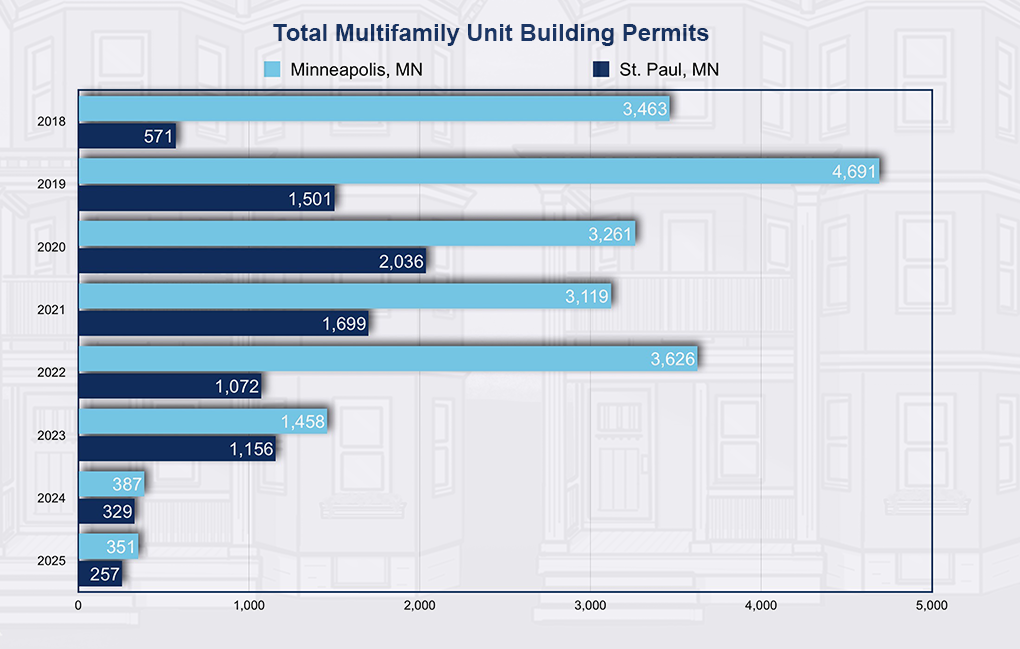
This chart shows the contrast in total multifamily building permits between St. Paul and Minneapolis in the years before and after St. Paul residents approved the nation’s most restrictive rent control policy. New housing was far more robust in Minneapolis, which has about 100,000 more people than St. Paul, up to and immediately after the rent control policy took effect.
As the chart illustrates, between 2021 and 2022, the period in which rent control was approved and took effect in St. Paul, new multifamily housing growth expanded in Minneapolis while it contracted in St. Paul. (For a more stark contrast between November and March of those years, visit the HUD building permits datasets page and enter specific data to see reports.) Minneapolis voters also approved an ordinance, in 2021, allowing their city to enact rent control, though it has not done so. Still, that future prospect may be dampening new housing in Minneapolis, too, as its multifamily permit activity has recently fallen in line with St. Paul’s. Chart: MassLandlords, Inc.
Another Rent Control Impact: Reduced Property Values
Depressed housing development isn’t the only negative impact ushered by St. Paul’s rent control policy. Citywide property values also shrank. During the nine months after the law’s enactment, real estate saw an overall decline in value of 4% to 5.5%, according to an analysis by Kenneth R. Ahern and Marco Giacoletti for the Rental Housing Association of Washington. That’s a citywide decline that includes all real estate. Rental properties in general experienced more decline, with apartment buildings with at least eight units seeing a 13% reduction in value.
This property value depression echoes what happened in Massachusetts in the 1970s through 1994, when Cambridge, Boston and Somerville maintained rent control. As a result of the policy, real estate values in those cities declined. All other towns and cities that did not have rent control in place effectively supported the policy in those three cities due to a formula that balances state aid among municipalities.
Lower property values translate to lower tax revenues that pay for teachers and public services like police and firefighters, paved roads and repaired water mains. So, in order to keep rent control, a city has to either cut services or raise taxes on property owners. St. Paul raised its overall property tax bills 6.2% in 2022 and 14.6% in 2023. It had more modest increases of 3.7% in 2024, 5.9% in 2025 and 5.3% in 2026. Other factors in addition to rent control no doubt contributed to the need for increases, but every time rent control has been applied, property values and tax revenues have declined.
3% Rent Increase Cap = Annual Net Income Loss
Also setting apart the St. Paul policy is its draconian 3% rent increase cap. Rent control laws passed elsewhere – Oregon and California both recently passed statewide rent control laws – have logically tied rent increases to inflation. Oregon’s law limits increases to 7% plus the CPI, with a 10% cap. The California law allows a 5% increase plus regional inflation measured by CPI.
A 3% hard cap, without inflation add-on, does not provide a realistic path to revenue gains for housing providers. Adding together insurance costs (with added liability for rentals) and real estate taxes alone likely surpasses 3% cost increases per year. Now add in building maintenance and upkeep costs (let alone improvements) and the 3% yearly rent increase is an annual, accumulative revenue loss.
As such, St. Paul’s rent control policy is a glaring redistribution of the financial burden of rental housing onto property owners. But its damage spreads far beyond just landlords. The analysis by Ahern and Giacoletti concludes that the St. Paul policy lowered property values, precipitated a depressed housing market and fewer available rentals, and caused a drop in new housing investment, and that its benefits accrue toward high-income renters.
The study’s recommendations include shifting away from rent control toward policies that grow the housing market, such as zoning reform, increased rental assistance for low-income households, and more mixed-income development to encourage long-term affordability. These are messages we’ve been espousing for many years.
An Example Not To Follow
St. Paul has provided us with yet another example of the negative impacts rent control imposes on the community. Not that we needed another example. Every time rent control has been adopted, communities suffer the same results outlined above. It’s hard to find a more reliably predictive economic forecaster.
But St. Paul’s extreme policy, with its 3% rent increase limit, took it a step further than most policies. The city has been scrambling ever since to patch the holes left by its punitive rent control policy. The short-term effects have been devastating, but its long-term effects will likely be even worse as municipal tax revenues fall short, property taxes continue to rise, housing stock dwindles, new housing development remains anemic, banks tighten lending policies and rentals deteriorate.
We will continue watching St. Paul and the ongoing effects of its drastic rent control law as an example of how not to administer economic policy.