
Rent Control Result in Portland, Maine: Property Owners Pay Millions More Per Year in Taxes
. Posted in News - 0 Comments
By Eric Weld, MassLandlords, Inc.
Portland, Maine, is halfway through its fifth year under rent control, and grappling with a shrinking tax base as a result.
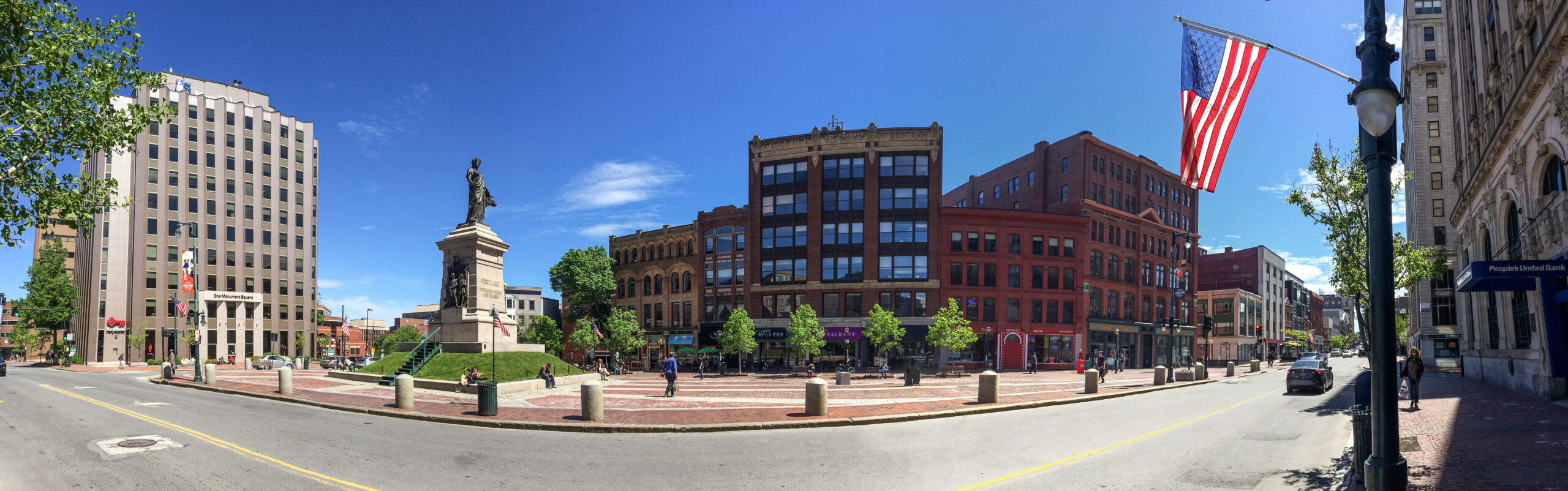
Portland, Maine, the state’s largest city and a popular tourist destination on the south coast, has had to increase taxes for single-family, condominium and rental property owners since enacting rent control in 2022, to make up for lost revenue as property values have slumped. (Image License: CC BY-SA Kenneth C. Zirkel-Wikimedia Commons)
Portland voters approved rent control in November 2020, with the law taking effect on Jan. 1, 2021. The policy empowers the city to set the annual allowable rate of rent increase based on a formula of 70% of the change in CPI-U for the Greater Boston metro area, announced on Sept. 1 each year. During the five years of Portland rent control, increases have averaged 3.6 percent, but that’s skewed by the high-inflation year of 2022, which resulted in an allowed increase of 7% in 2023. In the most recent three years – 2024 to 2026 – average increase allowances have been 2.23%.
The city’s rent control policy also:
- allows only one rent increase within any 12-month period, regardless of whether tenancies have changed;
- requires 90 days’ notice to tenants prior to a rent increase;
- allows a 5%-plus-allowable percentage increase between tenants, as long as the previous tenancy was terminated voluntarily by the renter;
- is timed such that rent increases will always lag inflation numbers: The increase rate is announced Sept. 1 to take effect the following Jan. 1, but cannot realistically be put into practice by most landlords until the following summer lease-up season.
- established a rent control board, appointed by the city, to adjudicate rent increases outside the general policy.
The most notable impact rent control has made on Portland is a reduction in property values. When rent revenues are restricted, a rental property’s valuation is, logically, reduced. It’s not valued at the same rate it would be if rents were market-based.
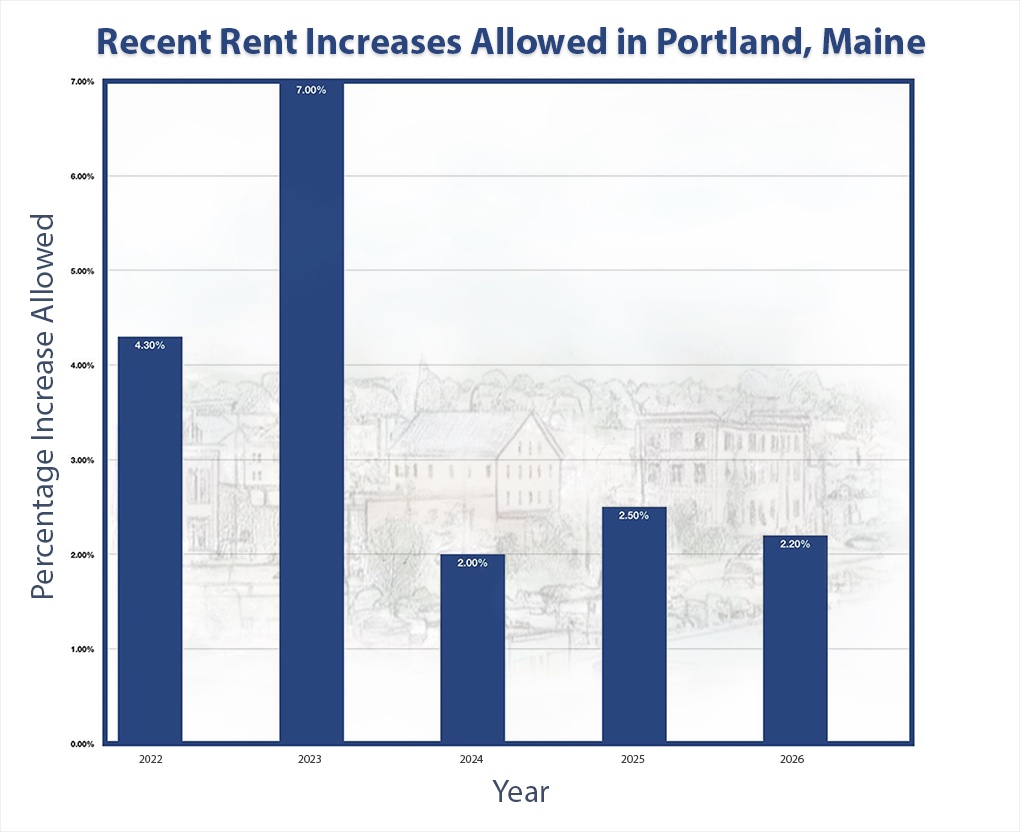
Portland’s rent-control ordinance, enacted in January 2022, empowers the city to set allowed increases for all non-exempt rental properties based on 70% of the increase in the Consumer Price Index (CPI-U) for Boston-Cambridge-Newton, MA. This table shows increases allowed since the policy took effect, an average of 3.6% (2.23% over the past three years). Allowed increases are announced each year in September, to take effect the following January 1. Image: Rent Increase Table Data Portland ME Gov Image Derivative Public Domain MassLandlords
A study by the Maine Policy Institute shows a reduction in Portland’s tax base of 3.2% to 5.4% since rent restrictions were enacted. In order to maintain levels of public service that are funded by property taxes, Portland has had to raise tax bills for rental and single-family property owners. The same study shows single-family and condominium owners shouldering 63% of that tax burden, paying between $6.3 million and $10.6 million more per year in taxes.
For Portland landlords, the financial shift may be more pronounced. On top of tax increases to subsidize rent control, insurance rates continue to increase, as do costs for upkeep and building maintenance. A 2.2% increase in revenue – the recent average rent increase allowed under rent control – is unlikely to come close to covering the combination of operating expense increases, without even considering return on investment.
Setting rent control limits below inflation year after year is an obvious detriment to business solvency. The constitutionality of mandating business owners to accept revenues below inflation is dubious.
Slowdown In Multifamily Housing Construction
Unlike most cities that have adopted rent control, Portland has not suffered the same precipitous drop in multifamily housing permitting. However, as with other cities under rent control, new housing construction has seen a slowdown.
We’ve written in depth about housing development losses in St. Paul, Minn. (80% drop in approved multifamily permits), and Montgomery County, Md. (96% drop), coinciding with their rent control enactments.
At first glance, Portland has not experienced similar drops in housing permits. In fact, Maine’s largest city approved more than twice as many housing permits in the five years since rent control was enacted than in the five years preceding. From 2016 to 2020, the city approved 1,902 housing units. From 2021 to 2025, it approved 4,556. These figures include non-rental properties.
Permit approvals don’t tell the whole story because they don’t always result in construction. While some rent control proponents applaud the city’s record-setting pace of permit approvals, others point to the record drop in construction. People are pulling permits for deals that subsequently fall through.
Because the record high permit approvals were mostly due to a few large apartment projects, as those building projects have stalled, the gap has widened between units permitted and those built or under construction. Following a record year in 2023, when 780 units were completed, and 2024 with 582 units, 2025 saw a year-to-year record drop of 68% in completed units, down to 187. That’s only 13% of the 1,420 permitted units approved that year (some completed units may have been permitted in previous years).
While rent control and rising construction costs are part of the reason for the slowdown, the city’s inclusionary zoning (IZ) law may also be damping new construction. The IZ ordinance requires new residential projects of 10 units or more to make at least 25% of the units affordable for residents earning 80% or less of Area Median Income (AMI), or pay a fee to the city instead, of $186,087 per noncomplying unit. That IZ law was amended from its original version in 2020, to the frustration of builders and investors, upping the affordable unit requirement from 10% for those earning 100% or less of AMI.
Both the IZ and rent control laws are slated for consideration by the Portland City Council, which will focus on the rent control policy in January 2027. The Portland city charter prohibits any changes to laws passed by referendum for five years. In anticipation of the city council’s scrutiny of the law, the Greater Portland Board of Realtors commissioned a study in 2025, “Evaluating the Impact of Rent Control on Property Tax Burdens in Portland,” that yielded some of the statistics cited above. A lobbying effort is underway prompting the city council to amend the rent control law.
A Comparison: South Portland Rent Control
As a side-by-side comparison, South Portland, a city less than half the size of Portland that sits across the Fore River from its larger counterpart, also enacted a different form of rent control. The smaller city’s policy, which took effect in 2023, was a 4-3 vote city council approval that caps rent increases at 10% for rental buildings of 15 units or more, a smaller fraction of the rental property stock than in Portland.
South Portland’s rent control also requires a 90-day notice for rent increases. But unlike Portland, it did not establish a rent control board to oversee disputes and approve rent increases beyond the ordinance.
South Portland’s law, in place for about three years, has yielded less resultant data than Portland. South Portland is also much smaller, with a population of about 27,000, compared with Portland’s 70,000, so the housing impact is less pronounced.
Still, even with the smaller sample, it seems clear rent control has stifled South Portland’s new housing pipeline more drastically than Portland’s. In the three years (2020-22) before South Portland’s rent control ordinance, the city approved 326 multifamily housing permits, compared with only 36 since (through April 2026), according to HUD Office of Policy Development and Research building permit statistics. That’s an 89% drop in housing permits since rent control was enacted in South Portland, a rate on par with other, larger rent-controlled communities we’ve analyzed.
Net Negative Rent Control Outcomes
It’s unclear why Portland’s multifamily housing permits have remained strong after rent control took effect, unlike other communities whose housing permits have withered. Portland may be an outlier as a very popular coastal city experiencing a protracted boom of tourism. And, upon deeper analysis, its permitting isn’t translating to completed housing units. A slowdown in actual housing availability, including affordable housing, remains the result.
Housing in any community is a complicated balance of supply, demand, socioeconomic conditions, local and state laws and a slate of other factors. There are many moving parts.
Even with its full pipeline of potential multifamily housing, it’s questionable whether Portland’s rent control ordinance is succeeding at its intended objective. It may be forcing cheap rents for the segment of tenants who live in controlled rentals. But it has shifted the tax burden onto single-family, condominium and rental property owners. The city has seen a slowdown in housing construction at a time when more housing is desperately needed. And landlords are increasingly unable to keep up with operating expenses when revenue growth is constricted below inflation.
Those are the common outcomes for every city or region that has imposed rent control.
Thankfully, for the time being, we don’t have to worry about the economy-depressing results of rent control. In late June, MassLandlords, in coordination with the Housing for Massachusetts statewide campaign, defeated rent control at the Supreme Judicial Court.
But rent control is likely to soon be back. Please become a member or sign in and make a donation to help us recover from our costly rent control victory, take on the fight next time around and save us all from Portland’s fate.