
Landlord Basics: The Eviction Process in Massachusetts
By Kimberly Rau, MassLandlords, Inc.
Our Landlord Basics series continues this month with a look at the eviction process. This is when you need to regain possession of your rental unit but the renter is unable or unwilling to leave on their own accord.
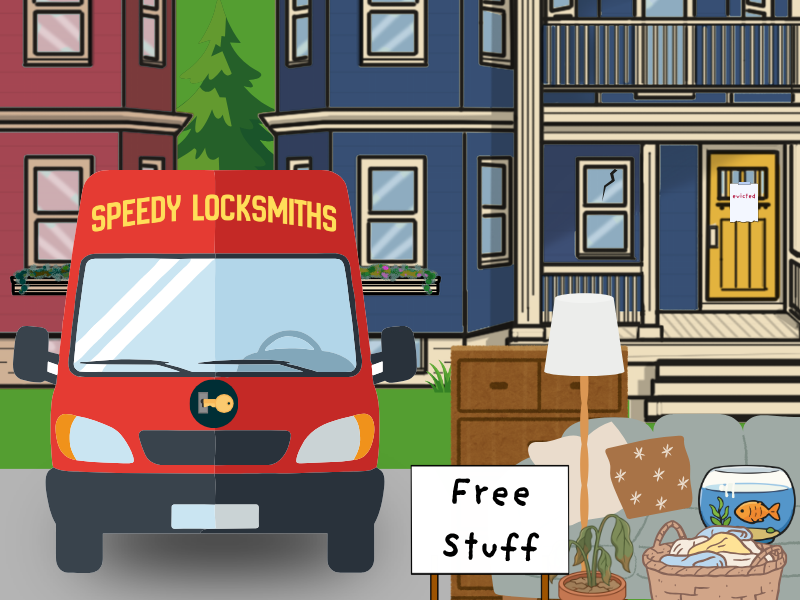
No self-help evictions allowed: Don’t change the locks, cut off utilities or put your renter’s belongings on the curb. If you must evict, get a lawyer and do it by the book. (Image License: CC BY-SA 4.0 MassLandlords, Inc.)
Evictions in Massachusetts can be complicated, and if you are facing an eviction situation right now you will want to read our more in-depth articles as well. They are linked throughout this article.
Because eviction can be expensive and time-consuming, you should avoid terminating a tenancy this way whenever possible. Court should be a last resort.
The Different Types of Eviction
There are three primary reasons for eviction in Massachusetts: nonpayment, for-cause (lease violations) and no-cause-stated (“no fault”).
First, eviction for nonpayment is when your renter can’t or won’t pay the rent and has no way to pay back what is owed.
Second, eviction for cause is when your renter has violated the terms of your agreement and you want to end the tenancy.
Both nonpayment and for cause evictions must be proved in court.
Third, no-cause-stated evictions (sometimes called no-fault evictions) are for when you need to regain possession of the apartment, but the renter has not violated the agreement or missed a rent payment. No-cause-stated evictions may not be used mid-lease.
You might also file a no-cause-stated eviction because the renter violated the agreement, but you are unsure you can prove it in court. This is one reason we don’t like the term “no-fault eviction,” because sometimes the renter is still at fault.
Unlawful: DIY evictions
Under no circumstances can you change the locks, cut off utilities or threaten your renter if they do not leave. You may not put all of their belongings on the curb and lock them out. These sorts of “self-help” evictions are not lawful in Massachusetts. They will cost you a lot of time and money in court. You might go to jail. Don’t do it.

Eviction in Massachusetts can take months longer than expected. Avoid going to court whenever possible. (Image License: CC BY-SA 4.0 MassLandlords, Inc.)
Alternatives to Eviction
If you can avoid going to court, especially for a nonpayment eviction, you are likely to save time and money.
If your renter is having trouble paying the bills, they may qualify for Residential Assistance for Families in Transition (RAFT) funds, which will pay up to $7,000 in a rolling 12-month period to help families stay in their homes. Evictions are paused if there is a pending RAFT application, so it makes sense to explore this option first.
If you need to evict for any reason, including nonpayment, you might consider offering a “cash for keys” deal to your renters. This may seem counterintuitive, especially if they already owe rent, but can be cheaper than court. Just make sure to get your agreement in writing (we have a form for that). There are other eviction alternatives you can consider as well.
Steps In The Eviction Process
Step 1: Serve the Notice to Quit
Once you have determined you must pursue an eviction, you have to let your renter know. They may already have an idea, especially if they haven’t paid the rent or have heard you talking about major renovations. Even if this is the case, you still have to formally serve them with a notice to quit to start the process.
The notice to quit must include very specific wording, sometimes including letting your renters know about the possibility of rental assistance, such as RAFT. We offer notice to quit forms, which are up to date with all required verbiage, but unless you are already very experienced with evictions, we suggest you hire an attorney to do this. Do not use AI. Messing up this part of the eviction process can cost you years of delay.
For nonpayment evictions, if they pay the rent within the indicated timeframe, the process ends and you continue as you were. If they do not pay the rent and do not move out, you will move forward with the process.
For-cause and no-cause-stated evictions, follow a similar process. If they do not leave by the date on the notice, you move forward in court. But before you get in front of a judge, you’ll go to mediation.
Step 2: Mediation
Mediation is the chance for you and your renter to reach a compromise without having to drag things out in court. A compromise could include an agreed-upon move-out date, cash for keys, or other agreements that facilitate you regaining possession of your rental unit.
You do not need an attorney for this step, but you might want one, especially if the case is complicated. Mediation agreements are legally binding.
If you can reach an agreement in mediation, all the better. Even if you do end up forgiving unpaid rent or offering cash for them to move out, it could still be cheaper than going to trial. Consult with your attorney before agreeing to anything.
If you cannot reach an agreement, you will go to trial.
Step 3: Trial
If your property is held in a trust or LLC, you will need a lawyer at this point. If your property is under your name, you do not need legal counsel, but it may still be a good idea, especially if you think your renter is likely to fight you.
Your renter is not required to have an attorney, but can hire one, or get free/affordable counsel through various renter legal assistance agencies. They may already have done this for mediation.
If you have made any mistakes with filing, serving notices or your paperwork, your eviction could be thrown out or delayed. If your renter makes any counterclaims about sanitary code violations, your case may be delayed.
If the judge rules in your favor, you will get a judgment for whatever money the court says the renter owes. Collecting on that judgment may not be easy, but if your renter wants their eviction sealed, they will have to satisfy the debt.
Step 4: Regain Possession
Once all appeal opportunities are exhausted, your renter will be given a date by which they must leave the rental unit. If you do not believe they will leave by this date, you can get a sheriff to escort them out on the final day. You will need a court order for possession to do this.
If anything is left behind and your renter has not specifically told you in writing (text messages count) that you can get rid of their things, you will need to store them under the state’s move and store law.
Conclusion
Eviction can be a long, complicated process. However, data shows that only 4% of tenancies end up in court in any given year.
In other words, it’s not only possible, but likely, that if you work hard to solve conflicts before you reach the point of serving a notice to quit, you can avoid court as well. This means communicating (and encouraging communication) with your renters, fixing problems before they get out of hand, and ensuring you know what’s going on at your rental properties to the best of your ability.
New to landlording? Experienced, but need a refresher? Read the rest of our basics series, and consider taking our one-day Crash Course in Landlording to set yourself up for success.