
Patricia Saint Aubin and Auditor Suzanne Bump
Recorded live on Wednesday, October 8, 2014, at the Small Business Candidates' Night, hosted by MassLandlords.net at Worcester Technical High School.
Patricia Saint Aubin and Suzanne Bump for State Auditor
[Start 0:00:00]
Raymond Mariano: Our next candidates are for state auditor. Patricia Saint Aubin was born in New Bedford and was raised in South Dartmouth. She has a B.S. in Accounting from Providence College, with professional auditing experience. She now lives in Norfolk with her husband, Ralph. With her expertise, the auditor’s office can perform better for all taxpayers.
Our current State Auditor, Suzanne Bump, elected in 2010. Suzanne Bump is the 25th State Auditor of Massachusetts. In her first term, her office has uncovered over $400 million in questionable payments, misspending, and fraud while professionalizing and diversifying the office. A native of Whitman, she currently lives in Great Barrington with her husband, Paul McDevitt.
We’re going to have obviously very different questions, but we’re going to follow the same format with a 2-minute opening for each of the candidates. The timekeeper is sitting right in the front. When she puts up the card that says time, I will stop you.
We had a coin toss. Miss Saint Aubin has lost the coin toss, and she’s going to be going first. Two minutes.
Patricia Saint Aubin: Do we need a test on the mike? Am I okay?
Raymond Mariano: We’re all set.
Patricia Saint Aubin: Okay, great. Good evening, everyone. Thank you for coming out here in Worcester. It’s a happy night for the candidates. My name is Patricia Saint Aubin, and as indicated, I was born in New Bedford and I grew up in South Dartmouth, Massachusetts, so I’m a lifelong resident.
My parents were both very civic-minded in the New Bedford community and South Dartmouth. My father was an entrepreneur, but he gave back to the community in many, many ways and he’s my role model, as is my 90-year-old mother who’s still living and was also very involved in our community. My father was involved with the chamber of commerce, the Rotarians, the Salvation Army, and many other civic organizations.
I grew up as I say in South Dartmouth. I went to Bishop Stang High School in Dartmouth, then I went on to Providence College where I studied accounting, a difficult major. When I got out in 1980, I was one of 20 women out of 90 people studying accounting. I paved the path for many women that came after me in the business world. I also happen to hold a Master’s in American History from Providence College, and I am a candidate for a double major Master’s in European History.
My first job out of school for about 4 years was auditing for one of the major banks in downtown Boston in the asset-based lending group, which is one of the more profitable areas of commercial lending, and the auditor’s role was extremely important to the loan officer. I then moved on and became entrepreneurial like my father and took steps in the insurance industry where I was appointed to the Board of Directors of the Boston Life Underwriters when I was 27 years old, one of the youngest females ever to be appointed to that board, and I was very proud of that work. I then moved on to the healthcare industries.
I appreciate your time this evening. I hope you give me full benefit of your consideration of your vote on November 4th. Thank you.
Raymond Mariano: Thank you, Miss Saint Aubin. Auditor Bump.
Suzanne Bump: Thank you so much. I am delighted to be back in Worcester. In fact, it was not that many years ago when I was secretary of labor and workforce development that I held meetings to address the problem of skills mismatch and the lack of opportunity for folks to connect with employers, who are in need of workers in this area, and to grow the economy right in this very realm.
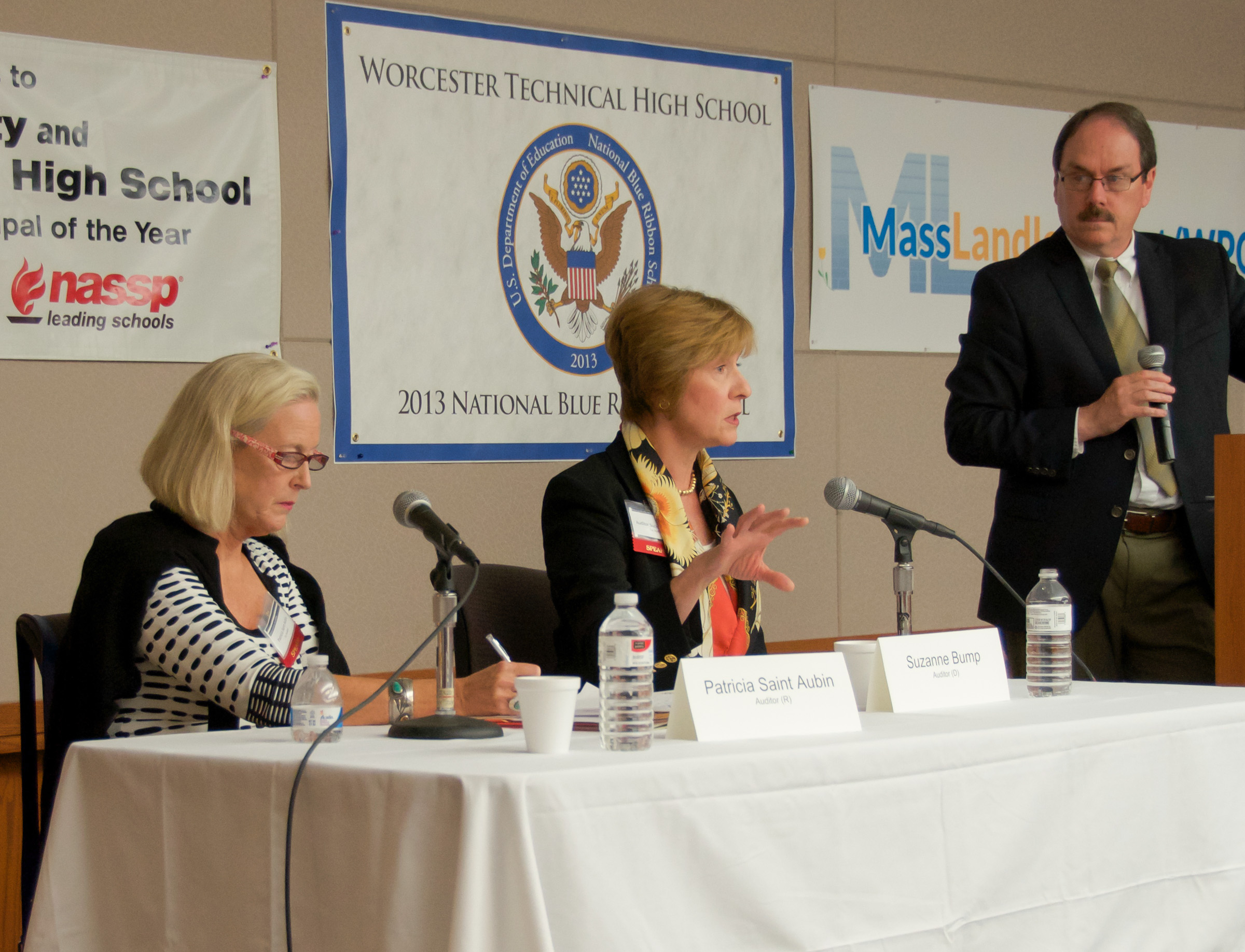
From left to right: Ms. Patricia Saint Aubin, seeking election as Massachusetts State Auditor, state Auditor Suzanne Bump, seeking reelection, and moderator Ray Mariano at the MassLandlords.net Small Business Candidates' Night 2014.
It was that experience in government, as well as years before when I was a state representative, that caused me in 2010 to decide to run for the position of state auditor. Because as a labor secretary, I became very focused on what were the benefits of the programs that we were running. Were we really preparing the workers for the future? Were we really meeting employer needs? How are we doing our strategic planning? What was the information that we needed in order to make government work better in this area?
When I ran in 2010, it was with those experiences plus what I’ve learned in the private sector and on the many nonprofit boards on which I’ve served over the years, boards for the Chamber of Commerce of the South Shore, St. Francis House, which is a large social service provider agency in the City of Boston. I had a plan for being your agent for accountability in state government to ask the questions that you want answered. How much are agencies spending on programs? Are they playing by the rules when they spend the money? Are we getting what we’re supposed to get? Are agencies meeting their missions? That’s the wonderful opportunity that the auditor has to ask those questions on your behalf, to stand in your shoes so that government delivers on the promises that it makes to you.
[0:05:09]
Raymond Mariano: Thank you. First section broad questions where each of the candidates will have 2 minutes to respond. The first goes to Auditor Bump. The website for the state auditor’s office uses the tagline “Making government work better.” Please give me two examples of how the auditor’s office has worked to make government work better.
Suzanne Bump: Two of countless examples. One of them was mentioned actually in the introduction. Over the past 4 years because of the additional skills training that we have done in the office, the introductions of new technologies that allow us to better analyze state spending and state performance, we’ve been able to identify over $400 million worth of broken systems, of misspending, of abuse, and of fraud. It’s come across all areas of government. We have found automated fare collection systems in the MBTA in Boston that couldn’t count fares to the tune of $100 million over the period of time since the inception of that system. We’ve found agencies that weren’t meeting their missions with regard to protecting children. We have found mismanagement of special education collaboratives.
We, when we find those things, direct the agencies to fix them. In many cases, this results in savings on an ongoing basis. That’s how we use our auditing function to understand whether agencies are obeying the rules, following their own regulations in order to deliver the results that you expect and figuring out how it is that we can do it better the next time.
The other way that we make government work better is by working with the legislature in a collaborative fashion after we’ve done an audit and found that an agency can’t fix things on their own. They need fundamental change in the law, and we’ve done that in special education programs at the Department of Children and Families, at the Department of Transitional Assistance, with the school anti-bullying programs, and on and on. Public Housing Administration, as our moderator well knows, our recommendations have been turned into law to make government work better, more effectively, more efficiently, with more accountability and more transparency.
Raymond Mariano: Miss Saint Aubin, you’ve heard her response. I’d like you to let us know how you might have improved on the work that she just cited.
Patricia Saint Aubin: Great! It’s interesting that you should mention the auditor’s website because there is actually a perfunctory video on the auditor’s website, and one of the things that that states is that there are 375 state entities that should be audited once every 3 years. When Suzanne Bump came into office in 2011, that particular Massachusetts General Law, which was Chapter 11, Section 12 stated that those 375 state agencies should be audited once every 2 years.
Government is not exactly working better under Auditor Bump. When she came into office, when she assumed office, when she ran for office, she was to do 187.5 audits on an annual basis. She went to the state legislature after getting a peer review that she failed because of the work of her predecessor, and she paid $3,500 for that particular peer review to find out how to audit. I went through 4 years of college to know how to audit. I worked in private industry for 4 years to learn how to audit.
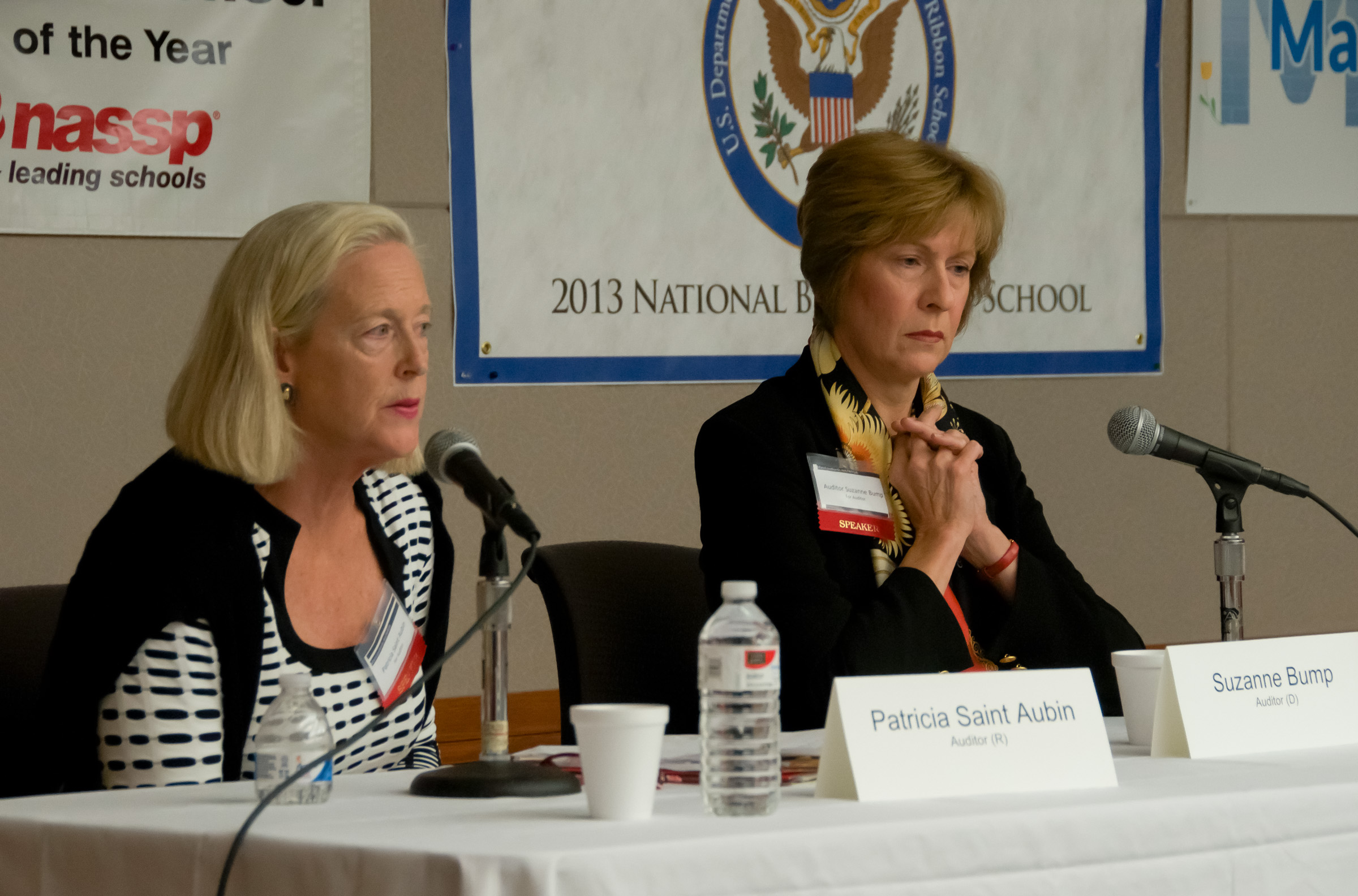
Ms. Patricia Saint Aubin, seeking election as Massachusetts State Auditor, and state Auditor Suzanne Bump, seeking reelection, speaking at the MassLandlords.net Small Business Candidates' Night 2014.
She changed the law. She went to the state legislature and had the law changed to bring it down to 125 audits per year, and she’s not met that benchmark but the first year in office and Auditor DeNucci got her across the line. She did 133 audits ‑ the first year 89 and the second year 64 audits. As of October 1st of this year, 36 audits. There are 98 people that serve in an auditing capacity based upon information I have from 2012. Professionalism will be brought back to that office if I am elected auditor. Thank you.
Raymond Mariano: Miss Saint Aubin, I think you’ve answered my next question but I am going to try it again anyways. Please give us two additional examples of what our current state auditor has failed to do and what you would do differently.
Patricia Saint Aubin: Yes, I can answer that as well. Mr. Mariano, you’re an executive director of the housing authority.
Raymond Mariano: I am.
Patricia Saint Aubin: And I have looked closely at the Housing Authority audits, and I am troubled by them. When DeNucci did your audit in 2009, he actually came up with 14 items that he looked at, at the time. As far as I’m concerned, that was pretty thorough. That has actually been my argument all along the way that when I look at the Housing Authority audits, they’re helter-skelter. There’s only one or two items that are reviewed, and actually maybe it is 14 items that should be reviewed. Maybe it’s 20 items that should be reviewed. They actually looked at your accounts receivable at the time. They looked at your inventory control list at the time. That should be done.
[0:10:50]
When recently an audit came out on the University of Massachusetts system, you have a college here that serves as one of the universities. There are seven in the state. As far as I’m concerned, each of those universities should be audited separately not under an umbrella of seven universities in one audit. That’s not thorough. That’s cursory auditing. I can do better. I’ve done better professionally. Again, you will get an upgrade of professionalism when you elect me auditor. Thank you.
Raymond Mariano: Auditor Bump, your response please.
Suzanne Bump: Unfortunately, I don’t think that despite the fact that she’s been on the campaign trail for a number of months, Miss Saint Aubin has really come to understand what government auditing is about and about the standards that we use in the office. What we’re doing in order to make the best use of the resources of the state auditor’s office is what the industry does and that is that we do risk-based auditing. We don’t do the kind of audits that had been done previously where when they look at the Department of, for instance, Transitional Assistance, they only look to see if they have a good backup computer system. When we audited the Department of Transitional Assistance, we wanted to know are you fighting fraud. Are you checking the eligibility of claimants? Are you using all of the tools that you have to prevent abuse of benefits?
Because of the depth that we’re bringing to our auditing, we are in fact, she’s right doing few of them but they are producing greater results for the taxpayers and for the agencies themselves. That’s the model that you should be using, strategic use of your resources. Don’t spend a lot of time where there is not a lot of risk, where there is not a lot of impact. Spend the time on the major programs that spend the most money that are most susceptible to fraud, waste, and abuse, and that’s how you work efficiently and effectively in government.
I’d like to point out to that what she was referring to in 2011 was that I asked for a peer review of the office as soon as I took office in order to find out how well the office was doing meeting government standards. In 2011, the agency that I inherited failed peer review. It didn’t have competent staff and it wasn’t auditing properly. In 2014, another peer review was done, just a few months ago. We got the highest possible rating‑
Raymond Mariano: Time.
Suzanne Bump: Which is a pass.
Raymond Mariano: Okay, thank you. Now the next section will have more rapid responses, 1 minute. This question will start with Auditor Bump. It’s related to the effectiveness of bureaucracy. According to a 2013 auditor’s report, 96 percent of Massachusetts tax revenue comes from just 6 of the 26 sources examined. The remaining 20 taxes require their own departments and commissions. How does Massachusetts compare with other states in your opinion in terms of the number of departments, commissions, or other measures of bureaucracy?
Suzanne Bump: We have a highly evolved bureaucracy in Massachusetts, and I think that it’s been actually made unnecessarily complex. There has been a multiplication over the years of specific quasi-public entities that don’t have the same levels of accountability that the rest of government does. They aren’t open to the same level of scrutiny. I can still audit them and I do audit them, but I think that we need in fact to simplify that bureaucracy. You know the fact of the matter is that the further you get away from central controls over spending, the more susceptible it is to waste, fraud, and abuse. We need to bring some of that back in so that we can do better strategic planning to make the best use of those resources and ensure that we are operating as effectively and efficiently as we can. That’s what we have to do that’s in your interest.
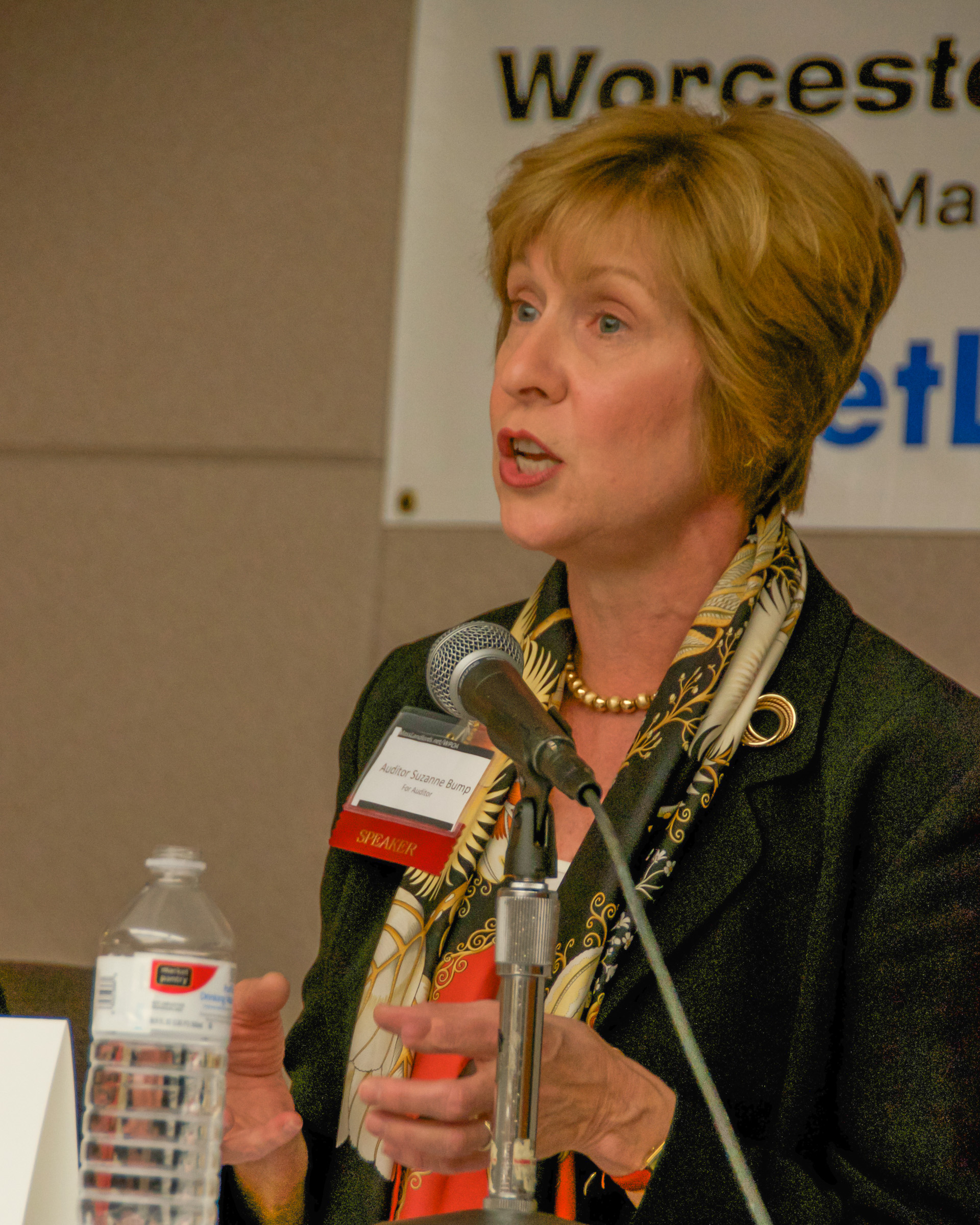
Massachusetts Auditor Suzanne Bump at the MassLandlords.net Small Business Candidates' Night 2014.
[0:15:02]
Raymond Mariano: Thank you, auditor. The response now from Miss Saint Aubin.
Patricia Saint Aubin: Yes. I hear about bureaucracy on the campaign trail all the time. In fact, I have been to 260 various places on the campaign trail since I announced my candidacy in February. I’m engaging with a lot of small business owners, and I know that the overhead for small business owners is quite severe in this state. But when we talk about bureaucracy, we need to look at what’s going on in the auditor’s office, and the bureaucracies that exist there and the fact that these audits aren’t getting done.
She talked about the peer review, and that it failed in 2011 and that she passed in 2014. I’ve spoken to the people in Kentucky about that particular peer review, which caused $3,500. Actually, it’s supposed to be done once every 3 years. Very similarly to the audits that are now done by the state when the law was changed, and 48 states out of 48 states got the pass. Some of them may have gotten the pass with a couple of items that they’re still doing wrong, but according to the executive director down there, the whole purpose of that peer review is to get states to pass. They do not want states to fail. They want them to pass.
She’s talked about bringing up the professionalism in her office, which she did, and the audits are still going down. Why is that? There’s all people with bachelors in accounting in there like myself. Why is she only producing only 36 audits this year? That’s somehow bureaucracy. I want to change that.
Raymond Mariano: All right. The next question is on corruption. Three recent house speakers have been convicted of felonies. The New York Times reported that Massachusetts State Government is 18th out of 50 states when ranked by number of convicted public officials. The Center for Public Integrity lists us 12th by risk of corruption, with F grades on public access to information and the state budget process. What can the auditor do to prevent or expose corruption in the commonwealth? Question goes to Miss Saint Aubin.
Patricia Saint Aubin: Well first off, I think when Suzanne ran the last time, it came up with her other opponent, the other Republican candidate, but it was suggested that the state legislature be audited. Auditor Bump said at the time that was a worthy cause to go in and audit the state legislatures and its legislators and how much their budgets and what they’re doing with their per diems and how they’re charging back to the state mileage and things like that. It’s not been done.
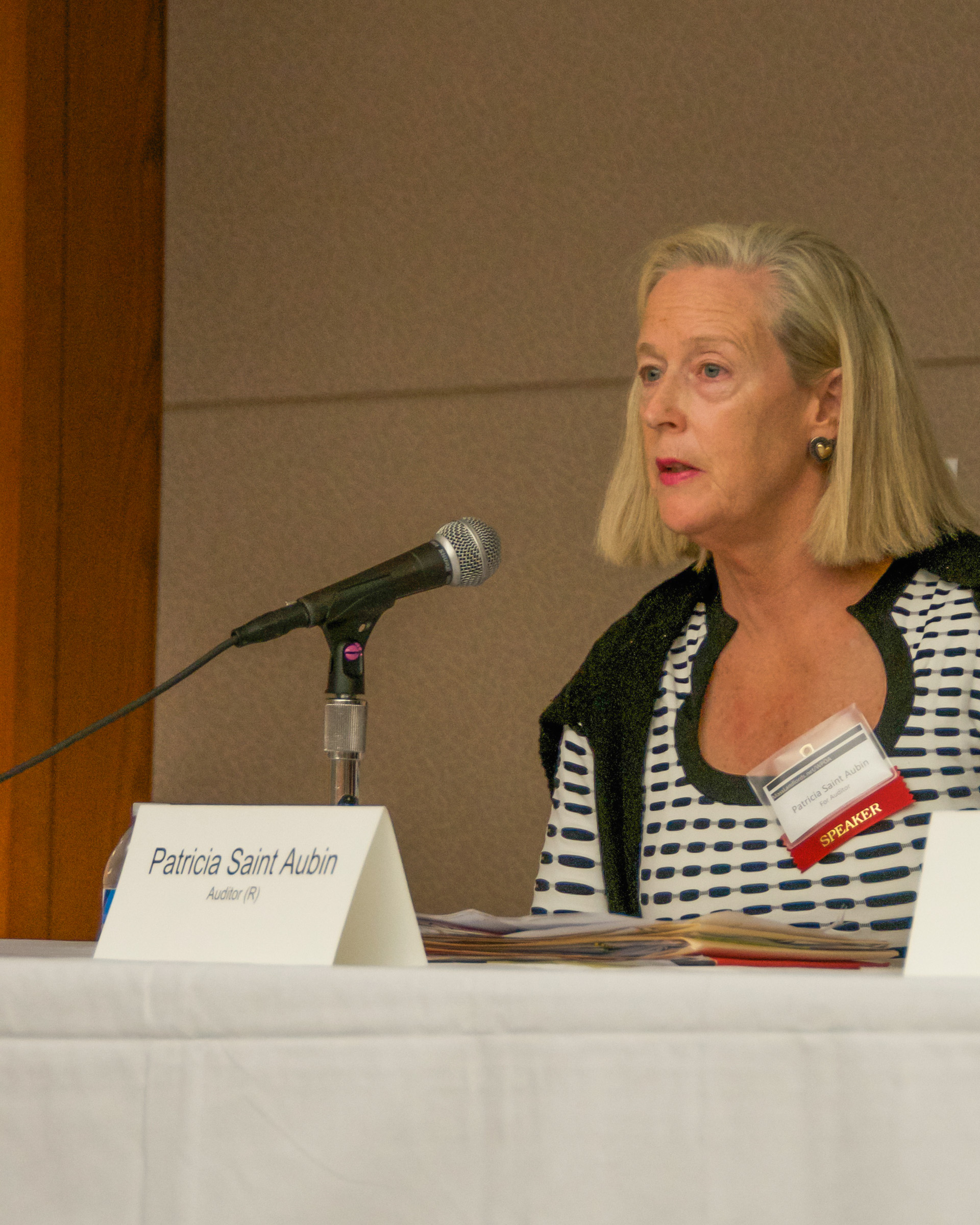
Ms. Patricia Saint Aubin, seeking election as Massachusetts State Auditor, speaks at the MassLandlords.net Small Business Candidates' Night 2014.
Suzanne Bump came out of the state legislature. She was one of them. Do you think she has any concept in going back and auditing the people that are her friends? No! I will go in, and I will audit the state legislature.
Raymond Mariano: Auditor Bump.
Suzanne Bump: In 2010, my Republican contender and I both agreed that the legislature should come under the purview of the auditor’s office, just as the judiciary does and just as the whole of the rest of the executive branch does. We agreed on that. We also agreed that the auditor does not have that power and what we needed to do was get the legislature to pass a law. And so, I have, in both of the two past legislative cycles, supported the legislation that the Republicans have filed, that would give the auditor that ability because I think that the public deserves to know how the legislature is spending their money, how it is that they’re making the decisions. But the fact of the matter is that under the law, the auditor doesn’t have that power. I’ve been supporting the efforts to give the auditor that power.
Raymond Mariano: The next section, we will allow candidates to give us responses up to one and a half minutes, and this will go to Auditor Bump. There have been several tragic examples of failures by the Department of Children and Families (DCF). What could or should the state auditor’s office have done to ensure that this agency operates effectively and that vulnerable children are protected.
Suzanne Bump: In fact, the state auditor’s office has contributed to the changes that are being made at DCF right now. Long before Jeremiah Oliver went missing and then was determined to have died and that his parents were responsible for that tragic death, we had commenced auditing one of the programs at the Department of Children and Families. We weren’t auditing the family services program that was supposed to be keeping an eye on that particular family. We were auditing the foster care program.
What we found is what the Child Welfare League found when it looked at the agency as a whole. Not enough staff to do the job, not enough resources available particularly in terms of electronic recordkeeping to see the kids were getting medical exams, to see the background checks on foster families were being done, to see that managers have the information that they needed to ensure that kids were being taken care of.
[0:20:25]

Massachusetts Auditor Suzanne Bump at the MassLandlords.net Small Business Candidates' Night 2014.
The agency was under-resourced, which is really what you were talking about with the two senatorial candidates. That’s exactly what the judge found as it’s being discussed right now in connection with the governor’s race. We have not provided that agency with the resources that it needs, and they don’t have a system for accountability. We’ve contributed to the solutions because of the audit work that we’ve been doing in that agency.
Raymond Mariano: Thank you. Miss Saint Aubin, same question.
Patricia Saint Aubin: Great. First let just preface that it’s very sad that a child went missing and deceased from under the care of DCF. In no way with my comments am I faulting Auditor Bump for that death. I want to make that perfectly clear because if I become auditor and a child dies while I’m auditor, I don’t want anyone pointing a finger at me, so I do want to preface that. But the auditor’s office did do an audit of DCF in March of 2011. It’s about 5 pages in length, and all was okay at that point in time. The second audit that she’s referring to came out on March 26, 2014, and it did only review the foster care aspect of DCF. It did not look at the in-home services where poor Jeremiah was residing in his house and ultimately found dead.
I think when you audit an agency, you audit it in its entirety; its entirety, not just one aspect of the division. Also Suzanne’s answer, and it’s not what an auditor is about is to suggest to throw more money at that agency. That is not under the purview of an auditor. That is not what auditing does is make suggestions that more money should be thrown at that agency. That’s for the legislature to decide, not for an auditor to decide.
Raymond Mariano: Thank you. The next question goes to Miss Saint Aubin. Last year, the legislature passed and the governor signed a welfare reform bill. Are there additional steps that should be taken to protect against fraud and abuse of public benefits, and is there anything that the state auditor can do to help prevent or expose abuse?
Patricia Saint Aubin: Yes. Thank you for that question. The auditor’s office can do far better with review of welfare fraud and the Department of Transitional Assistance. There is a Bureau of Special Investigations that does take in fraudulent calls on behalf of state agencies that do work in this area – food stamps and SNAP and the other divisions ‑ and also if someone in the John Q. public happens to come. Suzanne Bump recently found $9.8 million of fraudulent behavior through the Bureau of Special Investigations. She had an article about that yesterday, but the Bureau of Special Investigations is only 9.8 percent of what the auditor does. It’s only 9.8 percent of the budget; 78 percent falls into this auditing area. My belief is that these departments need to be audited on a regular basis, on an annual basis more closely than they are now. The last time it was audited was 2013, the Department of Transitional Assistance more thoroughly than what the Bureau of Investigations will be able to do. That’s what I intend to do. Because this is such a problem area, I will order that the Department of Transitional Assistance be audited on an annual basis. That’s what you will get out of me as an auditor. Thank you.
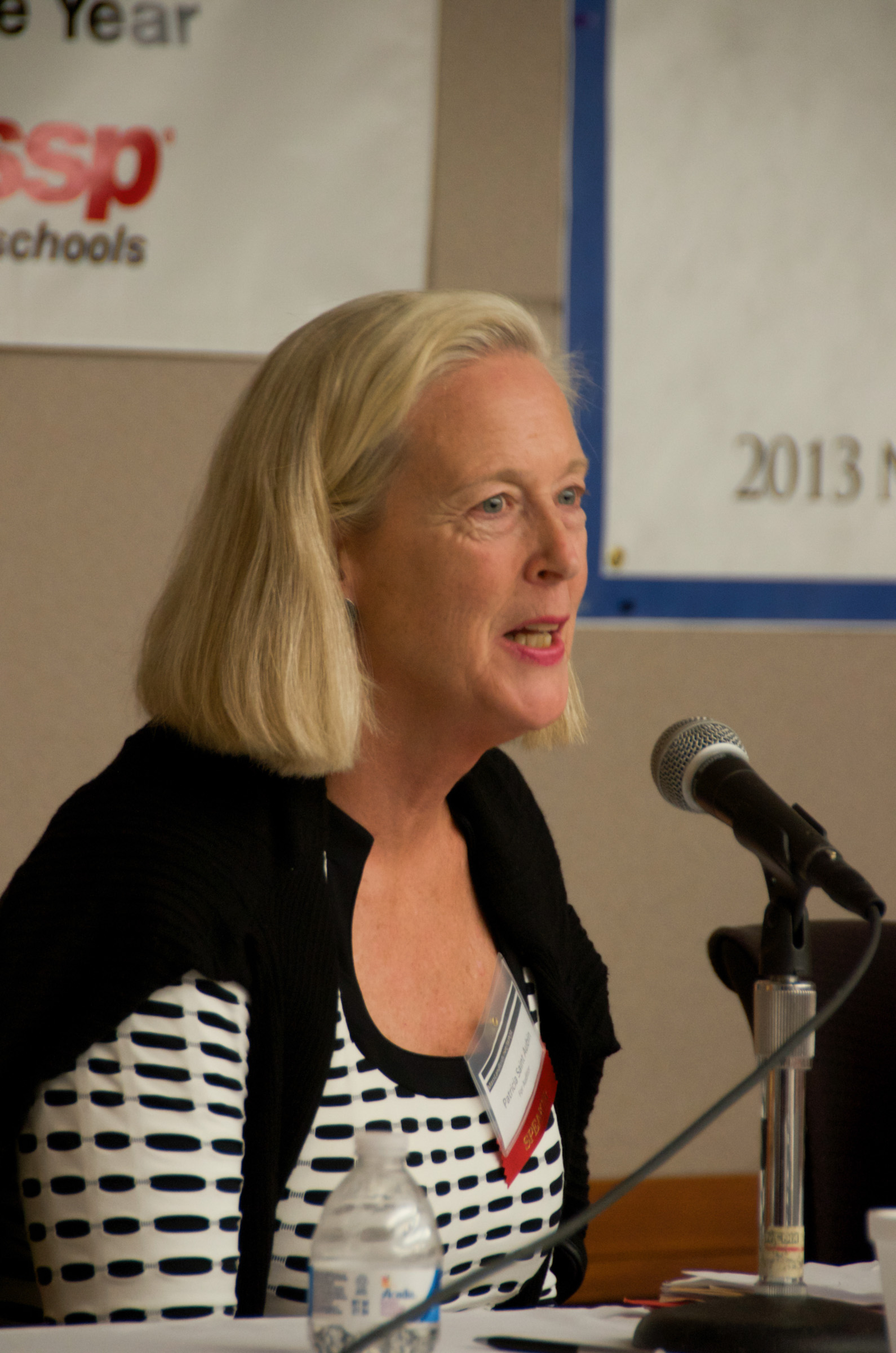
Ms. Patricia Saint Aubin, seeking election as Massachusetts State Auditor, speaks at the MassLandlords.net Small Business Candidates' Night 2014.
Raymond Mariano: Thank you. Auditor Bump.
Suzanne Bump: There are two ways that we try to protect the public interest with regard to public assistance programs. One of them is through our Bureau of Special Investigations, which looks at individuals who are either ineligible for benefits and have been wrongly claiming them or are abusing their benefits. We have fewer staff now than when I took over, but we actually have identified this year more than three times as much fraud as had been the case. That’s because we’re working smarter. We’re using more data analytic tools, and I know this gets a little computer wanky here, but because of the skills acquisition of our staff, we are actually finding more fraud with fewer resources than we were before. That’s a record; in fact, $9.5 million in that.
[0:25:04]
With regard to the auditing side of the operation, I think I mentioned to you a minute ago that a few years ago when an audit had been done, it was just looking at computer backup systems. Whereas when we did our audit, we were focusing on the question is there a culture of fraud fighting in that agency, and we found that there wasn’t. We found that they weren’t checking social security numbers to verify eligibility. You may remember the stories from a year ago of over 1,000 people who were using the social security number to get benefits of a dead person. They were using dead people’s social security numbers. We were the ones that uncovered that and also uncovered that they weren’t using all of the reports‑
Raymond Mariano: Time.
Suzanne Bump: That they had in order to detect abusive patterns‑
Raymond Mariano: Auditor.
Suzanne Bump: In the use of benefits.
Raymond Mariano: Warning. Thank you very much. The final question will start with Auditor Bump. Tell me an idea proposed by your opponent that you would consider adopting – no, no. Give her a chance – if you get elected.
Suzanne Bump: Well, clearly I would agree that we would love to be able to have even more of an impact in state government. The way to do that is to enhance our skills, make sure that we’re auditing to the highest standards, and to do risk-based auditing so that we aren’t spending time on [unintelligible 0:26:26] agencies when there’s not much chance of things going wrong and we can spend time on the big programs.
We have a standing Medicaid unit that is constantly auditing different aspects of the Medicaid program. We find again problems with putting people on benefits that aren’t entitled to them. We find abuse by providers ‑ providers who are overbilling, who are billing for services that they never even rendered ‑ and we prosecute those in conjunction with the attorney general’s office, and we get restitution.
There are innumerable ways that we can advance this cause of public accountability and enhance the public trust. That’s what my role is in state government to act on your behalf, to make sure the government is operating the way you need it to do.
Raymond Mariano: Thank you, auditor. Miss Saint Aubin. Tell me an idea proposed by your opponent that you would consider adopting if you get elected.
Patricia Saint Aubin: Number 1, she said it over and over, hasn’t she? Bring the degree of professionalism up. You got to get an auditor that’s audited, somebody that has a Bachelor’s of Accounting in there in order to elevate the professionalism of that department. That’s the story. I have the degree. I have the background. Suzanne wants to constantly in a somewhat condescending way tell me that I don't know about governmental auditing. I’m telling you, when you study accounting, it’s not like a vocational school where half the class gets governmental auditing and accounting and the other class gets private sector accounting. You get one and the same.
The only difference here is that rather than the stockholders that you report to in the private sector, it’s the public interest and that’s all of you, folks, the public interest. That’s what governmental auditing number 1 priority is: the taxpayer. I can do this. Perhaps I need to dummy down to do this job for governmental auditing, but if that’s the case, I can do it. I can do it. I’ve done this in the private sector. I can do it in the governmental sector as well.
Thank you so much for your time.
Raymond Mariano: That concludes this portion of our debate. How about a nice round of applause for our state auditor candidates [applause]?
[End 0:29:12]