Ballot Question Would Allow Single-Family Home Construction on 5,000 Square Feet by Right
. Posted in News - 0 Comments
By Kimberly Rau, MassLandlords, Inc.
Amid the loud debate over rent control, a second housing-related ballot question that would remove overly restrictive lot size minimums slipped under our radar. Unlike rent control, this initiative could actually do something to help fix the housing crisis.
Legalize Starter Homes’ ballot question seeks to make homeownership more attainable for residents by getting rid of restrictive zoning that prohibits the construction of smaller homes. (Image: Fair Use)
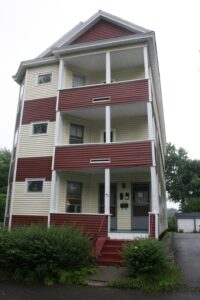
If passed, the ballot question would override local lot size restrictions, and allow by-right construction of single-family homes on lots of just 5,000 square feet. That’s an area just under an eighth of an acre. Lots would need to have at least 50 feet of street frontage, and access to public sewer and water services. Incidentally, 5,000 square feet is also the typical lot size for a triple-decker in Worcester. Allowing a single-family home seems easy by comparison.
“With the median home price approaching $700,000, young families, workers, and seniors have been priced out of the communities they love,” states Legalize Starter Homes, the group officially backing the ballot initiative.
“Restrictive local zoning rules have allowed a small number of opponents to block the critical construction of the homes Massachusetts desperately needs,” their main page continues.
The ballot question does not require any owner to subdivide their existing lot. Nor does it require any town to grant an owner’s request to subdivide. It merely allows owners of smaller lots to build if they want.
Many Massachusetts cities and towns have minimum lot sizes far above 5,000 square feet. Some have one- or two-acre lot size minimums. According to data from the National Zoning Atlas, 99% of single-family zoned land in Massachusetts has a minimum lot size. More than half of those lots are in areas that prohibit building on lot sizes less than one acre. Worse, 24% of those lots are in areas with a two-acre minimum.
The Greater Boston area encompasses 187 cities and towns. Of those, 95 have one-acre lot size minimum requirements. Worse, 14 of those communities have two-acre minimum requirements for 90% of their land, according to an article from Re:Main Places, which supports the ballot initiative.
The ballot question is gaining attention outside of Massachusetts. The New York Times editorial board supports Legalize Starter Homes’ initiative.
“When it comes to housing policy, the state of Massachusetts is often a bystander, allowing town governments to impose classic ‘not in my backyard’ policies,” stated the New York Times in its editorial.
“This November, Massachusetts has a chance to do better,” it continued. “It can live up to its self-image as a progressive, inclusive state by passing a ballot initiative to override stifling local housing rules that harm the young at the expense of the old and the middle class at the expense of the wealthy.”
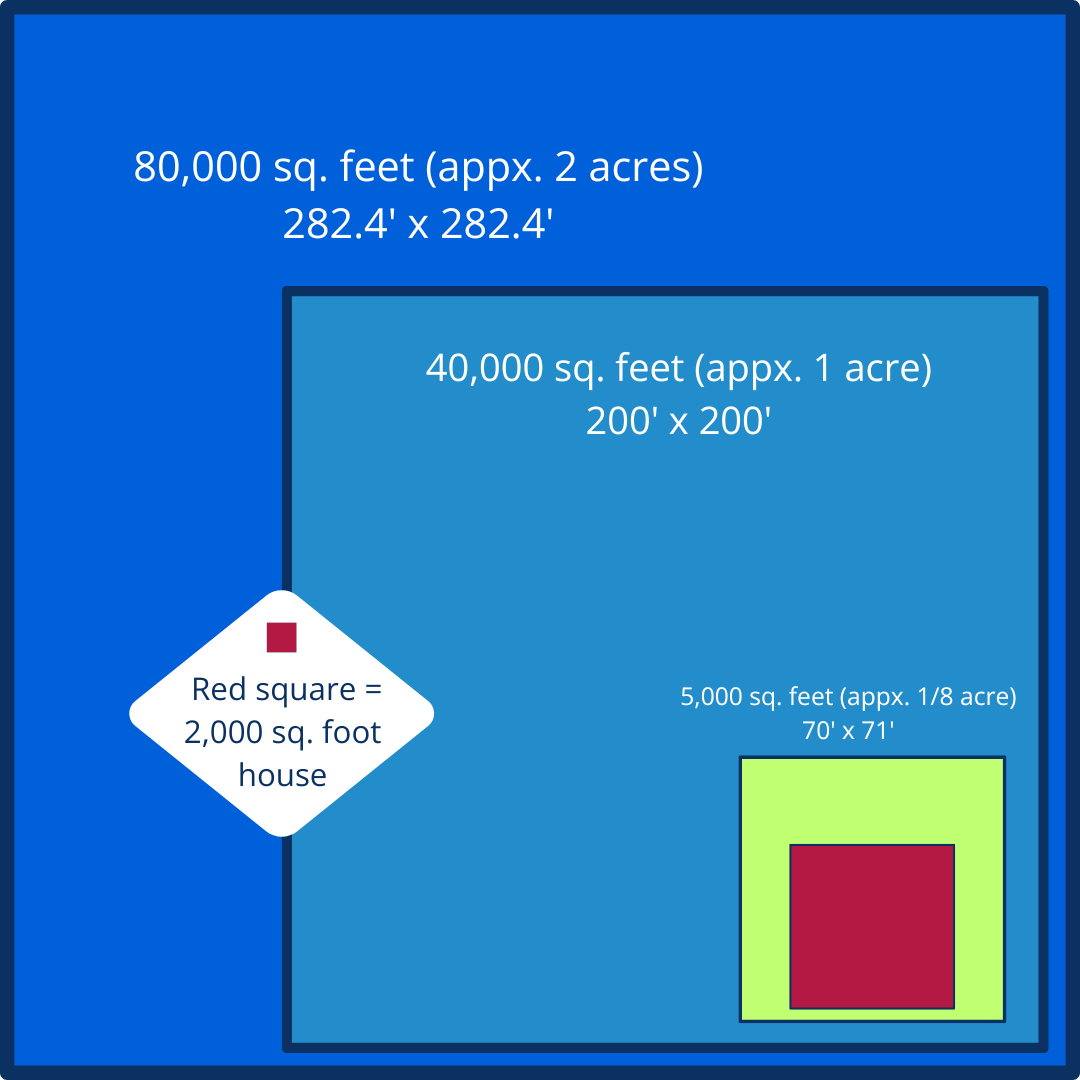
Many cities and towns in Massachusetts have lot size minimum requirements that could accommodate multiple single-family homes. A ballot initiative would allow subdividing by right under certain circumstances. (Image License: CC BY-SA 4.0 MassLandlords, Inc.)
By-right Initiative Comes With Caveats
If this initiative passes in November, it will open the door to more construction opportunity. However, the baked-in exemptions will allow plenty of communities to disregard the potential new law and continue with restrictive zoning policies.
For instance, Carlisle, located 26 miles from Boston, currently has one- and two-acre lot size minimums throughout most of its residential zones. Some lots are a minimum of four acres. This should be a prime opportunity for subdividing and new construction, but because Carlisle has no municipal water supply, it will be free to continue its exclusionary zoning practices. Homes there routinely sell for over $1.3 million.
Even closer, Dover, located 18 miles from Boston, has home prices that average around $1.8 million and lot size minimums that range from half an acre to two acres for residential areas. If the ballot initiative passed, property owners could potentially subdivide their lots and create lots of new housing, but nearly 70% of those properties have private wells.
Even with exclusionary zoning, the aforementioned towns (and all the ones like them throughout the state) may end up with public water service eventually. Private wells are not desirable amenities. They require lots of extensive, expensive filtering for sediment, heavy metals and radon. The water pressure after three layers of filtering is often lacking. How long will people pay more than $1 million for a property that doesn’t guarantee a good shower?
Additionally, communities will still be able to place height restrictions on new construction, and maintain their own setback and parking requirements, which could kill other attempts at subdividing lots for new housing.
Conclusion
Exclusionary zoning is outdated, harmful and designed to keep those not already on the property ladder from having a chance at homeownership. When wealthy NIMBY residents attend town meetings to decry the loss of the town’s “character,” we have to wonder when we all became entitled to a neighborhood that freezes in time the moment we sign the closing documents. If people had done that centuries ago, many of the properties these residents live on wouldn’t exist. There would be no desirable neighborhood areas in Back Bay, Harvard Square or Turners Falls. Think of your favorite “small town” downtown area where you go for summer ice cream or to see holiday lights. None of those existed until people started disrupting the existing “character” of those towns.
The pattern of pulling the property ladder up after yourself and shutting everyone else out is both elitist and untenable in a desirable, high-cost state like Massachusetts. Inequality like what we currently experience leads to strident calls for social reform, including attempts to revisit failed economic practices and systems like rent control.
Residents who want to live in a small town can continue to do so: there are plenty to choose from that don’t see the same intense housing demands the eastern part of the state does. Residents who want to live in a small town with relatively quick access to the state capitol may be out of touch. We need homes for the next generation, for our workers and seniors, or everything that’s good about Massachusetts will be gone in short order.