
AGO Reaches $500,000 Settlement with Property Management Company Over Unlawful Fees
. Posted in News - 0 Comments
By Kimberly Rau, MassLandlords, Inc.
The Massachusetts attorney general’s office announced it had secured a $500,000 settlement against Green Ocean Property Management, which it alleges charged renters a host of illegal junk fees between May 2020 and the filing of the agreement in July 2026. However, portions of the decision contain verbiage that cannot be backed up by current law.
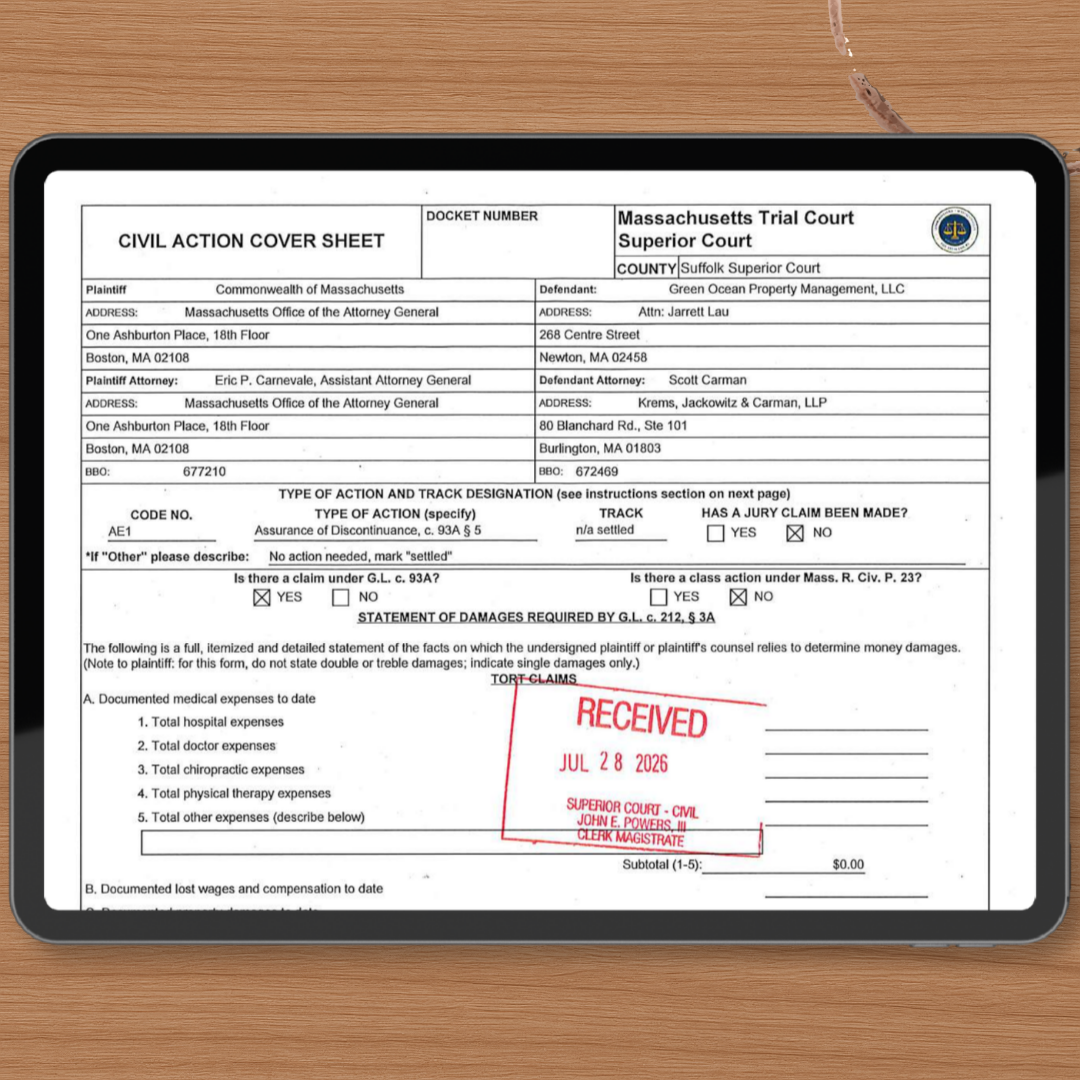
The agreement filed on July 28, 2026, requires Green Ocean Property Management to halt a series of alleged unlawful rental housing practices and pay $500,000, which will be distributed to affected renters. (Image License: CC BY-SA 4.0 MassLandlords, Inc.)
Green Ocean, a Newton-based company that manages approximately 350 rental units in the Boston area, did not admit to any wrongdoing when it agreed to the settlement, which includes an order to stop a long list of unlawful practices. The $500,000 payment is slated to be distributed among impacted residents.
Here are just some of the allegations levied against Green Ocean, as well as our review of two concerning statements from the attorney general’s office.
AGO Alleges Myriad Unlawful Tenancy Fees and Charges for Green Ocean Residents
The attorney general alleges that Green Ocean charged residents a host of unlawful fees. Many were attached to the move-in and move-out processes, both of which are heavily regulated under Massachusetts law.
This includes fees ranging between $250 and $500 for executing a new lease, and similarly priced charges for residents looking to add someone to the lease during the renewal process. (MGL Chapter 186 Section 15B permits charging only first month’s rent, last month’s rent, a security deposit and the cost of locks prior to signing a lease.) Rental agreements also purportedly required tenants to pay brokers’ fees regardless of who contracted the broker. (Chapter 112 Section 87DDD1/2 says the person who pays is the person who first engaged and entered into a contract with the broker.)
Green Ocean also reportedly charged last months’ rents that were higher than first months’ rents. (Chapter 186 Section 15B caps last month’s rent at a value equal to the first month’s rent.)
“This occurred when Green Ocean collected a full ‘last month’s rent’ in connection with a lease that included only a partial final month, or when the true rent for the final month was higher due to mandatory ‘move out’ fees,” the finding states.
Pyramiding Late Fees
The attorney general found that Green Ocean had a practice of applying collected rent to any late fees or other non-rent charges before applying the rest against the rent balance owed. The result was pyramiding, or cascading, late fees. A renter who received a late fee and then paid their rent balance would have it applied to the fee first, creating a deficit in rent owed. The next month, if the renter paid in full, they would still be behind, potentially receiving another late fee for the owed rent. The attorney general cited only Chapter 93A Section 2 and stated that this was “unfair.”
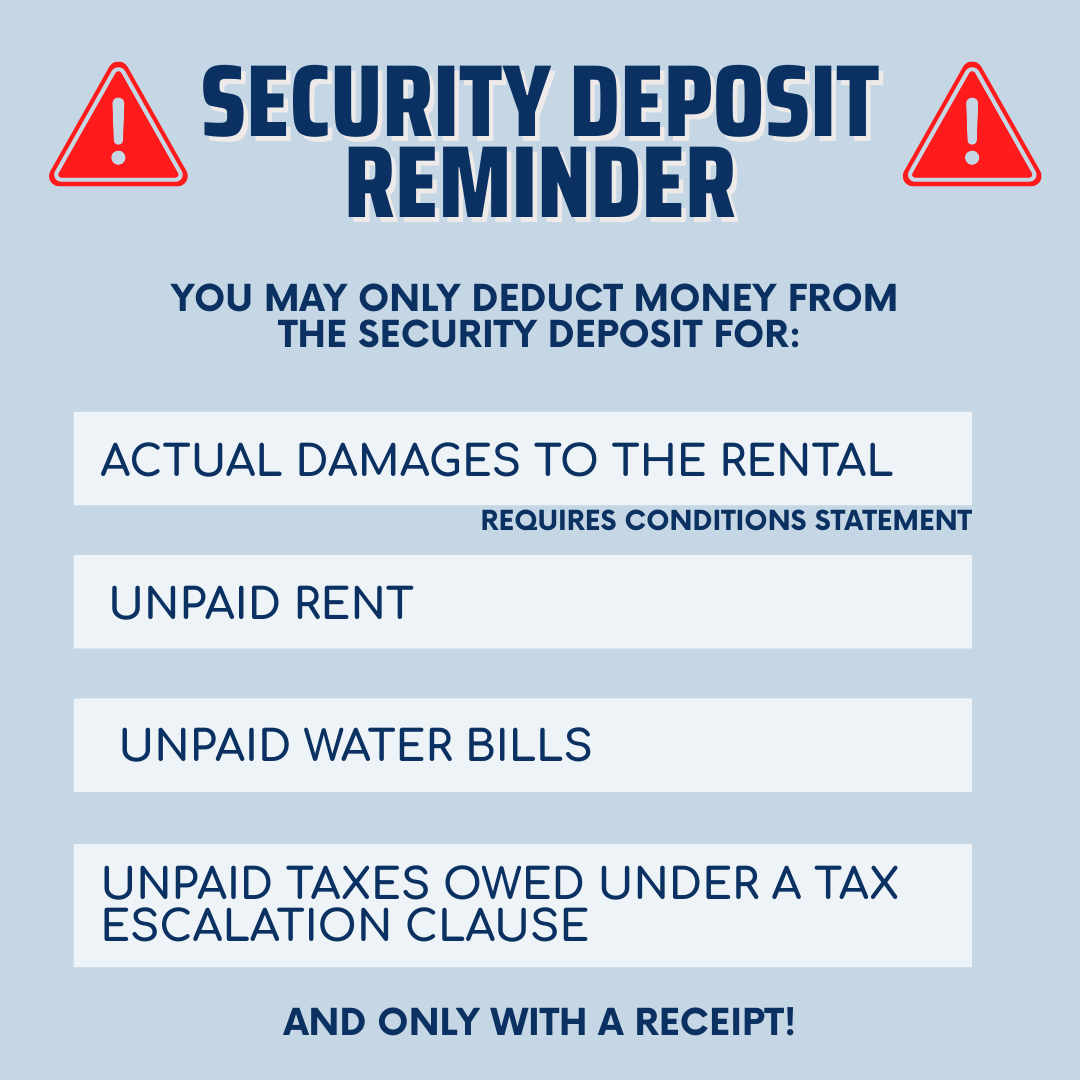
Avoid costly fines and court by remembering the limitations on security deposit withholding. (Image License: CC BY-SA 4.0 MassLandlords, Inc.)
Other Practices Ran Afoul of Security Deposit Law
The Massachusetts security deposit law prohibits landlords from withholding all or part of the security deposit for anything other than actual damages to the unit (excluding reasonable wear and tear), unpaid rent, unpaid water bills and unpaid taxes owed under a tax escalation clause. Green Ocean, however, allegedly deducted a “lease break fee” from the security deposit for renters looking to terminate their rental agreement early, as well as actual damages. (The attorney general cited Chapter 186 Section 15B.)
Green Ocean reportedly also charged renters constable fees, office fees and penalties for late rent before the 30-day grace period was over. Their leases had verbiage that stated they would charge tenants for court charges and other legal fees before any amount had been awarded by a judge. (The attorney general cited Chapter 93A Section 2, saying that this was unfair.)
Perhaps most egregiously, the statement alleged that Green Ocean allowed company representatives who were not attorneys to file lawsuits and represent Green Ocean in housing court. (The attorney general cited her own regulation, which does not provide a legal citation; she ought to have cited Chapter 239 Section 1, which states who has standing to bring a case.)
AGO’s Statements Concerning Late Fees Not Backed By Law
It is routine practice in the industry to maintain one total balance owed and not to maintain two separate ledgers: one for rent, one for late fees. It is also routine practice to apply late fees as interest to this one balance, which is to say, stacked or pyramiding. General Law Chapter 186 Section 15B explicitly contemplates that late fees may be applied as interest.
AGO’s Statements Concerning Renter Insurance Not Backed By Law
The statement released by the attorney general’s office did not specifically allege that Green Ocean’s rental agreements required tenants to obtain renters’ insurance through specific companies. However, in the section titled “Assurances and Undertakings,” which specifies the actions Green Ocean must take to comply with the settlement, there is the following verbiage:
“In the event that Green Ocean requires Tenants to maintain a rental insurance policy in the course of their tenancy, Green Ocean shall not require Tenants to obtain rental insurance by or through Green Ocean at the exclusion of other insurance providers, or require payment by the Tenants for insurance beyond the actual cost of any insurance purchased.”
This statement implies that landlords are able to require their renters to obtain renters’ insurance policies as long as they do not restrict their tenants to using a certain company.
However, there is nothing in state law that allows the attorney general to grant this concession to Green Ocean, especially since that is not something the average landlord is allowed to do. We have cautioned our members to encourage, but not require, renters’ insurance. That’s because this is a gray area of the law, and Massachusetts is so strict about what landlords can collect at move-in.
Statements About Broker Fees Not Backed By Law
Green Ocean was charged with unlawfully collecting broker fees. Requiring renters to pay fees for a broker the landlord hired has been illegal since the 1970s, and made explicit in 2025. The only time a renter should be paying a broker fee is when they hired the broker to help them find a rental.
Nevertheless, the attorney general’s office wrote the following:
“Notwithstanding the foregoing, Green Ocean is not prohibited from seeking recovery of a broker fee as actual damages in the case of early termination (or breach) of an existing lease by a Tenant where Green Ocean mitigated its damages by securing a replacement tenant which required payment by Green Ocean of a broker fee.”
In other words, if a renter breaks the lease early, and Green Ocean uses a broker to fill the vacancy, the company would be allowed to bill the former renter for the broker fee. At MassLandlords, we recently removed this clause from our lease to avoid this scenario, which we feel is not in compliance with the law.
Under a standard rental agreement, the renter is notionally required to pay rent for the entire duration of the agreement.
Some judges in the past have been swayed by legal services arguments stating that the landlord has a duty to mitigate a renter’s losses by re-renting the apartment if possible. There is no citation for this. The one thing we do have a citation for is Chapter 112 Section 87DDD1/2, which says a broker fee in this scenario will be paid for by the lessor.
Conclusion
Any charges other than rent should be included in the apartment listing so that they were disclosed prior to lease signing, even prior to a renter’s decision to apply. Otherwise, it could be considered unfair and therefore a junk fee. Furthermore, the law explicitly disallows certain fees landlords might wish they could charge. Do not charge them.
The charges against Green Ocean are numerous and clearly appear to violate Massachusetts housing law. The company did not admit wrongdoing, which is common: Individuals and companies often settle out of court because it’s cheaper than a drawn-out litigation. They’ve agreed to pay a half a million dollars and stop the unlawful practices the attorney general reportedly found.
That said, two of the attorney general’s orders for Green Ocean conflict with existing law and grant special privileges to Green Ocean that the average landlord or property manager does not have (the ability to require renter’s insurance and the ability to charge for a renter for the landlord’s broker post lease-break). This not only sets Green Ocean up for possible future challenges, but it creates confusion for smaller landlords who rely on the state to promote lawful practices.