The State Sanitary Code
Learn More
Also known as 105 CMR 410, the state sanitary code sets the standards by which shelter in the Commonwealth is to be judged. Its official title is "Minimum Standards of Fitness for Human Habitation."
All apartments should comply with the state sanitary code. You will probably only encounter the code under two circumstances:
- You are a diligent landlord seeking to comply with the laws of your own accord.
- You had a tenant call the board of health on you.
The code is about 30 pages and has, the last time we counted, 270 unique inspection points. Some of these inspection points, like outlets, have multiple inspection locations within an apartment. There are literally hundreds of places in each unit where you could be fined for non-compliance.
The state sanitary code is different from the building code. The state building code, which derives from the International Building Code, applies to new, permitted construction. The state sanitary code applies to all rentals all the time.
There are times when the sanitary code will reference the building code. This is often for things such as fire safety. For example, the sanitary code says that rooms must have the proper number of egresses, which is outlined in the building code.
Jump to
- Sanitary Code Basics
- Square Footage Requirements
- Past Presentations
- The State Sanitary Code on Building Signage
Compliance with the State Sanitary Code Is Very Important
You should strive to make sure your rentals are in compliance with the sanitary code. First, and foremost, everyone deserves a safe, healthy place to live. When we become housing providers, we take on the responsibility to provide that.
If you are not on top of compliance, and your tenant discovers an issue, they can lawfully withhold rent until you make the necessary repairs (MGL Ch. 239, Section 8a). They could do the repairs themselves and deduct the cost from their rent (also lawful, MGL Ch. 111, Section 127L).
If you do not follow the sanitary code, you could run into trouble if you ever need to evict your renter. You file the eviction for nonpayment, and your renter counterclaims. They tell the judge their apartment has mice, or the kitchen has mold, or the hot water isn’t reliable…you get the idea. This is almost certain to add weeks or months to your summary process time.
Evicting after sanitary code complaints could be seen as retaliation.
If your tenant asks for an inspection and you need to terminate their tenancy for any reason within six months of that inspection (even if you make the repairs right away), your tenant can claim that you are retaliating against them for reporting you. Retaliation is unlawful, and it can be tricky to prove you weren’t retaliating by ending their tenancy, even if you have a good reason. Do your best to avoid these issues by following the sanitary code and fixing issues as soon as possible.
Basic Points of the State Sanitary Code
The state sanitary code is very detailed. If you have concerns about a certain aspect of your rental, or are planning a major renovation, you should go through it to make sure you are not missing something. These are just a few of the more important points to pay attention to.
Note: The state made many changes to the sanitary code in 2023 that are beneficial to read about. Updates include what to do about mold, landlord availability, and kitchen requirements.
Kitchens and Bathrooms
Every dwelling unit must have what we think of as a kitchen, a bathroom, hot and cold drinking water, heat, windows, electrical outlets, lights, ventilation, and waste plumbing.
The Sanitary Code states that kitchens must have a stove and an oven. Landlords used to only have to provide space for a refrigerator, but as of 2023, you must provide a fridge with a freezer, and at least 11 cubic feet of combined storage space. (If your renter wants to bring their own fridge, the lease must state that.)
As of 2023, you must have a waterproof seal behind your kitchen sink. That means a “smooth, non-absorbent, and easily cleanable surface” that, where practical, extends 24” up the wall. It must have a waterproof seal with the countertop, which can be done with caulk. You don’t need to use tile, but you can’t have wallpaper or unfinished drywall, either. It can be gypsum board, as long as it’s applied properly and coated with paint or another appropriate sealant.
The kitchen floor must be waterproof, smooth, non-corrosive and non-absorbent. Wood floors are only allowed if they have a water-resistant finish. They also cannot have cracks that can accumulate debris or allow pests to live. This also applies to pantry floors, if your rental has one.
Each unit must include at least one toilet, one washbasin (this cannot be the kitchen sink) and one bathtub or shower in a separate bathroom. Privies and chemical toilets are prohibited except with Board of Health permission.
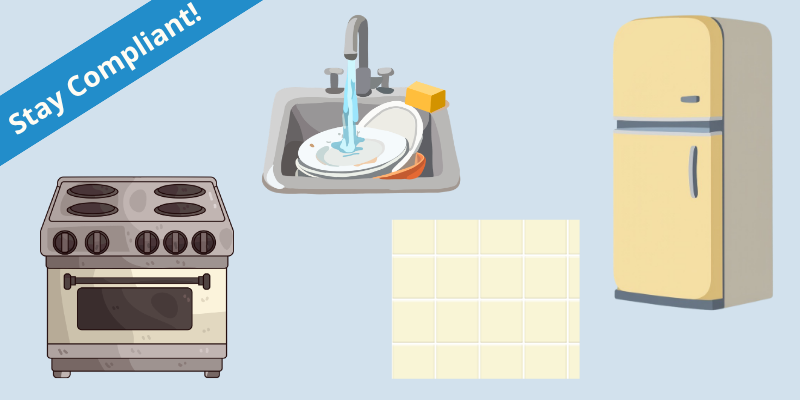
Make sure your rental kitchens have (among other requirements): A sink with hot and cold water, appliances that meet sanitary code standards, and waterproof floors and backsplashes. (Image License: CC BY-SA 4.0 MassLandlords, Inc.)
Asbestos and Lead
If asbestos is in a friable (crumbling) condition, then it is hazardous and must be remediated.
If lead is in a hazardous, unremediated state, then children under the age of six cannot live there, but landlords cannot discriminate against families with such children: Landlords must delead. This can be an expensive, time-consuming process and is best done between tenancies whenever possible. Tax credits are available for deleading. In 2023, we helped double the deleading tax credit to $3,000 per unit. It’s not enough, but it’s a start.
Utilities
Utilities must be somehow metered or included in the rent. If you have a multifamily building, you cannot charge your renters separately for water unless your water is properly submetered. This means every unit is on its own water meter, and common areas are separate.
The same is true for electricity. Every unit should be on its own meter unless you are including electric in the rent, and common areas should be on their own meter as well.
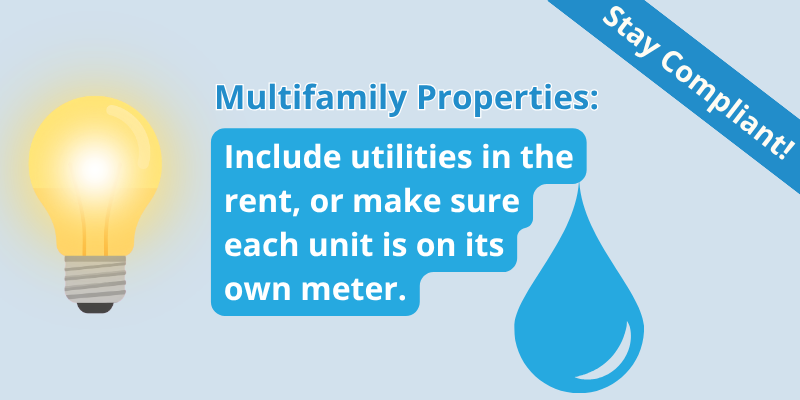
Don't separately charge your multifamily renters for utilities unless everything is properly metered. (Image License: CC BY-SA 4.0 MassLandlords, Inc.)
Safety Matters
You must provide adequate ceiling height, square footage, and freedom from below-grade dampness.
You must have the appropriate means egress, handrails, smoke detectors and carbon monoxide detectors.
You must keep the premises free of vermin. The law requires landlords inspect for pests and vermin before a new tenancy begins. After the tenancy starts, you must maintain the property so pests and vermin cannot get into the unit. In a single-family home, the renters are responsible for pest control as long as you have kept the building properly maintained. In multifamily homes, you are responsible for pest control at all times.
Along with making sure your building is not an open door to wildlife, insects and other pests, you must keep the structure in good repair and weather-sealed to a reasonable extent. This includes providing window screens, and screens for certain doors.
Garbage and rubbish must have temporary storage on the premises and be removed somehow.
The board of health may enter the premises following a request for an inspection from anyone.
Square Footage First Requirements
Realtors talk about square footage including bathrooms, porches, hallways, and sometimes basements. Not so for the state sanitary code. Bathrooms, porches, hallways, and all closets and storage areas are not counted for the purpose of calculating occupancy.
This example comes from Springfield. Suppose we have a two bedroom townhouse (click to zoom):
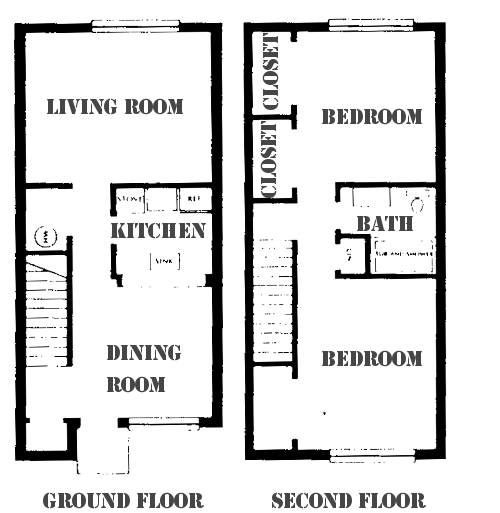
Square Footage Example
How the state sanitary code calculates footage.| Room | Measured Size | Size in Feet | Square Feet (sf) |
|---|---|---|---|
| Bedroom | 10'2" x 11'2" | 10.17 x 11.17 | 114 |
| Bedroom | 9'10.5" x 12'3" | 9.88 x 12.25 | 121 |
| Kitchen | 6'5" x 7'6" | 6.42 x 7.50 | 48 |
| Living room | 13'3" x 11'2" | 13.25 x 11.17 | 148 |
| Dining room | 9'6" x 9'9" | 9.50 x 9.75 | 93 |
| Total | 524 |
Since this townhouse has 524 sq. ft., the legal occupancy is only four:
| Sq. Ft. | Legal Occupants |
|---|---|
| 150 | 1 |
| 250 | 2 |
| 350 | 3 |
| 450 | 4 |
| 550 | 5 |
The parts of the code used to calculate this example are found in Section 410.400 and subsequent. The definitions for a habitable room are in section 410.020.
Square footage for sleeping areas
The sanitary code also has minimum square footage requirements for sleeping areas. There must be at least 70 square feet of sleeping area for the first occupant, 100 square feet combined for two occupants, and 50 additional square feet for each additional occupant.
Changes April 2023
Learn More
You should know the code forward and backward, because the above summary doesn't explain the details. Some rules apply to four unit buildings and up, some rules are much more specific than we've indicated here.
Read the state sanitary code (105 CMR 410).
The State Sanitary Code on Building Signage
If you are a landlord who does not live in the same location as your rental unit, and you do not have live-in management onsite, you are required to let your tenants know who you are and how to get in contact with you. The state sanitary code is very specific about how you must do this.
The sign you post must be no less than 20 square inches in size and has to include your name, address, and telephone number. The sign must be posted either by the mailboxes in your rental building or somewhere inside that is visible to the residents. The state sanitary code further states the sign must be made of a “durable material” and maintained, either by you or someone you designate to maintain it.
ut
If the building is owned by a partnership or trust, your sign must include the contact information for the managing trustee or partner. If it is a corporation that owns the dwelling, the name, address and telephone number of the corporation’s president must be on the sign. Furthermore, if you appoint a property manager who also does not live in the building, the sign must also include that person’s name, address, and telephone number.
Numbers
In order to allow emergency services to easily identify your building, you must put a number on the front of it that corresponds to your address. The sanitary code does not tell you what material your number must be made from, or specify a certain height, though it does say that it must be made of a “nature and size and be situated on the building so that… it is visible from the nearest street providing vehicular access.”
Emergency Lighting and Signage
If your rental property has 10 or more units, you also must provide emergency lighting and signage that is not part of your regular lighting system. These lighted signs must indicate both a primary and alternative exit to the building, and must include a diagram or signal so non-English speakers can still easily understand it. (Think of the common pictogram with a fire, a person walking, and an open door.)
Neglecting to follow these directives puts you in violation of the Massachusetts sanitary code, which can have negative consequences for landlords. It can be a minor inconvenience to the person looking to contact their landlord or property manager, or the delivery driver looking to find your building. But it can also pose a serious safety issue if your tenants cannot leave the building quickly in an emergency or be located by fire, ambulance, or police. Consult your attorney if you have concerns about being in compliance with this regulation.
Past Presentations
- Statewide 2022-10-18
- Statewide 2022-03-09
- Statewide 2021-10-14
- Worcester 2020-09-09
- Cambridge 2020-01-21
- Cambridge 2019-11-19
To view all of this presentation, you must be logged-in and a member in good standing.
Log in or join today and gain access all presentations and videos