
By Kimberly Rau, MassLandlords, Inc.
The Executive Office of Housing and Livable Communities announced, starting July 1, 2026, landlords participating in the Massachusetts Rental Voucher Program (MRVP) would be limited to 3% annual rent increases, citing requirements from the state Legislature and “unsustainable increases in subsidy amounts.” All new payment standards will be in effect by Dec. 1, 2026. Some started earlier.

Recent changes to the Massachusetts Rental Voucher Program restrict landlords to 3% annual rent increases. (Image License: Khay Edwards for Unsplash)
The changes affect MRVP, as well as the Alternative Housing Voucher Program (AHVP), both of which are state-funded. Federally funded voucher programs, including Section 8, are not affected by the change, which was announced in April 2026.
“We understand that changing these policies may limit rental income,” the letter from the EOHLC states. “We are also making changes that may increase the amount households pay in rent. We made these choices to ensure that MRVP and AHVP can continue to serve as many households as possible given limited funding.”
As of 2025, more than 10,700 renters in Massachusetts participate in MRVP, and more than 168,000 applicants are on the waiting list, which the state estimates is “over five years.” New applications are no longer being accepted, so the wait time is actually infinite.
Changes to Contract Rent Standards for Recertification Also in Effect from December 2026
Landlords participating in MRVP are allowed to set an initial contract rent that is based on the fair market rent for their area. The state aligns these applicable payment standards with the fair market rent set by the federal department of Housing and Urban Development (HUD) for its voucher programs. New applicable payment standards were just released by the state. They became applicable for new leases or relocations on Oct. 1, 2026, and will apply to recertifications starting Dec. 1, 2026.
“The new applicable payment standard shall be applied at regular, annual recertification regardless of whether the payment standard has gone up or down,” the state website announced. “MRVP households are no longer held harmless if the payment standard decreases.”
In other words, if the market rate in your area drops, your rent could also drop, even if your tenant isn’t leaving. The tenant will have to pay the difference and it’s rarely the case that MRVP renters have any extra household budget.
Nothing in this new announcement suggests the program is walking back the 3% rent cap.
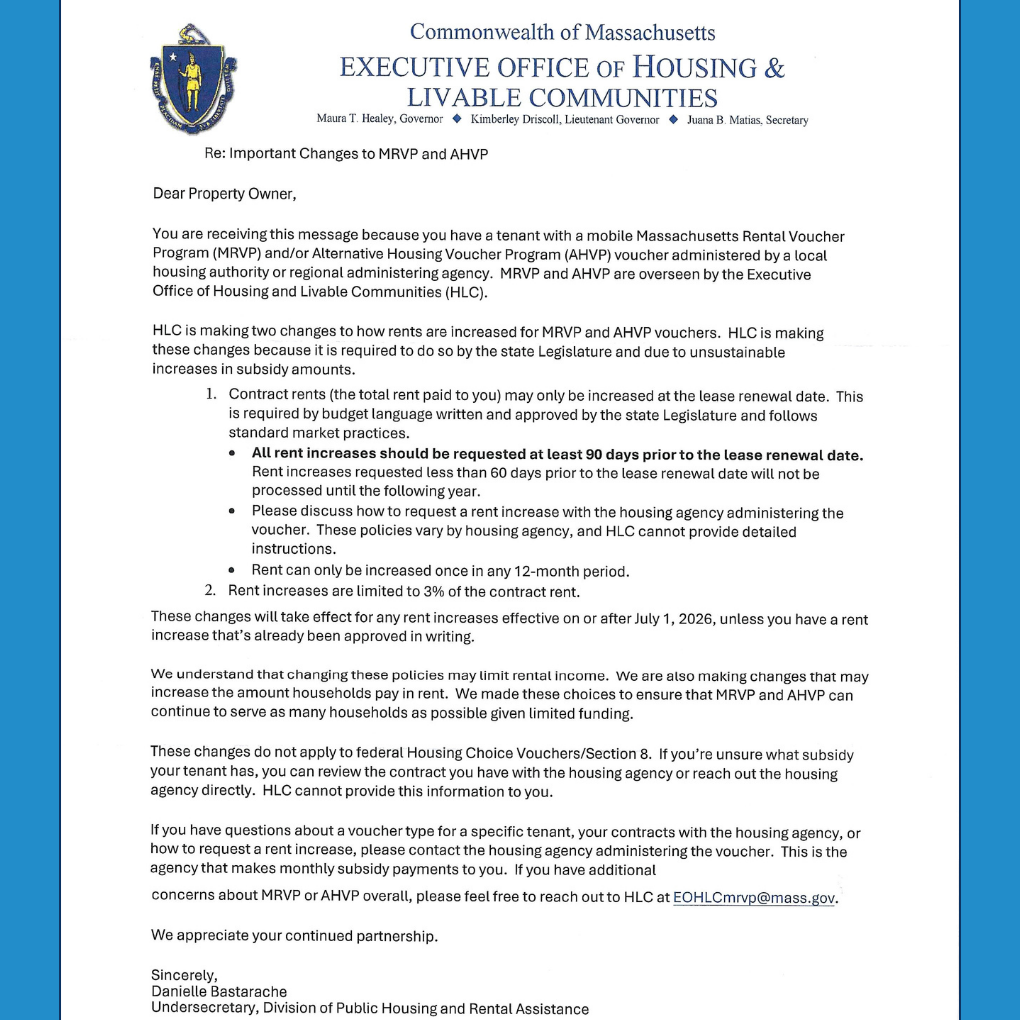
The letter from the Executive Office of Housing and Livable Communities states any rent increases after July 1, 2026, are limited to 3% or less. (Image License: CC BY-SA 4.0 MassLandlords, Inc.)
How To Request a Rent Increase
Rent increases for MRVP participants can only be done at the time of lease renewal, similar to households without a voucher. Rent increase requests must be made with the applicable housing authority at least 90 days before the renewal date. Requests made less than 60 days prior to renewal will not go in effect until the next year.
Landlords can only increase the rent once in a 12-month period, and are limited to rent increases of a maximum of 3%.
Your request could be denied. And, given the verbiage announcing the new fair rent standards, you could find yourself having to accept a lower rent at recertification if the market has dropped around you.
Are the New MRVP Standards Rent Control?
A 3% rent cap, regardless of what the market around you is doing, looks a lot like rent control, especially since the standard agreements for the program do not let landlords evict renters without cause.
If you could evict without stating a cause, then it would be easy to simply end the tenancy and start a whole new rental agreement, which would allow you to set a new contract rent. Per the MRVP Lease Addendum, these are the only reasons why landlords working with MRVP may end a tenancy:
- The tenant doesn’t pay their portion of the rent.
- The tenant is interfering with the rights of other tenants.
- The tenant causes “serious damage” to the rental unit or common areas.
- The tenant is a threat to the health or safety of other renters, the landlord/owner, or people working for the owner.
- The tenant violates some part of the lease.
- “Other good cause” after the initial lease term is up. This includes the renter rejecting the terms of the new lease at renewal, or the landlord needing the rental unit for their own use.
The last point does not apply to project-based MRVP vouchers, but for private landlords accepting vouchers, it is the only “no fault” termination option they have. Other than that, you cannot end the tenancy unless the renter doesn’t pay their portion of the lease or otherwise violates the rental agreement. This effectively locks you into a 3% maximum rent cap at renewal.
Changes Punish Participating Landlords
It is unlawful in Massachusetts to refuse a renter because they participate in a state or federal housing voucher program. That said, it can be very difficult for renters with mobile vouchers to find housing with private landlords.
The reasons for this can vary. A 2025 article from The Boston Foundation states “…fully one-third of MRVP tenants say it took them four months or more to find an apartment.” Landlords and renters cite administrative hurdles as a primary cause, though both demographics expressed overall satisfaction with the program.
Locking landlords into 3% increases may make more housing providers shy away from the program, especially if they have to wait to get a participating renter in place. While it would still be unlawful to refuse an applicant, other qualified candidates are likely to apply in the space of time between application and approval.
Key Takeaway
This change is unlikely to affect many landlords, as most renters in Massachusetts do not participate in MRVP. However, the housing providers who do have renters with vouchers may find themselves stuck with minimal rent increases, and little recourse to end the tenancy.
There’s more to this article.
MassLandlords members can continue reading.
- Learn how to work around the rent increase restriction.
- Understand how to end an MRVP tenancy.