
MUC Acquires Its First Parcel, Launching Statewide Educational, Environmental Mission
| . Posted in News - 0 Comments
By Eric Weld, MassLandlords, Inc.
When MUC, the Massachusetts Urban Conservancy, an offshoot of MassLandlords, signed closing documents at the beginning of July for a property in Randolph, Mass., it officially embarked on its mission of acquiring unbuildable lands donated by members and putting them to their best use.
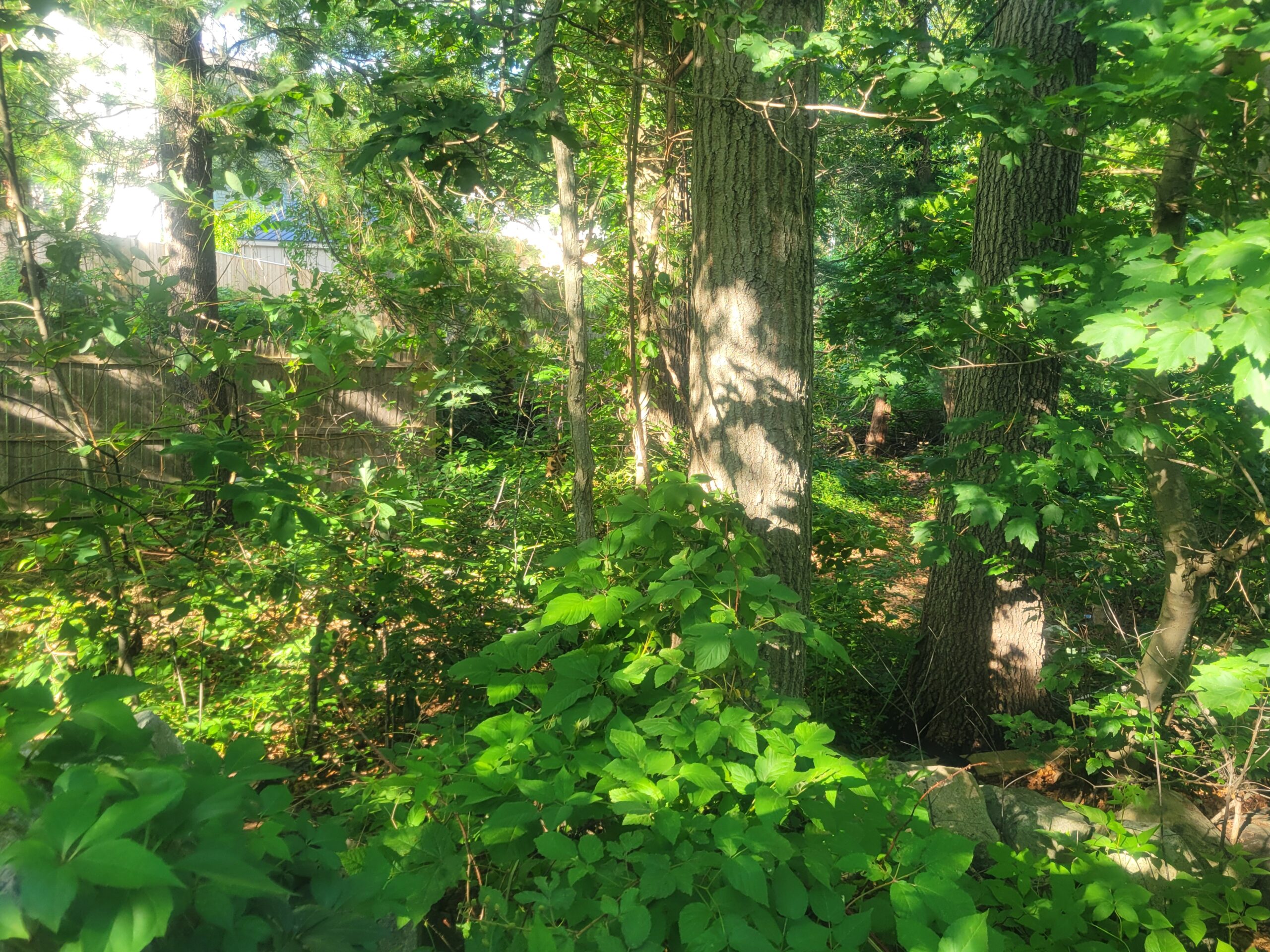
This sliver of unbuildable land, in a residential neighborhood in Randolph, Mass., now belongs to the Massachusetts Urban Conservancy (MUC), an offshoot of MassLandlords, the nonprofit’s first acquisition. MUC plans to remove invasive vegetation and plant native plants and trees, restoring biodiversity and pollinator habitats, and open the parcel for public enjoyment and nature education for local students. If you own an unbuildable chunk of land, and are tired of paying taxes on it year after year, donate it to MUC; email eweld@muc.bio. Image: CC BY-SA MassLandlords
As in the case of its new Randolph property, MUC aims to remove the burden of unbuildable plots of land from their owners and use the sites for educational purposes, and to bolster their environmental health.
With the Randolph acquisition completed, MUC now turns to a list of MassLandlords members who wish to also donate their unused land to our mission. These members recognize the opportunity: They will rid themselves of the annual tax burden, as well as the costs to maintain and, in some cases, insure the land, while knowing it will be used to help educate students, improve neighborhoods and help the environment.
The Randolph parcel, a small sliver of wooded land on Millhouse Avenue, was generously donated to MUC by the Sudnovsky Family Trust, which owned the lot for more than 50 years.
MUC worked with trust executor Don Sanders, who expressed the trust’s wish to transfer the land to someone who would retain it as undeveloped, semi-wild green space. Sanders was the first to respond to MUC’s original outreach to landowners to donate their land to MUC and realize the benefits of doing so.
Our offer to donate unbuildable land remains open to MassLandlords members in good standing. If you’re an owner of unbuildable land, stuck paying taxes on it year after year, and maybe maintaining and insuring it, join our waitlist of land donors. You’ll soon have the opportunity to save potentially thousands per year, and we will ensure the land remains a vital piece of undeveloped urban green space forever. Send an email to eweld@muc.bio if you have land you’d like to donate to MUC.
MUC was enabled to acquire the Randolph property with assistance from a grant from the state Executive Office of Energy and Environmental Affairs, received in May 2026. The grant paid for legal costs, and will support surveying and environmental assessments.
The grant is supplemented by funds raised in summer and fall 2025 through a GoFundMe crowdsourcing campaign.
Focus On Environmental Education
In particular, MUC focuses its mission on land parcels in environmental justice communities such as the one in Randolph. We aim to restore biodiversity and pollinator habitats on the land parcels while inviting the public to enjoy the green space, and young students to use it for environmental education.
We also plan to partner with nearby schools in Randolph and other communities to develop science and environmental education teaching units using our properties as living laboratories.
We invite connections with educators across the state to work with us, through our donated lands, to craft curricula around science topics such as urban ecology, animal behavior, biogeochemical cycles, tree growth, interactions among ecosystem organisms, and more.
Young students, many of whom may rarely step into natural, undeveloped land, will have an opportunity to see, touch, smell and hear nature in action, and learn about natural phenomena right in their backyards.
If you have connections to educators in your region, let us know.
Next Steps
With ownership secured of its first land holding, MUC will now take steps to stake the lot and assess its soil and vegetation. This will help determine any further environmental actions needed.
We continue to seek additional funding to support our plans to acquire more land, and to remove invasive vegetation from the Randolph property. We know from visual inspection that the newly acquired lot contains knotweed, a highly invasive, non-native plant that muscles out other plant species and reduces diversity. It also contains other non-native vegetation.
Once cleared of invasive plants, we plan to plant native species that will balance and enhance the diversity of species there, as well as invite pollinators by offering food for native animals and insects. More plant and animal species diversity translates to a healthier ecosystem that ultimately affects humans’ consumption of food, medicine, clothing and other plant-derived products.
First Of Many
The Randolph property we just secured is the first in a series of unbuildable, urban parcels statewide.
We call on MassLandlords members to help us (and help themselves) in providing and protecting semi-wild green spaces in cities, where residents can experience nature right in their neighborhoods. In too many cases, urban residents, especially those in environmental justice communities, do not have access to greenery – trees, bushes, flowers, pollinating animals, natural shade and emitted chemicals, like phytochemicals, that help strengthen immunity – and its many benefits.
We want urban dwellers to see, walk through and experience wooded, undeveloped space with all their senses without having to drive out of the city, and reap its benefits for their lives and their children’s lives.
MUC is one of very few conservancies to focus on urban areas. Large tracts of land are protected in rural, non-urban regions, many of them owned by well-established conservancies and land trusts. We applaud the work of these organizations for their contributions to the environment.
But cities are where most people live, and where biodiversity and pollinators are disappearing fastest, robbing residents of opportunities to ever be in nature. MUC aims to offset that detriment by acquiring unbuildable urban lots and making sure they remain unbuilt, green nature preserves for residents there to enjoy.
Our newly acquired property in Randolph is the beginning of that long-term objective.
Are you paying for and maintaining unbuildable land? Join our mission, contact us today about donating your land to MUC.
Send an email to Eric, President if you have land you’d like to donate to MUC.