
Landlord Basics: Move-In Money for Massachusetts Rentals
By Kimberly Rau, MassLandlords, Inc.
Massachusetts law is clear that there are only certain fees and deposits a landlord can collect at the start of a new tenancy. This article will provide a basic overview of those lawful fees, as well as a quick recap of fees that are unlawful.
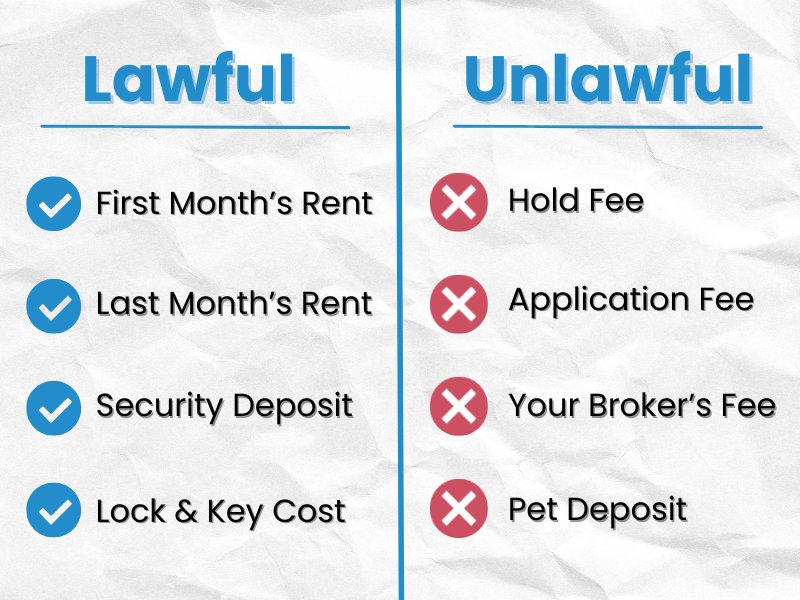
Massachusetts allows landlords to collect only certain fees and costs at move-in. Make sure you’re not charging for unlawful things. (Image License: cc BY-SA 4.0 MassLandlords, Inc.)
We recommend you collect at least some of the allowed move-in costs. These fees/deposits should be collected before lease signing, after you have already screened and approved your new renters. (We say before lease signing because ACH transfers require two days to clear. Personal checks can take up to 10 days. If your renter wants to pay when they sign the lease, they should bring a bank check or money order. Do not let anyone move in without paying at least the first month’s rent.) All applicable receipts and paperwork can be found on our forms page.
Lawful: First Month’s Rent
This one is self-explanatory. This is the first full month of rent, at whatever price you advertised the unit at.
You should collect the first month’s rent in full, even if the tenant is moving in after the start of the month and you plan to pro-rate it. Pro-rate the second month instead. That way, the requirement to come up with move-in monies applies equally to all renters regardless of move-in date.
Lawful: Last Month’s Rent
This is prepayment of the last month’s rent, which cannot be more than the regular monthly rent rate.
Unlike the security deposit (more on that in a moment), the last month’s rent belongs to you, not the tenant. We caution you against spending it before the last month actually comes up, however. You never know what might happen.
If you collect this charge, you have to provide your renter with a receipt, as well as an annual interest statement. You do not have to place the last month’s rent in a separate bank account.
Read a more in-depth article about last month’s rent, which includes a section about paying out interest.
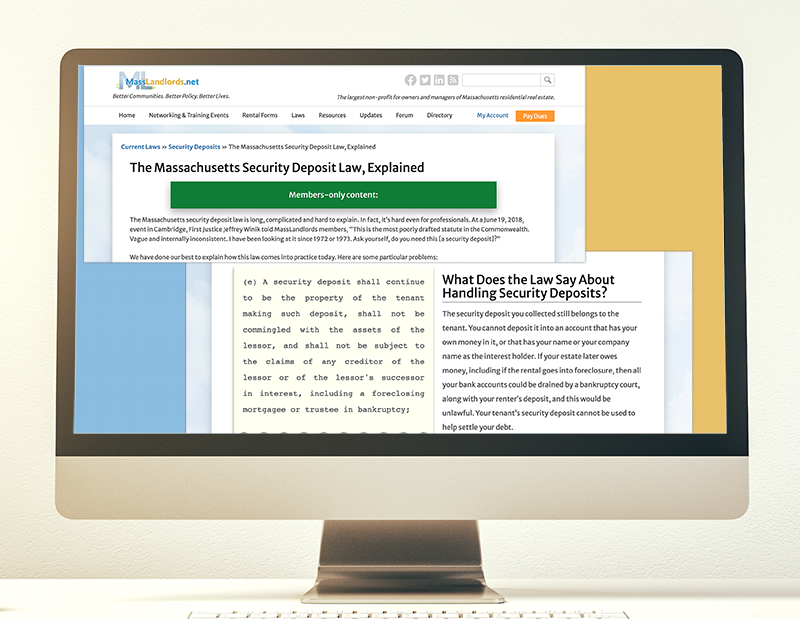
If you are going to take a security deposit, make sure you understand exactly what the law requires. (Image License: cc BY-SA 4.0 MassLandlords Inc, derived 123rf)
Lawful: Security Deposit
This is a fee that you collect as a damage deposit for the unit. It cannot be more than the first full month’s rent. It must be deposited in a separate, interest-bearing account in a Massachusetts bank, in the tenant’s name.
You must issue a receipt for this, along with a conditions statement. Every year, you must pay out the interest and issue an interest statement.
If after move-out, you discover something is or has been damaged, you can withhold money from the security deposit for the actual cost of repairing the damage. You cannot withhold money for reasonable wear and tear, or for a cleaning fee. You have 30 days to return the deposit. If you did not take a conditions statement at move-in, you cannot withhold anything from the security deposit.
Security deposit law in Massachusetts is so detailed we’ve already published a basics article about it, as well as an in-depth security deposit overview, and an explainer that breaks down the security deposit law into plain language. We also offer a brochure about security deposit law, because it’s vital you get everything right if you collect it. The penalties for making an error can be triple damages plus attorney’s fees.
If you decide to collect a security deposit, be very organized with your paperwork.
Lawful: Cost of Lock and Key
You can charge your renters the actual cost to have the rental unit re-keyed before they move in. This is true whether you are using old-school locks or electronic locks.
Some electronic locks may have a free way for you to re-code them yourself. If you need to call a locksmith, prices will likely fall within a certain range. For example, if you needed to call a plumber, you would typically be charged a site visit fee of around $200, and then $90 per hour for the service you needed. We searched online for various locksmiths and found similar pricing structures. Expect to pay around $200, with some variation.
Unlawful: Pet Deposits, Hold Fees, Most Broker Fees, Application, Background and Credit Check Fees
You may see other landlords advertising rentals with other fees attached. These are likely unlawful in Massachusetts, which bans landlords from collecting anything other than the four fees/deposits listed above. Recent “junk fee” regulations make this even clearer.
You cannot charge an application fee. We’re still not sure how sites like Zillow get away with this. (Renters who want to apply for any rentals through Zillow must pay a monthly fee, which sure sounds like an application fee to us.)
You cannot charge your applicants for background checks or credit checks. You should still do both, but consider it the cost of doing business. It’s a lot cheaper than what an unscreened renter might do to your apartment.
Pet deposits are unlawful, however, case law suggests that pet rent is fine, as long as you advertise that cost when you list your apartment. You cannot charge extra pet rent for service animals or emotional support animals.
Hold fees, that is, deposits to hold an apartment until an application is approved, are unlawful. This was recently affirmed via a decision from the state’s Eastern Housing Court. Instead of a hold fee, take the move-in monies.
It has always been illegal for anyone other than a licensed broker to charge a broker’s fee for a rental in Massachusetts. In the past, landlords who hired a broker would sometimes pass that cost onto their renters. A 2025 law makes that practice unlawful. However, if a renter hires a broker themselves, the broker can charge them a fee.