Landlord Basics: The Security Deposit in Massachusetts
By Kimberly Rau, MassLandlords, Inc.
Did you know you can collect money from your renter as a kind of protection against damage to your unit? It’s called a security deposit.
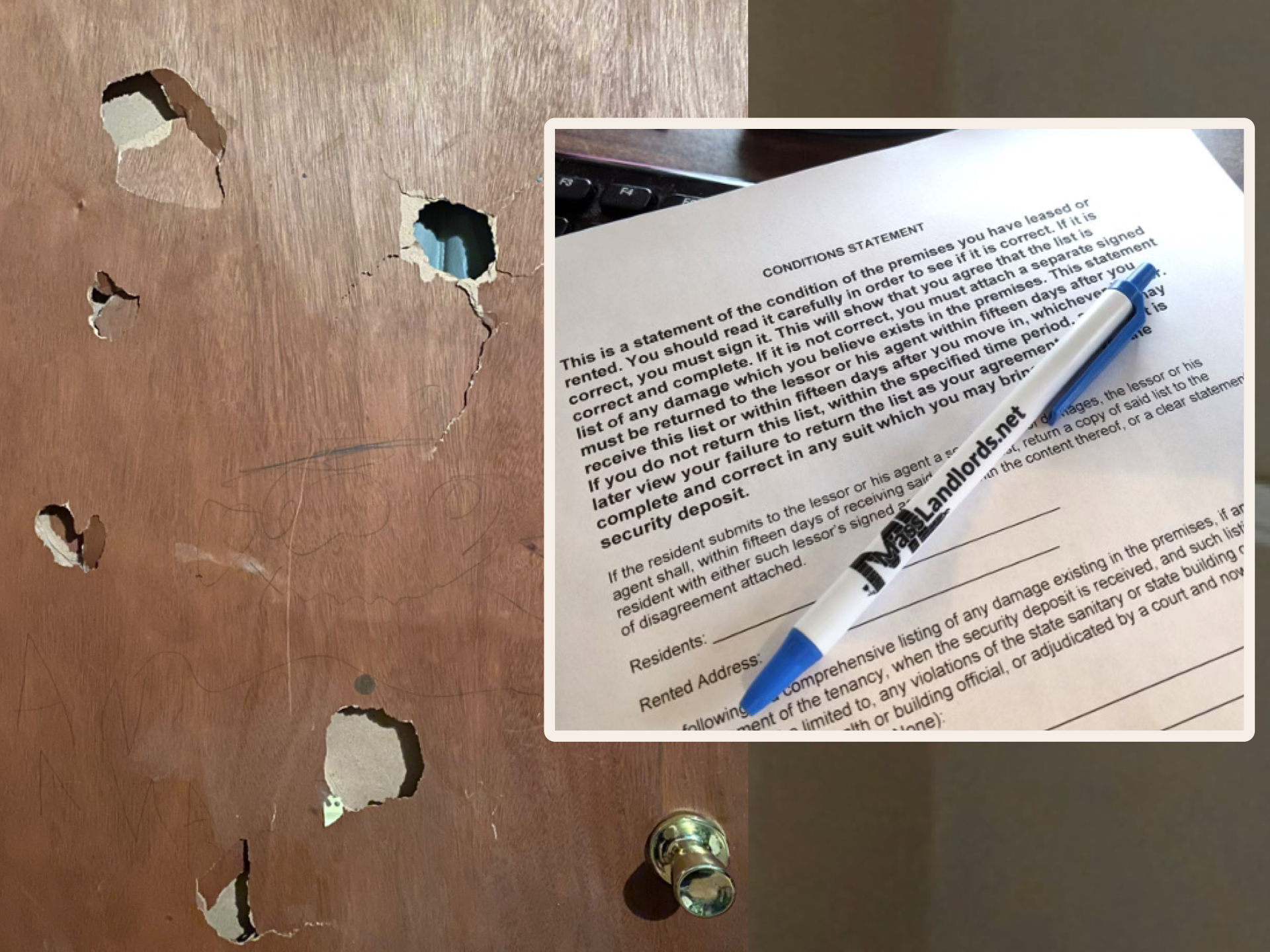
“It was like this when we got here!” A conditions statement is the only way to prove to the courts your renters did this after they moved in – and the only way to withhold money from the security deposit to pay for it. (Image: cc BY-SA 4.0 MassLandlords, Inc.)
There are things you have to know before you collect a security deposit. Unlike the rent you are paid each month, which belongs to you, the security deposit belongs to the renter. You are just holding onto it until their tenancy is over and they move out. Then, you will either return it to them, or take some or all of it to repair damage.
But you must be careful. If you mess up any part of handling the security deposit, your renter can take you to court. If the judge agrees with your renter, you might have to pay triple damages and attorney’s fees.
Taking a Security Deposit
You don’t have to take a security deposit in Massachusetts. If you do take one, the amount of the deposit cannot be more than the amount of the first month’s rent.
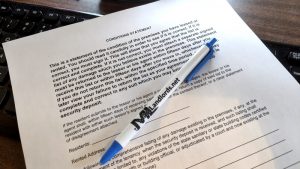
If you take a security deposit, you need a conditions statement. After you sign the lease, give your renter a statement that documents any damage or issues that already exist in the apartment. Your renter can read the statement and add problems if they find them, and return it to you. They have 15 days to do this. If your renter does not return the conditions statement, it is considered accurate and will hold up in court.
You cannot withhold anything from the security deposit without a conditions statement. If you did not provide that statement, and you try to charge your renter for damage, the court will say you have no way to prove the damage did not exist before the renter moved in.
Take the security deposit and deposit the entire amount in a Massachusetts bank account. The account must be interest-bearing, and must be a landlord-tenant account. This means the account is under the tenant’s name and social security number, with you as the signatory.
You have 30 days from lease signing to provide a receipt with the name and location of the bank, the amount of the deposit, and the bank account number.
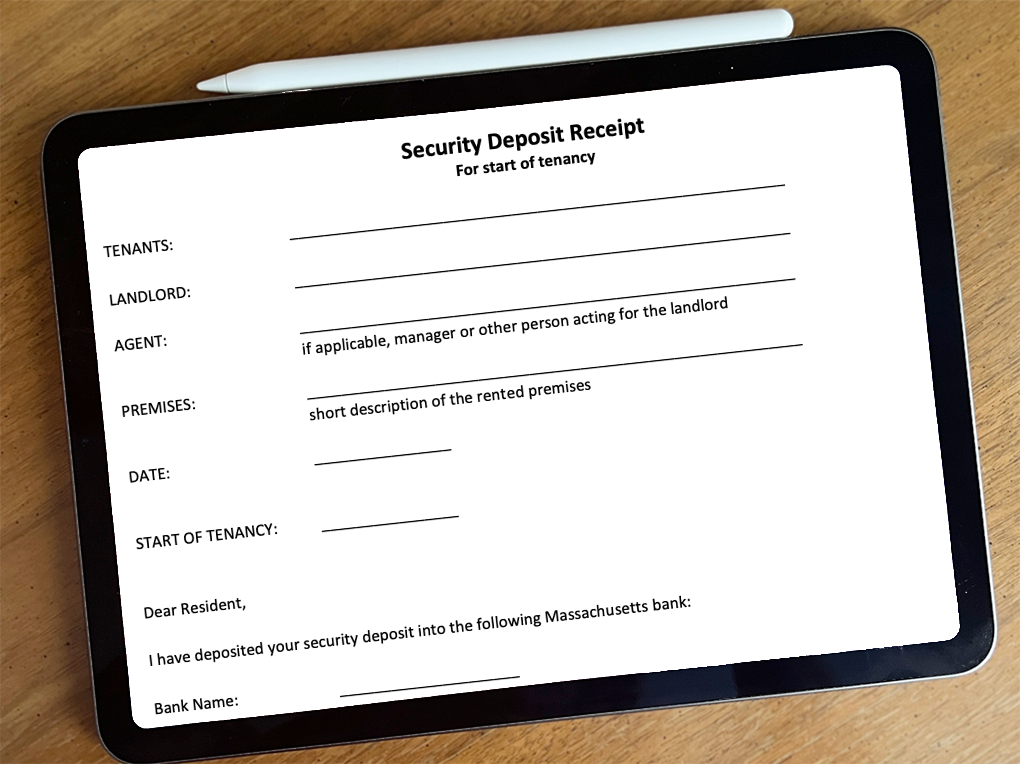
You do not have to take a security deposit. If you do collect one, you must give your renters a receipt with all the required information on it. (Image: cc BY-SA Jennifer Rau for MassLandlords, Inc.)
Maintaining a Security Deposit
Every year, pay your tenants the interest on their security deposit. This is either 5% or the actual amount paid by the bank, whichever is less (which will likely be the amount paid by the bank).
You also must provide an annual statement. This statement will have the same information as the security deposit receipt, plus a record of the interest earned.
Returning or Withholding a Security Deposit
When your renter moves out, inspect the apartment. Look at your conditions statement to see if there is new damage. If you did not provide a conditions statement, you cannot keep any money from the security deposit. Return all of it to the renter, including any unpaid interest from the deposit.
If there is damage, you can keep some or all of the money from the security deposit to pay for the repairs you need to make. You can only charge your renter for actual damage to the unit. Normal wear and tear doesn’t count. You cannot deduct cleaning fees.
You can only charge your tenant for the true costs of fixing the damage. Don’t guess or make up a number.
You must give your renter a signed statement that has all of the damage listed, along with the cost to repair it. Include receipts from things you had to purchase, and invoices from any professionals you hired.
The statement should have pictures proving the damage. When you give it to your renter, make sure the form says: “signed under the pains and penalties of perjury.” This is very important. If you do not include those words, a judge will probably not accept it if the case goes to court.
If there is money left after you pay for repairs, return that to your renter. If there is no money left, return the unpaid interest only.
You have 30 days from the end of the tenancy to do all of this.
If You Mess Up the Security Deposit
If you realize you made an error with the security deposit, don’t panic. If the tenancy is still ongoing, simply return the full deposit (with interest). If you want, you can then issue a conditions statement and take a new deposit.
If the tenancy is ending or has just ended, return the whole deposit with interest. You do not want to end up in court. The penalty for making an error is triple damages plus attorney’s fees. It’s not worth it.
This is a basic overview of security deposit law and best practices. It is meant to be an introduction to security deposits, or a refresher for experienced landlords. For in-depth learning and frequently asked questions, visit our main security deposit page, or read a line-by-line plain-language explainer of the entire law.