Why “Greed” Needs to Leave the Debate
. Posted in News - 0 Comments
Doug Quattrochi, Executive Director, MassLandlords
Imagine if landlords went to a State House hearing and described renters as high, loafing deadbeats just waiting for their next RAFT application. It would be extremely unwelcome, inaccurate, and counterproductive. But that is exactly the kind of invective renter advocates, and even committee chair Senator Cindy Friedman, dished out to landlords at the rent control hearing on March 17, and afterwards over email.
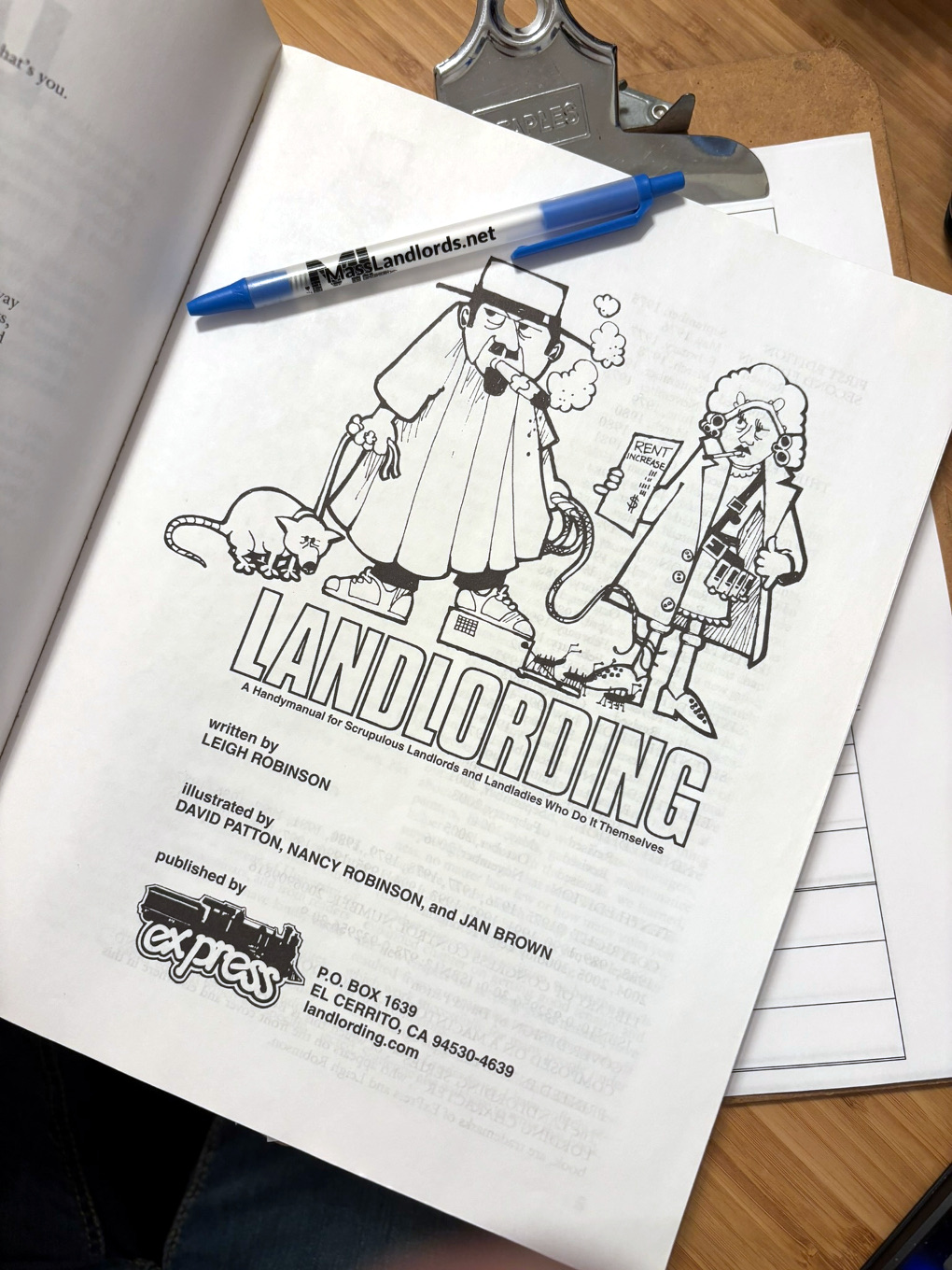
In 1975, Leigh Robinson published “Landlording” with illustrations preparing readers to be the brunt of a harmful stereotype that landlords are greedy and evil. This stereotype has played out so long few will now admit to their friends, family or coworkers that they own rental housing. There is less rental housing and fewer good landlords as a result. (Image: Fair Use Leigh Robinson, “Landlording,” 1975)
It happens on a regular basis – they say we are motivated by greed, that our corporations are evil, and that the housing crisis would be better solved if only landlords were more civil. That might score political points among some, but it reveals the renter advocacy side to be utterly lacking in ideas. They don’t understand how much housing costs, or which market forces drive and constrain housing, or what it means to be civil. They are being uncivil themselves, and factually wrong, to insist that greed is the major factor in the housing market. It is not. Supply is. And it’s not just supply of housing, but supply of all the factors that go into housing: credit, insurance, materials and labor included.
We’ve taken pains to explain the contexts in which large rent increases happen. See our related testimony, “Why Would a Landlord Raise the Rent 100%?”
It should go without saying that corporations are not inherently a problem. All the renter nonprofits that testify against corporate landlords are corporations themselves. A corporation is simply a legal entity where people associate for a common purpose, or where an individual seeks to separate their professional life from their personal life. Most real estate corporations are single-member LLCs, where a single person, perhaps with their spouse or partner, has sought a measure of professionalism and separation by incorporation.
It is wrong to imply or to state that corporations are anything other than our neighbors. The vast majority of real estate corporations are small and owned by Massachusetts residents. This fact is frequently overlooked, especially in pseudoscientific “studies” made to politicize rather than to understand. We take pride in providing housing. We like to see the results of our labor in the world, rather than on a computer screen. And we are not likely ever to have a real estate empire, despite our corporate form. Half of MassLandlords members own fewer than nine units. Two-thirds of all rental housing is owned by people who know their renters well enough that the decision to evict is socially inflected, meaning we agonize over it and delay until we can withstand whatever is going on no longer. This is the true definition of a small landlord: Do we know our renters? The vast majority of us do. The vilification of corporations per se, without regard to the fact that we know our renters and are part of our communities, is a gross and pernicious misstatement about our society and this very complex market.
Let’s consider for a moment what we indicate when we say landlords are greedy. What is the message to everyone else? It sounds to a landlord like, “Don’t save money, because wanting more money is greedy. Don’t buy a home, because owning real estate is greedy. Don’t provide rental housing, because collecting rent is greedy.”
These are unequivocally the wrong messages in this housing crisis. Not only does this tend to pit one group against the other, making actual policy work impossible, but it harms renters financially. They could instead hear, “Build financial independence for you and your family with a 3% down mortgage on a two-unit property; live in one half and help cover the bills with the other, and do the much-needed public service of operating rental housing.” That is the traditional message of homeownership, made attainable for people who otherwise do not have the income. And that is exactly who our members are. We are the people who couldn’t afford an acre in Weston, who bought our first rental property in Worcester because it was to be our home. I bought my three-decker because I could not square the numbers another way.
True, we have systemic barriers that mean not everyone will be a homeowner. There must be a robust safety net that covers everyone. This is why we spent years and tons of our own money litigating against the Executive Office of Housing and Livable Communities to show where RAFT failed pandemic renters. Is this greed, because we want the RAFT money? No, there was no possible way to recoup any of the lives lost or get that year back. No renter advocacy organization came to our assistance for fear of biting the hand that feeds them. And it’s a rational fear: A former Secretary of Housing is known to have placed an angry phone call at the slightest whiff of vocal dissent. Massachusetts’ housing policy climate is as rotten as any run-down shithole property. Our case failed at great expense. And we are the greedy ones?
Is it any wonder there aren’t more people clamoring to be housing providers, when the public rhetoric holds us to a standard that no nonprofit or other business is held to? All successful nonprofits have entire positions related to “donor development,” which is to say, getting more money. City Life Vida Urbana’s operating budget is 6x MassLandlords’ and they are sitting on 60x more assets. Mass Law Reform Institute’s budget is 20x ours and they sit on 254x more assets. Huge numbers of Massachusetts nonprofit managers make six figures or more. Elise Cherry of Blue Hub Capital, whose organization was found liable for violating consumer protection law and stealing people’s home equity, pulled down over a million dollars annually as personal salary and perquisites.
Somehow, none of these are greedy. Yet small housing providers, who have no such salaries, are the ones tarred and feathered for greed. We are oftentimes the only people in the room with enough money and financial cushion to actually keep rents below market, which we do. This is called “naturally occurring affordable housing.” Economics gives us the tools to understand why in the “utility curve.” Successful landlords don’t raise the rent aggressively because it doesn’t mean as much to us anymore. We have made it, and by and large, despite the charlatans who would have you believe otherwise, Massachusetts residents are basically good, landlords included. Our Director, Steffen Amun Ra, testified that he keeps rents 25% below market. I do as well. We have made it, and we will not be called greedy.
Finally, we have spent an enormous amount of time and effort in our white paper on an alternative ballot question to find a solution that actually would work to stabilize households and yet would not have any of the dire consequences of the proposed rent control system. There is no such effort made by renter advocates. To the contrary, they proudly proclaimed on social media that they would not compromise. To hell with them.
If there is a deadly sin at play in the Massachusetts legislature, it is surely sloth: the intellectual laziness of resorting to cheap shots and slurs against a minority economic group scapegoated for the whole housing crisis, when in fact we are the only private citizens sharing our patches of earth with strangers. The legislature’s ineptitude at addressing the smoldering housing crisis over the last many decades is plain for all to see in the way it treats the very housing providers it needs to build us out of it.
Join us and let's show them the true power of the market.