
Providence City Council Fails to Override Mayor’s Rent Control Veto
| . Posted in News - 0 Comments
By Kimberly Rau, MassLandlords, Inc.
Providence, R.I. – Rent control will not be coming to Providence this year after the city council failed to obtain supermajority support to override Mayor Brett Smiley’s veto on the policy. Had it passed, rents would have been capped at 4%, with exemptions for landlords owner-occupying rentals with three or fewer units.
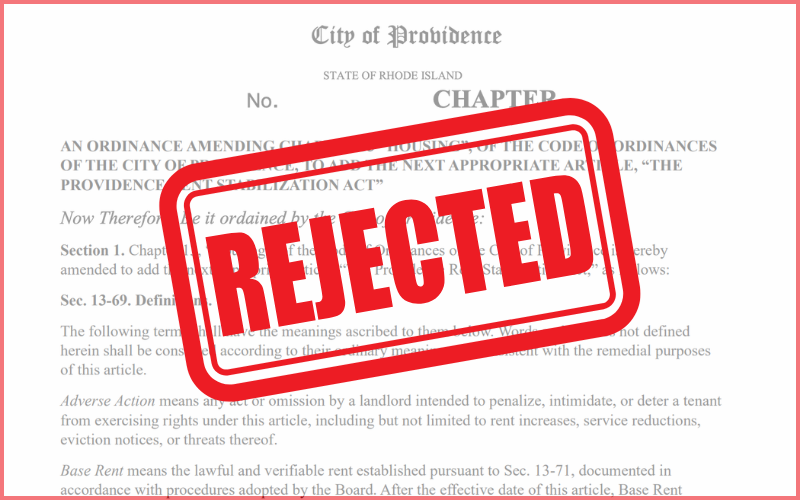
After Providence, R.I., Mayor Brett Smiley rejected the city council’s rent control proposal, the council failed to get a supermajority vote to override the veto. (Image License: CC BY-SA 4.0 MassLandlords, Inc.)
The 15-member city council gave first passage to its rent stabilization proposal in a 9 to 6 vote on April 2, 2026. This marked the first time in Providence history that rent control had been proposed and approved by the city council. It received final passage from the city council by the same margin on April 16.
The victory was short-lived for rent control proponents, however, as the proposal had to be signed into law by the mayor. Mayor Smiley, who has publicly voiced his opposition to rent control, had already promised to reject the ordinance ahead of the vote. He vetoed the bill less than 24 hours after the council gave it final passage.
“Based on available data and the experience of other municipalities, policies of this kind do not lower rents and often lead to higher costs and diminishing housing stock across the market over time,” Smiley reportedly wrote in a letter to the city council that accompanied his rejection.
“They can discourage new housing development, constrain supply, and ultimately make it harder for the very neighbors they are intended to help,” he continued.
Smiley also raised concerns about the five-member Residential Rent Regulation Board the ordinance called for, stating there were unanswered questions about how the board’s authority could be exercised. He also noted concerns about policy enforcement and other logistical issues, such as administrative support.
Following the veto, the city council had 30 days to vote on the ordinance again. A two-thirds supermajority vote of 10 to 5 was required to override the mayor’s veto. The council met on Friday, May 15, but only 10 of the15 members attended. WPRI reported that nearly all of the counselors who had voted against rent control were not present. The measure failed by a vote of 9 to 1, killing rent control in Providence for the time being.
How Did the Providence Rent Control Plan Compare to Massachusetts’ Ballot Question?
The now-defeated Providence measure bore some similarities to the statewide question proposed in Massachusetts. In some ways, it was more strict. We’ll go over some key details here. You can also read the full Providence rent stabilization proposal, and the proposed Massachusetts rent control ballot question.

Rent control is defeated in Providence, R.I., at least for now. (Image License: Michael Denning for Unsplash)
Rent caps appear stricter in Providence proposal; actual results would vary.
The Providence rent control plan called for a flat 4% limit on rent increases in a given year. The Massachusetts question at first seems more lenient: It would impose an annual rent increase cap of 5% or inflation, whichever is less.
It’s the last part that makes Massachusetts’ plan more restrictive. There have been very few years when inflation has exceeded 5%. Most years, landlords would be stuck with much smaller increase limits.
Had it passed, the Providence proposal would have set base rents at the amount being charged 180 days prior to passage. The ballot question in Massachusetts would force landlords to adjust their rent to whatever they were charging on Jan. 31, 2026, nearly a full 11 months before the vote.
Both proposals exempt owner-occupy rentals.
The Providence plan exempted landlords who owner-occupy buildings with three units or fewer. The Massachusetts rent control proposal is slightly more lenient, exempting landlords who owner-occupy buildings with four units or fewer.
One major difference is that Providence landlords who owner-occupy one of their properties would have been able to exempt a second property of four units or fewer as well, as long as they did not have other rentals beyond those properties. There is nothing like that in the Massachusetts ballot question.
New construction limits more lenient in Providence.
The rejected Providence plan would have had a 20-year exemption for new construction. If the Massachusetts ballot question passes, it will come with a smaller 10-year exemption.
This is a big difference, especially since recent data shows new construction permits drop precipitously when rent control is enacted, even in places with 23-year exemptions.
Neither plan allows for vacancy decontrol; rules vary for improvements and taxes.
Neither the Massachusetts ballot question nor the defeated Providence proposal allow for vacancy decontrol. That means that when your renter leaves, the new renter would be paying the same rent until the next allowable increase after their lease expires.
Had the Providence stabilization plan passed, a five-member rent control board would have been established to allow landlords who performed major renovations or repairs to petition for greater rent increases. Our ballot question calls for no such board, and in fact leaves the question of enforcement wide open. This means landlords will have no avenue to petition for increases after major expenditures.
Providence would have allowed potential additional adjustments if property taxes increased by more than 5% in a single year. The question going before Massachusetts voters does not include a tax clause.
Conclusion
The Providence rent stabilization plan was far more detailed than the ballot question slated to go before Massachusetts voters this November. It considered major improvements, tax hikes and other things ignored by Bay State rent control proponents, and had a plan for enforcement. Even if rent control boards are historically bad news, at least they had a framework sketched out.
In reading both proposed ordinances, it’s clear Providence’s plan had a lot more thought behind it than the one introduced in Massachusetts. Even with this additional attention to detail, the mayor vetoed the proposal, and a portion of the city council refused to back it. We agree with their actions. Rent control doesn’t work, it didn’t work for Massachusetts before, and it won’t work now.