Multifamily Permits Drop Sharply in Maryland County After Rent Control
| . Posted in News - 0 Comments
By Kimberly Rau, MassLandlords, Inc.
Montgomery County, Md., saw the number of permits for multifamily houses drop 97% after rent control took effect in 2024, even with a generous 23-year exemption for new construction. The difference means thousands of housing units that might otherwise have been constructed won’t be available, furthering the state’s significant housing crisis.
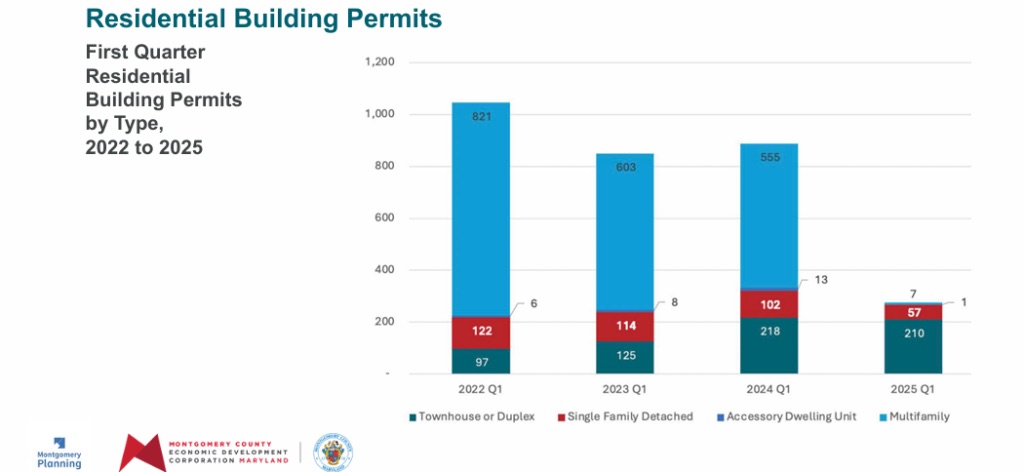
The number of multifamily building permits in Montgomery County dropped significantly once rent control was passed mid-2024. This graph shows Quarter 1 numbers: 555 permits in 2024, and just seven in 2025. (Image: public domain, Montgomery Planning and Montgomery County Economic Development Corp.)
This provides a look at what could happen in Massachusetts, a state with a shortage of more than 200,000 housing units, if rent control is passed next year.
Permits Drop From Thousands to Double Digits
Rent control took effect in Montgomery County, one of the wealthiest counties in Maryland, in July 2024. Vanguard News Group reported that between January and August 2024, the county issued 2,093 permits for multifamily homes. This is nearly as many permits as all other Maryland counties combined, which issued 2,274 permits in the same timeframe.
But between January and August 2025, Vanguard reported, the number of multifamily permits in Montgomery County dropped to just 54, a 97% decrease. The rest of the state issued 2,248 permits, essentially remaining at the same level.
“We have had basically three straight quarters – that’s over nine straight months – of very low, basically zero, rental multifamily housing permitting, which is very concerning,” Ben Kraft, who works for Montgomery Planning, told Bethesda Today.
“Three quarters really is something … and that really does suggest that there’s a real suppression of housing production in the county,” Kraft continued.
A comparison of multifamily permits pulled in Montgomery County the first quarter of each fiscal year confirms the significant drop. In 2022, 821 multifamily permits were pulled in the first quarter. There were 603 and 555 in the first quarters of 2023 and 2024, respectively. Then rent control passed, and in Q1 of 2025, just seven multifamily permits were issued.
And while others who spoke to Bethesda Today blamed inflation for the drop in permits, that doesn’t explain the relatively level numbers seen throughout the rest of Maryland. The only difference? Rent control.
Montgomery County Limits More Generous Than Mass. Ballot Initiative
Rent control advocates might be able to rationalize the drop in permits if Montgomery County had no exception for new construction. But that’s not the case. In fact, the county’s exception for new construction is 23 years. That’s more than double the 10-year exemption Massachusetts’ ballot initiative calls for.
If Montgomery County can’t entice builders with more than two decades of market-rate rents, what hope does Massachusetts have?
Montgomery County vs. Massachusetts’ 2026 Ballot Initiative
When compared to the 2026 ballot initiative, Montgomery County’s rent control scheme is more generous and less restrictive. And still, no one wants to build there.
The county’s rent cap is CPI-U (unlike Massachusetts, they specified which consumer price index they reference in setting rent increase limits) plus 3%, or a flat 6%, whichever is lower.
This is more lenient than Massachusetts’ proposal, which caps rents at CPI or 5%, whichever is less.
Montgomery County allows for one rent increase every 12 months, at either lease renewal or when signing a new lease. The ballot proposal also only allows for one annual increase.
One major difference is Montgomery County allows landlords to “bank” increases. If a landlord does not increase the rent by the full amount allowable, they can bank the unused portion for future use. However, the maximum rent increase even with banked allowances cannot exceed 10%.
The county’s list of exemptions is far longer than what is being proposed for Massachusetts, and includes exceptions for “substantial renovations” within the last 23 years, as well as ADUs.
Conclusion
Economists have long warned us that rent control doesn’t work. It doesn’t increase the housing supply, even when the exemption period is decades long for new development. It only helps those who are currently in an eligible unit when rent control is passed. That benefit is lost as soon as they need to move.
We deserve better than the “I got mine” mentality of rent control. We saw its disastrous effects years ago in our own state. Now, people too young to remember Massachusetts’ rent control days need only look a few states away to see the effects of a policy not even two years old.