MassLandlords Submits Amicus Briefs to SJC Against Rent Control Ballot Question
. Posted in News - 0 Comments
By Eric Weld, MassLandlords, Inc.
MassLandlords has coordinated and funded two amicus briefs that have been added to the Supreme Judicial Court case against rent control. The hearing on May 6, 2026, will determine whether the rent control 2026 ballot question is constitutional and can be presented to voters or will be struck.
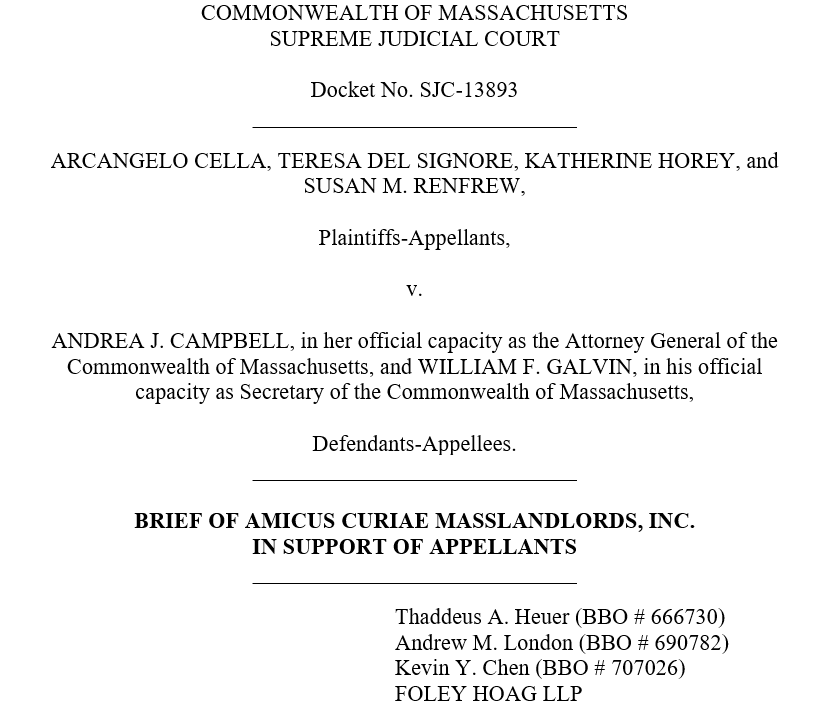
The Supreme Judicial Court will hear arguments against rent control on May 6. (Image: Public Domain)
One of the amicus briefs, written by MassLandlords counsel, spells out two main arguments with three reasons each against the question proposed for the November election ballot.
The second brief was written by counsel representing Millbury National Bank, a 200-year-old community bank that focuses primarily on small business, construction and small investment property lending in central Massachusetts. Millbury National has a reputation in its region as the “go to” lender for small local property investors, notes bank CEO John Latino in an affidavit for the brief.
The Millbury National amicus brief is particularly notable because the bank is the only lender to add its voice to the rent control opposition campaign. Though many, if not most, banks will be negatively impacted – some drastically – if rent control becomes law, Millbury National is the one lending institution to say so publicly, adding considerable weight and powerful detail to the case.
How can rent control advocates put an unconstitutional question on the ballot? Great question. We’re asking the court to stop them. (Image License: CC BY-SA 4.0 MassLandlords, Inc.)
Three Constitutional Arguments Against Rent Control 2026
The MassLandlords brief, a 219-page paper including testimony already submitted to the legislature, details the three core legal arguments that define why the rent control question should not be allowed on the election ballot.
Argument 1
Amendment Article 48 of the state constitution governs the rules around citizen referendums and initiatives for new laws, such as the rent control petition, and how they may be placed on the ballot. These are rules written to ensure fairness and compliance with the constitution’s tenets. One of those provisions is a requirement that all initiative petitions must be consistent with eight individual rights enumerated in the constitution, including the “right to receive compensation for private property appropriated to public use.”
If approved by voters, the rent control ballot question would repeal Chapter 40P. This is a law approved by voters in 1994 that codifies a right to compensation for housing providers when their rental units are subjected to rent control. The ballot initiative, which has no compensation, is therefore a clear violation of Article 48.
Argument 2
The petition again violates Article 48 in its proposed appropriation of the security interests of mortgage holders. This argument is squarely based on the 1998 case Dimino v. Secretary of the Commonwealth, in which the SJC struck down the attorney general’s approval of a petition that would have eliminated the collection of tolls on the Mass Pike. Doing so would have jeopardized the security interests of bondholders, which would have constituted a breach of their contracts and an illegal appropriation.
Forcing rent increase limits on rental property owners would likely make it harder for borrowers to pay back loans, as has happened before in all rent-controlled communities. This would in turn appropriate and invalidate the security interests of mortgage lenders for those properties. That would be a clear violation of Article 48, as established by court precedent.
Argument 2 is bolstered and authenticated by our amicus brief from Millbury National. The investment property lender is precisely one of those contract holders whose security interests are protected by Article 48 but would be appropriated by the rent control petition. Read more on this amicus brief below.
Argument 3
The third Article 48 violation of the rent control initiative petition procedure is about fairness, or unfairness in this case. When summarizing a question for the election ballot, the constitution mandates that the attorney general prepare “a fair, concise summary…of the proposed measure as such summary will appear on the ballot.” While the text of the question states Chapter 40P would be repealed and replaced, the summary for the rent control initiative does not contain that information. It does not explain that voters would be eliminating an established statute guaranteeing compensation for rental property owners whose units are subjected to rent control.
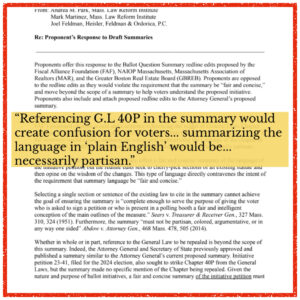
When given an opportunity to include this information in the ballot summary, which would give voters a clear understanding of what the law would do, Andrea Park, a housing attorney with the Massachusetts Law Reform Institute, which represents the petitioners, said no. “Referencing G.L.40P in the summary would create confusion for voters…summarizing the language in ‘plain English’ would be…necessarily partisan,” Park said.
How can the initiative petition be considered fair and in compliance with Article 48’s carefully crafted rules of equitability and impartiality when the writers of the question intentionally withheld information from voters, the amicus brief asks.
In addition to addressing the unlawfulness of the rent control initiative, the brief has a second line of argument discussing whether the proposal itself is a good idea. It states that rent control would “cause widespread harm – burdening small landlords with unsustainable operating costs and eroding the property values on which many depend for retirement, while conferring windfall benefits on tenants, including those who need no subsidy.” It further underscores other harms, such as reducing housing supply, imposing costs on municipalities as local tax revenues dwindle, impairing labor market mobility, adding substantial administrative burden, and damaging the state’s climate change commitments.
Millbury Bank Amicus Brief
The amicus brief written on behalf of Millbury National Bank is a powerful testament to the devastating, cascading effects this rent control petition would impose on banks’ security interests. The bank has three classes of loans that are not predicated on the property value, but rather, are predicated specifically on rent increases.
First, Millbury National issued loans on the basis of raising the rent to market as renters leave over time, faster than would be allowed under rent control. Second, they issued loans on the basis of raising the rent following renovation faster than would be allowed. Third, they issued loans for units that are now at market rent, but which were vacant on January 31; these rents will have be reset downward to their pre-renovation rents.
The brief specifies that nearly a quarter of Millbury National’s total loan portfolio – $25 million out of a $107 million loan portfolio – is in primarily small rental properties (one to four units) that would be subject to rent control under this petition. Although the initiative excludes owner-occupied properties with four units or fewer, it does not exempt non-owner occupied smaller properties, or any owner-occupied property with four units or fewer that is held in a trust or LLC.
“Millbury National’s financial future depends on the outcome of this case,” the brief states. “Rent control would have devastating effects on Millbury National, its ability to continue to service loans, its borrowers, and its borrowers’ ability to be successful landlords.”
Millbury National enters into loan contracts with many of its landlord customers on the grounds that they will eventually collect market-based rents in order to keep the properties’ values at a level that ensures their economic security. The rent control proposal, with its 5% or CPI-measured inflation limit on rent increases, would disallow owners’ abilities to collect market rents. Without such assurances, Millbury National, and most other banks, will not be able to lend money for rental properties because the cost of operating those properties will rise but rents will remain controlled.
Not only will all this deal a disastrous blow to the rental housing market, but it’s also a blatant violation of Article 48’s protection of mortgage lenders’ security interests without compensation, as buttressed by Dimino v. Secretary of the Commonwealth.
Counter Arguments To Rent Control Proponents
These amicus briefs deliver a strong rebuke of the rent control petitioners, while also outlining the litany of harmful outcomes their proposal will render to Massachusetts’ economic future if approved. In contrast to the throng of deceptive voices clamoring for this destructive, unartful rent control proposal, our amicus briefs deconstruct and define exactly why the petition is a sloppily conceived, unfit and unconstitutional question that should not be posed to voters.
It’s impossible to predict what the court will decide, and we are prepared to fight this rent control initiative all the way to the November election and beyond, if necessary.
Regardless of how things unfold, at the very least, the court – and more of the public after the May 6 hearing – will be informed of the constitutional violations of the rent control petition, and the deep damage it will cause to all our livelihoods if we are not able to stop it.