Emotional Support Animals
By Peter Vickery, Esq., Legislative Affairs Counsel
Lance Talkington made snarky comments about emotional support animals and ended up in court for allegedly interfering with his neighbors’ federal Fair Housing Act rights. Talkington lived in in the US Virgin Islands at Cowpet Bay West Condominiums, which had a no-dogs policy.
Jump to
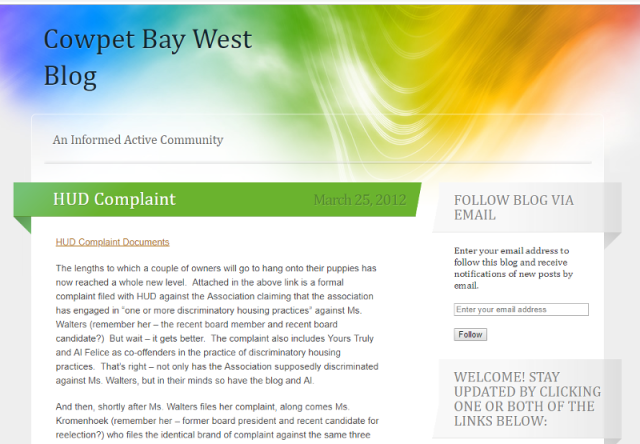
A screenshot of the allegedly hateful rainbow-colored blog of Cowpet Bay West Condominiums.
When his condo neighbors Judith Kromenhoek and Barbara Walters (no, a different Barbara Walters) each brought home a dog and claimed that the dogs were emotional support animals, Talkington made derogatory comments on his blog. He cast aspersions on the validity of the certificates that Ms. Kromenhoek and Ms. Walters had obtained. He suggested that the certificates might have come from one of the “disreputable” websites that would provide documentation without “verifying either the animals credentials or the purported disability.” The court report does not say which websites Talkington had in mind, but interested readers with access to Google and a few minutes to spare can get a rough idea of the possibilities.
Seventy-nine bucks for same-day service
Near the top of the list of search results comes the United States Dog Registry where obtaining the basic kit (certificate, lifetime registration, identification card, and tag) is a breeze. You do not need medical documentation from your health provider or a letter from the veterinarian. You do not even need an animal. All you need is $79.
If you are willing to shell out 98 cents more, go to USServiceAnimals.org, site of the “Official Service Animal and Emotional Support Animal (ESA) Registry.” For $79.98 in addition to the certificate, tags, etc., this company offers a card containing “legal information about your rights” and the peace of mind that comes from having said rights protected “with the help of our on-staff attorneys.”
And you do not even need to provide them with a letter from your physician because the company will take care of that too: “A doctor in our network may be able to prescribe an emotional support animal with only one phone call.” Need a doctor’s note? Just scroll down and click on the big red button that says, “speak to a doctor now.” Need that note quickly? Have no fear: “Our network of independent mental health professionals will get your required documentation today.”
A certificate, a lawyer, and a doctor, all for just $79.98.
In any event, Mr. Talkington’s online comments, which he made in 2011, landed him the role of one of seven defendants in a lawsuit that commenced in 2014 and concluded in 2017. The trial judge granted summary judgment in his favor, but the Court of Appeals for the Third Circuit reversed, holding that “a reasonable jury could find that there was a causal connection between Talkington’s blogging and [the plaintiffs’] exercise of their fair-housing rights.” Bloggers beware.
A turkey, a goat, and a pig walk onto an airplane
News stories about emotional support animals tend to focus on air travel. Federal aviation regulations allow passengers to bring their “emotional support animals” on board the aircraft. Unlike pets, they fly free of charge so, not surprisingly, the number of emotional support animals on flights has risen dramatically in recent years, from 481,000 in 2016 to 751,000 in 2017. The variety of supposed “emotional support animals” has risen as well. The list of airborne emotional-support creatures includes a turkey, a peacock, a goat, a large pig, and a miniature horse.
The pig kicked up a stink, as the headline from the Hartford Courant suggests (“Pooping Pig and Its Owner Booted from Bradley Flight”). Within the strictures of federal regulations, airlines are now trying to crack down.
For example, Delta and United now require customers to confirm that their animals can behave in public and provide a health and vaccination form signed by a veterinarian. Based on the story about the pig, this does not seem like too much to ask. Alaska Air requires that emotional support animals be of a size that does “not exceed the footprint or personal space of the guest’s seat or foot area” and must be leashed “or in an approved carrier that fits under the seat,” which would seem to rule out the larger-breed pigs and, perhaps, most goats. In any event, the airline warns fliers that “the only emotional support animal permitted into Hawaii is a cat or dog.”
Hawaiian Airlines “does not accept under any circumstances certain unusual animals.” The link to the list of “unusual animals” does not work, possibly because the company is overhauling its policy so as to conform to current regulations, which do not permit companies to declare certain species off limits.
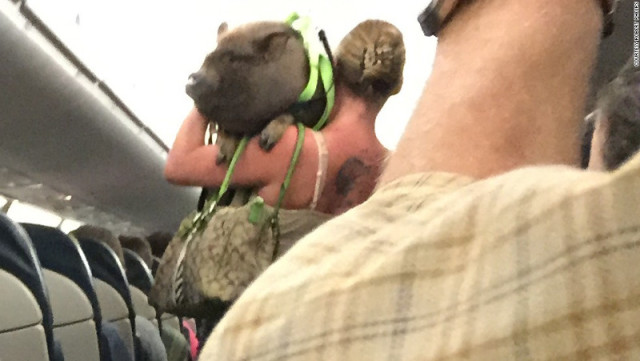
Landlords can imagine the relief felt when this ESA pig relieved itself once in the aisle and then was removed. Robert Phelps via https://www.courant.com/breaking-news/hc-pig-on-plane-at-bradley-1130-20141129-story.html
Fight or flight
The industry group Airlines for America has asked the US Department of Transportation to redefine “service animals” so as to include “only dogs that are individually trained to do work or perform tasks for the benefit of an individual with a disability.” If the administration does decide to pick this fight, a swift victory over sundry advocacy groups seems unlikely.
The challenge facing airlines also confronts landlords. Tenants with disabilities are entitled to reasonable accommodations. This is not news. Nor is it news that the reasonable accommodation may come in the form of a service animal, even if the property owner has a no-pets policy. Landlords know that if they customarily prohibit animals of all sorts, they have to make exceptions for trained service dogs that perform tasks for tenants with disabilities.
But does an animal qualify as a service animal for landlord-tenant purposes when it has no special talent (e.g. an amiable but essentially unskilled miniature horse) and its role is simply to provide emotional support? Having read about Lance Talkington’s experience at the Cowpet Bay West Condominium you can probably guess the answer.
Under the federal Fair Housing Act and the regulations that implement it, housing providers must provide equal opportunity for each tenant with a disability to “use and enjoy” the dwelling.
In 2013, the Department of Housing and Urban Development (HUD), which enforces the federal Fair Housing Act, issued guidance on the subject. HUD stated that although the Department of Justice had interpreted the Americans with Disabilities Act (ADA) so as to exclude emotional support animals from its definition of “service animals,” HUD would interpret the Fair Housing Act (FHA) so as to include them. So far as HUD is concerned, a reasonable accommodation under the FHA includes emotional support animals.
According to the HUD notice, if a tenant whose disability is not readily apparent claims to need an emotional support animal, the landlord is entitled to ask for “reliable documentation” from a physician, psychiatrist, social worker, or other metal health professional as to the disability and the “disability-related need” for the animal. They may not ask for access to medical records or for “detailed or extensive information” about the mental impairment.
As for showing that the animal is “necessary” for the tenant’s enjoyment of the premises, landlords may ask for evidence that “that the animal provides emotional support that alleviates one or more of the identified symptoms or effects” of the disability. Some appeals courts have upheld this extremely generous interpretation of the word “necessary.” If a tenant can show that the animal alleviates an effect of the mental-health condition, then the animal is “necessary.” In this context, the meaning of “need” grows somewhat fuzzy.
As parents sometimes grow tired of explaining, especially around the holidays, there is an important difference between want and need. “We fully appreciate that you want the Xbox One/every single item in the American Girl Doll catalog/a pony [delete as applicable] but we do not believe that you need it.” It may come as some consolation that offspring’s failure to understand the want/need distinction will not prevent the little moppets from becoming either the authors of HUD notices or appellate-level judges.
Beasts and burdens
Under the FHA and the Massachusetts state-law equivalent, G.L. c.151B, an accommodation must not unduly burdensome, i.e. must not impose undue financial or administrative burden on the landlord.
If the landlord can show that the animal in question poses a threat to other tenants, then that danger may outweigh the disabled tenant’s need for a reasonable accommodation. However, landlords cannot get away with blanket general assertions against certain species or breeds: the danger must be particularized. It is not enough to say that ferrets foment fear, pythons perturb, and bull-terriers bite. Instead landlords need to make individualized assessments for each animal.
Conclusion
Even if your rental property has a no-animals policy, your tenant with a non-obvious disability (e.g. behavioral-health issues) has the right to seek an exemption in order to keep an emotional support animal on the premises. That said, you can and should ask for “reliable documentation” from a physician, psychiatrist, social worker, or other metal health professional that the tenant has (1) a disability and (2) a “disability-related need” for the animal. If you can show that the animal in question would impose an undue burden, you may still be able to enforce your no-animals policy.
Service Animals are Dogs but not Pets
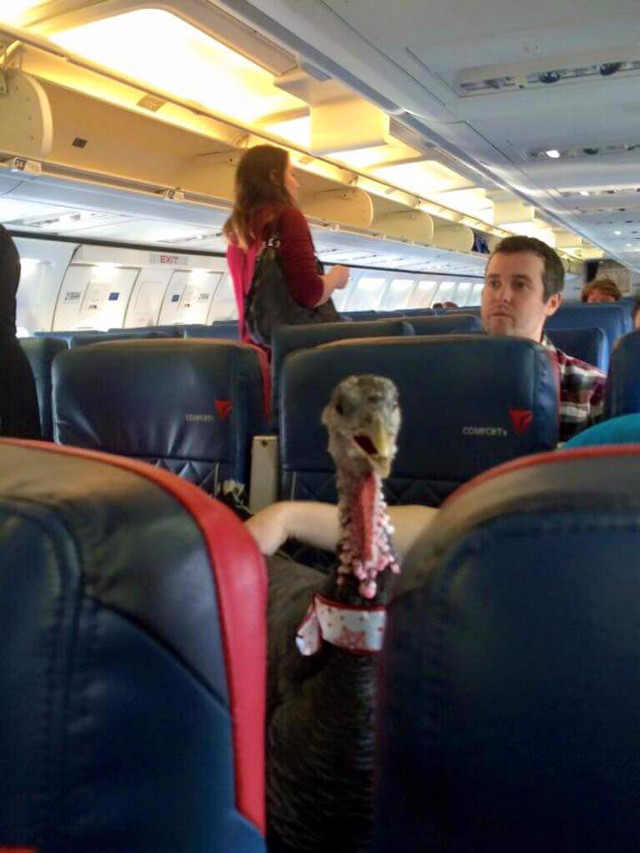 An airline passenger made news in January for taking their "emotional support turkey" onto a Delta flight. Here's what landlords need to know.
Service animals are trained for specific tasks with specific people. For instance, a guide dog helping a visually impaired person into a subway is a bona fide service animal.
This is different from a pet. Anyone can buy a cat or give it away. Service animals and people are paired up together. The person travels only with that specific dog, and that specific dog helps only that person.
Businesses that have a "no pets" policy must be careful not to appear discriminatory. Service animals are not pets and must be granted reasonable accommodation. You cannot discriminate against someone on the basis of their disability (Federal law). You can only turn away their request if unreasonable.
An example of a reasonable request: "I need my service dog to live here with me so I can move around the apartment. It is licensed and friendly and I will clean up after it."
An example of an unreasonable request: "I need my service dog to have a gold-plated dog house that you will pay for at a cost of a million billion dollars."
Since March, 2001, only dogs have been recognized under the law as a "service animal" (search for this term and you will find the definition at this link).
Emotional Support Animals Can be Dogs, Might be Turkeys
People with emotional disabilities are also eligible for reasonable accommodation, and unlike service animals, emotional support animals can be any kind of creature.
The federal government specifically refuses to recognize emotional support animals as service animals. This means fewer places are required to accommodate ESA's. But airlines and housing are two of the major areas singled out.
Cats, dogs, ponies, pigs, and turkeys have all been identified at one time or another as essential life companions for the disabled. These must be allowed with proper documentation.
To learn about the documentation required, visit our page on reasonable accommodations.
Dogs Cannot be Declared Dangerous based on Breed
Dogs in Massachusetts have their own discrimination protections. Landlords and insurers cannot refuse to rent to a dog because of its breed.
The Acts of 2012, Chapter 193, Section 32 states that "no dog shall be deemed dangerous: (i) solely based upon growling or barking or solely growling and barking; (ii) based upon the breed of the dog; or (iii) if the dog was reacting to another animal or to a person and the dog’s reaction was not grossly disproportionate to any of [a long list of] circumstances."
This means that insurers can't refuse to insure you because of a dog breed. And you, therefore, cannot refuse a service animal or emotional support animal for fear of your insurer.
We now have an answer to the question, "What about a seeing-eye rottweiler?" The answer is, "Landlords must allow it unless that specific dog has a history."
Now Everyone has an Emotional Support Animal!
Under Massachusetts law, it's relatively easy to get the paperwork required for an emotional support animal. We may say we need a doctor's note, but actually a wide variety of sources can provide legally binding documentation.
Any of the following can prove a disability requiring an ESA:
- Treating Physicians/Psychologists
- Clinic and Hospital records
- School records (IEP, IQ evaluations, etc.)
- Consultative Examinations authorized by the Department of Developmental Services
- by panel physicians/psychologists
- by attending physicians/psychologists
- Non-physician health care professionals (e.g., licensed clinical social workers)
Any of these data sources can require you to allow a tenant to have an ESA in your no-pets apartment.
Landlording Best Practices
In advertising a "no-pets" apartment, say "no pets (SA's/ESA's allowed)." Someone with a service animal or emotional support animal will know what you mean by SA/ESA and won't feel discriminated against.
When asked if you allow pets over the phone, don't prompt the tenant to go get an emotional support form from a corrupt doctor or social worker. Tell them "yes, with appropriate paperwork." If they are legitimate, they will know what you mean. If they are trying to abuse the system, they will produce only an animal license at first.
In setting the rent for an apartment where different candidates have different accommodation requests, remember that you can negotiate the rent up or down to compensate you for legitimate extra expenses. Be very careful. If you can't produce receipts showing your additional expense, you could be found to be discriminating.
Whatever you do, be fair, and keep a paper trail!
Webinar: Emotional Support Animals

Discrimination and Emotional Support Animals
Slides are available only for members in good standing who are logged in.