
Help, My House Burned Down! What To Do After a Fire
It’s something we hope you never need to know, but if you do, this article will help you recover after your house or building has a partial fire loss or burns down entirely.
This article is inspired by the educational event on May 9, 2018, in which Bay State Restoration presented a rough outline of what to do after a fire, by the experience shared by a member in Greater Springfield, and by the Lawrence, Andover and North Andover gas explosions of September 2018. The article is written for owner/operators of rental real estate, rather than single family owner-occupied homes.
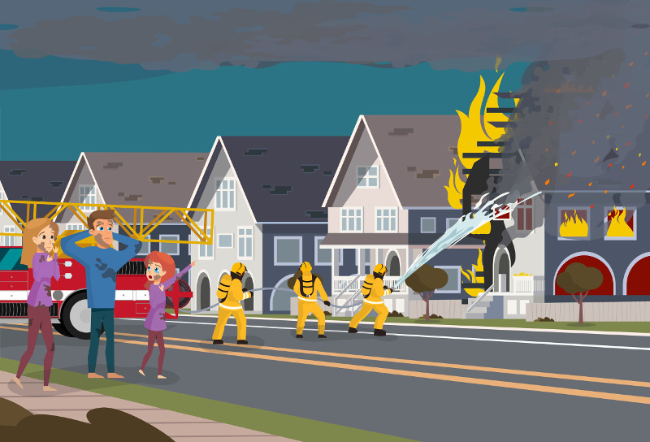
Any fire can be a tragedy and a terrible loss. We have written this article in the hopes that you read it but never need to use it.
Preface to Recovery After a Fire: Put People First
We hope that you and yours escaped unharmed. Sadly, it is not always the case that fires damage only real property. If you or a renter suffers personal tragedy, forget about the property for the time being. Help yourself, your loved ones, and your renters first. You may wish to search for other articles for help on the long, slow road through physical and emotional survivorship.
When You First Get or Make the Call
Your presence on-site is important after a fire. How that happens will depend on what type of rental you have.
If you are remote: You may be a remote owner or an on-site owner-manager who is not present when the fire begins. When you are informed that there has been a fire on your property, you need to take action immediately. Go there, or if you cannot get there immediately, send someone to represent you, evaluate the situation and make decisions. Remember to have your contact information posted on the building and on file with the municipality.
If you are on-site already: If you owner-occupy your rental, having a presence will happen automatically. (Notes for future reference: Fire extinguishers and residential sprinklers may be inadequate to contain the fire. Do not attempt to fight the fire yourself unless you know what you are doing.)
Replacement Housing After a Fire
You will probably not have to make decisions about whether your renters can stay in the apartment. The fire department will make this decision for you, and the answer will more than likely be “no.”
Not only can fires weaken structural members, but also their combustion residue and any water poured into the apartment will create a carcinogen, mold and air quality danger that renders the unit and other affected units uninhabitable on the spot.
You will need to decide whether you want to help relocate displaced renters.
Legally speaking, any well-drafted rental agreement should terminate in the event the premises become uninhabitable. Also, any rental property policy must carry insurance (at time of writing, and as of 2026, $750) to cover a renter’s fire relocation expense. You are therefore not legally or financially obligated to help your renters. You may wish to move further along the recovery process by focusing on boarding up your building, see below.
You and your renters are free to agree to try to sustain the tenancy, but repairs always take much longer than expected.
Our suggestion is that you should not go to bed until your renters have a safe place to sleep that night. The American Red Cross or other local aid agencies may come to the rescue. Or depending on the size of your fire and the local charitable capacity, you may want to pay for hotel rooms, AirBNB stay or other short-term emergency housing out of pocket.
Consider that whatever the cost of hotel rooms, you will earn more in goodwill than you can save by being hands off. Remember that you may face liability exposure if there is any suggestion that you didn’t provide adequate fire prevention, detection or escape routes. There is every business reason to help your renters first, never mind the humanitarian reasons.
State sanitary code changes require you to house renters for a time if the unit becomes uninhabitable.
Changes to the state sanitary code in 2023 require you to house your renters for the remainder of the lease term or rental period, until the unit is habitable again or until your renters can find someplace else to live - whichever is shorter.
105 CMR 410.900, section E states:
“When a residence or portion thereof has been condemned and placarded as unfit for human habitation and the occupant of a condemned dwelling unit or rooming unit is not the owner of the residence, the owner shall provide comparable, suitable housing for the occupant for the following time period, or whichever is shortest:
- The remaining term of the lease or rental period;
- Such time as the residence is deemed suitable for habitation by the board of health;
- Such time as the occupant finds alternative, permanent housing and voluntarily terminates tenancy.”
As stated above, a well-structured rental agreement will terminate the tenancy as soon as the unit becomes uninhabitable. That would certainly be the shortest option out of the three above. If your rental agreement does not have such language, you will need to house your renters until one of the three conditions is met.
Securing the Building After a Fire
Once your renters are attended to, you need to secure the building against further loss from weather, animals and vandalism. This means boarding up any holes or fire-melted surfaces.
If you are a DIY type, you had better have a truck and a spare supply of plywood and tarps on hand. If you are not, or if you do not have what you need, you will want to call a restoration company. They can tarp and board up your property within hours, even in the middle of the night when all the big box stores are closed.
Some restoration companies offer priority service agreements. For a professional owner/manager, these are an excellent idea. Primarily, these agreements offer a way to give your name and contact details to the restoration company in advance, so that when you call, whenever it is, you are already recognized in their system. You can get right to boarding up the building instead of reading a credit card number over the phone.
Securing Your Business After a Fire
After the building is secured, you need to secure your business. There are three aspects to this.
First, you need a construction estimator to quote tear-down and rebuild for the damaged portions of the building.
Second, you need an insurance adjuster working for you directly (in opposition to the insurance company’s adjuster) to obtain the best insurance payout for you.
Third, you need an attorney to review your building, the fire report and potential liability claims, and to prepare defenses and/or answer letters.
Depending on whether you hired a restoration company to board up the building, and depending on the extent of their services, they may be able to act as both estimator and adjuster for you.
Also, depending on the size of your business, the cause of the fire and your actions on-site to help renters relocate, you may not need to contact an attorney yet or at all.
Waiting to Rebuild After a Fire
You cannot start rebuilding until the cause of the fire has been determined. Usually the fire department and the insurance company will have one or more inspections. The insurance company, for example, is looking for arson. Depending on the fire department’s initial report, you may also have police or FBI inspections (if criminal or terrorist activity is suspected). All investigations need to complete their data gathering before you can rebuild.
Getting the insurance money to rebuild after a fire may be a long and challenging process. Remember that insuring to replacement value will not cover needed upgrades, like sprinklers, that didn’t previously exist. For new sprinklers, you also need “ordinance and law” coverage. You should look for further resources on insurance prior to any loss to be sure you know what will be covered. Not all residential policies are created equal.
Rebuilding After a Fire
You can start demolition and rebuilding once all post-fire inspections are done.
Demolition of your fire damaged building will be relatively easy, but don’t forget about disposal costs. Think of how many dumpsters it would take to equal the size of the damaged portion of your building, or your entire building, and you’ll realize it’s a huge number. If you are a licensed, registered DIY owner-contractor intending to rebuild yourself, you may still want to hire for removal and disposal.
The one silver lining in this cloud of smoke is the fact that you now have a chance to make your unit or building better. You can have new plumbing, new electrical, and new tenant-proof finishes. You can redo floor plans, add insulation, and soundproof drain pipes.
And of course, with new construction, you can have hardwired smoke detectors, residential sprinklers, kitchen hoods with chemical extinguishers, and arc fault circuit interrupters.
Thoughts on Natural Gas and Fire Safety
It’s worth considering, especially after the terrible loss in Lawrence, Andover and North Andover in September 2018, whether you can eliminate natural gas use in your building. Natural gas is both a risk and an accelerant. Simply having a pilot light facing an open gas line, as is the case with most boilers, exposes your building to overpressure or other gas company accidents. If a fire starts for any other reason and impairs a gas line in the building, the broken gas pipe can become a blowtorch, turning what would have been a small apartment fire into a total building loss.
A post-fire gut is an opportunity to reevaluate your heating strategy. To replace natural gas or another combustible as a heat source, you will need to have tight insulation and mini-split heat pumps. If you add solar panels, the electricity needed to drive the heat pumps and your electric ranges can be free or discounted.
The up-front capital costs will be greater for solar panels and heat pumps than for natural gas. But they can be partially offset by the insurance that would have been used to replace boilers and furnaces, and energy upgrades also qualify for tax incentives and preferred financing. The long-term operating costs will be cheaper, especially if you consider that a carbon tax may someday be enacted, or that natural gas prices may rise above their historic lows. Even without this speculation, heat pumps are already cheaper per BTU than residential natural gas.
Conclusion
The recovery process for rental real estate starts with taking care of your displaced renters. You then need to secure the building after a fire. You will need to plan for the rebuild, secure your insurance payout, and address any legal liability you may have incurred. And then you need to reinvest in the future of your business. We hope this helps. May you never need to use this knowledge of what to do after a fire, and may you never need to search for “Help, My House Burned Down.” Feedback or corrections? Email hello@masslandlords.net and we’ll update the finished article on the site.