
Rent Control Ballot Question Defeated for 2026; Donations Still Needed
| . Posted in News - 0 Comments
On June 23, the Supreme Judicial Court struck down the attorney general’s certification of the rent control ballot question as unconstitutional. There is no ballot question, and no expected rent control compromise anymore.
Success is attributable to the cooperation between MassLandlords, the Greater Boston Real Estate Board and the official Housing for Massachusetts ballot opposition campaign. A majority of the funding came from the Greater Boston Real Estate Board.
This is a tremendous victory, but at a high cost: MassLandlords’ share of the litigation, the advertising and the lobbying came in over budget. MassLandlords’ cash forecast shows an uncertainty around meeting fall obligations.
We are asking all landlords to join as a member and all members to make a property rights supporter contribution. We want to continue our strong and vocal defense of our mission to create better rental housing without cuts.
Understanding MassLandlords’ Spending To Win
Rent control is a “die on the hill” moment for us: We know we need to put everything into the fight to protect you, your investment and your renters’ homes. That’s just what we did.
Last December, we toured Massachusetts to fundraise for this fight. We raised $72,000 in new donations, which for mom and pop landlords is a big deal. We’ve spent more than we raised:
- January: Materials to lobby the State House for a funded compromise: $13,000.
- March: Two amicus briefs, $93,000.
- April: Spanish language RentControlHistory.com, plus member services, anticipating a whole market campaign this fall: $21,000.
We’ve drained ourselves to the bottom of the tank for this. But look at what we’ve done!
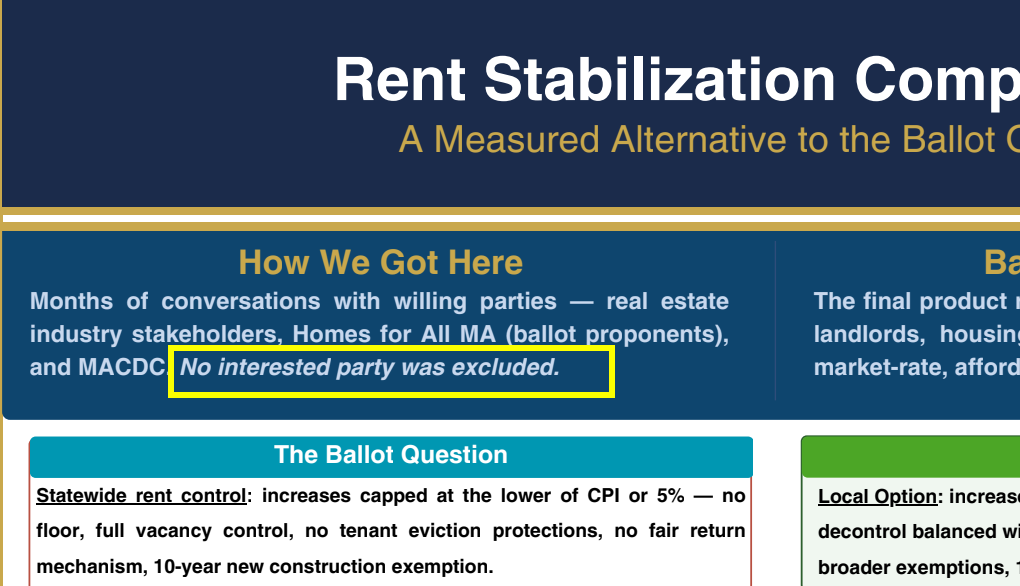
A false and misleading document produced by the Massachusetts Association of Community Development Corporations implies MassLandlords, the Greater Boston Real Estate Board, NAIOP, MAR, SPOA or any number of organizations were involved. None were. Yellow box added by MassLandlords for emphasis. (Image: Fair Use)
Impermissible Exemption for Religious Institutions
Four legal arguments were raised in opposition to the ballot question:
- It would appropriate (take) private property to public purpose without compensation, which cannot be done by a ballot question.
- It would exempt properties operated for religious purposes, but religion cannot be considered on a ballot.
- It would regulate long-term housing and vacation rentals, but ballot question components must be related. Long-term housing is not the same as vacation rentals.
- It would have been presented to the voters with a false and misleading summary.
One of these arguments was featured at the hearing: religion. This, as it turns out, was what the court selected as the winning argument.
The court wrote, “Initiative Petition 25-21 subjects all ‘covered dwelling units’ to rent control. However, the petition excludes several categories of residential properties from its definition of ‘covered dwelling units,’ including those in ‘facilities operated solely for educational, religious, or nonprofit purposes…’
“The petition contains matters ‘relat[ing] to religion, religious practices or religious institutions" in violation of art. 48.”
That’s it. Done!
No Need for “Our Lady of the Security Deposit”
Had the religious exemption become law, MassLandlords’ might have recommended to members that they consider declaring their religious purpose to their renters to exempt themselves from rent control. The law doesn’t require a church to own the land or even that the property be owned by a nonprofit. One simply needed to have a faith-based purpose for operating rental housing.
You have to have faith to operate rental housing in Massachusetts, anyway, right?
We’d have to be careful not to suggest or imply to our renters that we have a preference for their religion, only that we ourselves have a faith-based purpose for being in real estate.
Any member who was operating housing out of a conviction to do good could be said to be operating with a purpose or with faith. This might have been enough. This issue is what the courts sought to sidestep:
“[I]n order to enforce the proposed law, the exemption would require the government to determine if a facility is ‘operated solely for . . . religious . . . purposes,’ and then make an enforcement decision based on the facility's religious purpose (or lack thereof).”
The ballot question stipulated that religious purpose was exempt from rent control, independently of nonprofit status. This would have opened a quagmire of public inquiry into who’s religious and who’s not.
Surprisingly, religion was the only argument the court addressed. None of the three other arguments were even considered. This means the other three arguments can be used next time. The court are explicit on this point. Footnote 6 from the decision:
“Given the result we reach, we do not address the plaintiffs' alternative arguments that the petition is inconsistent with the right to receive compensation for private property appropriated to public use, that it violates art. 48's related subjects requirement, or that the Attorney General's summary of the petition is unfair.”
In the words of Tad Heuer of Foley Hoag, MassLandlords’ counsel for our primary amicus brief, “Those issues remain live and problematic for any future ballot question that may try to reimpose rent control.”
Pending what the proponents may try next time, we’re ready now more than ever.
![Alt: A highlighted quote appears superimposed above the ballot referendum. It reads:
“Referencing G.L 40P in the summary would create confusion for voters… summarizing the language in ‘plain English’ would be necessarily partisan.”]](https://masslandlords.net/app/uploads/rent-control-ballot-question-defeated-image-2-lic-cc-BY-SA-4.0-MassLandlords-Inc.png)
This email from Andrea Park, Massachusetts Law Reform Institute, proves proponents sought to hide the truth. (Image License: CC BY-SA 4.0 MassLandlords, Inc.)
Proponents Slapped Down?
It is a rare ballot question that fails so utterly to meet the requirements that it is struck down by the court. The usual position is deference to democracy. “Let the people decide!”
That the rent control ballot question was struck down without the court even considering three of the four arguments could be viewed as a serious indictment of the proponents’ approach. Had they been acting in good faith, this would be an exceedingly technical way to stop a ballot. But the proponents did not act in good faith.
We have said from day one that they were lying and were attempting to delete our right to compensation in secret.
We have litigated for years against the City of Boston to expose improper, undisclosed lobbying in favor of rent control (we won that case, by the way; full article to come).
Phoebe Fischer-Groban at the attorney general’s office misled us into providing inadequate testimony last August. When challenged, she issued a non-apology apology.
Andrea Park at the Massachusetts Law Reform Institute wanted to hide from voters the fact that the ballot question would delete housing providers’ right to compensation. When challenged, she refused to edit the summary.
Nathanael Shea of the Massachusetts Association of Community Development Corporations was circulating rent control text claiming that MassLandlords and other real estate groups were backing it, saying “No interested party was excluded.” When challenged, he did not reply. Nor did CEO Emily Haber.
The proponents did a bad job from start to finish. Their text was bad. They lied repeatedly. They deserved to be slapped down. And most importantly, after this failure, they will have a hard time raising funds again.
Remember in 2024 a similar rent control ballot question was stopped for failure to raise enough signatures. This makes two in a row.
The proponents only have two real assets:
- They can bank on a majority of people not knowing how complex the world is, such that they might vote for rent control despite the unintended consequences.
- They lobby with impunity, taking tax-exempt money as 501(c)3 charities and spending it without reporting. This is a violation of city ordinance, state law and federal tax law.
Who will shine a light on the proponents’ noncompliance, or level the playing field for mom and pop owners, if not MassLandlords? Our mission is to create better rental housing. It’s time to get those other groups out of our way.
We Might Have Won Either Way
Even without this court decision, it bears mentioning that we were ready to win the statewide ballot fight regardless. Proprietary polls taken for the Housing for Massachusetts campaign indicated approval for rent control statewide had fallen roughly 17 points from last fall, from around 65% to around 48% leaning yes, with a growing block of voters already decided “no.”
Please donate. The request is $80 per member or whatever higher amount you may feel able to give.
Not a member? Join.
Defeating rent control is what we can do with a shoestring. So why not invest in us in a big way? Let’s make Massachusetts the best place to own and to rent. Let’s hold the nonprofits accountable. And let’s actually create the rental housing these nonprofits claim they so desperately want. Next time, we’ll have stopped it before it starts.