
What Can Massachusetts Learn About Rent Mandates From St. Paul?
. Posted in News - 0 Comments
By Eric Weld, MassLandlords, Inc.
Thankfully, Massachusetts voters have a recent example to look at to inform their understanding of the many ways rent control can smother a community’s economy. If the statewide rent control 2026 initiative ends up on the November election ballot, Bay State residents can study the rent control policy that St. Paul, Minn., voters approved in 2021, to help their voting booth decisions.
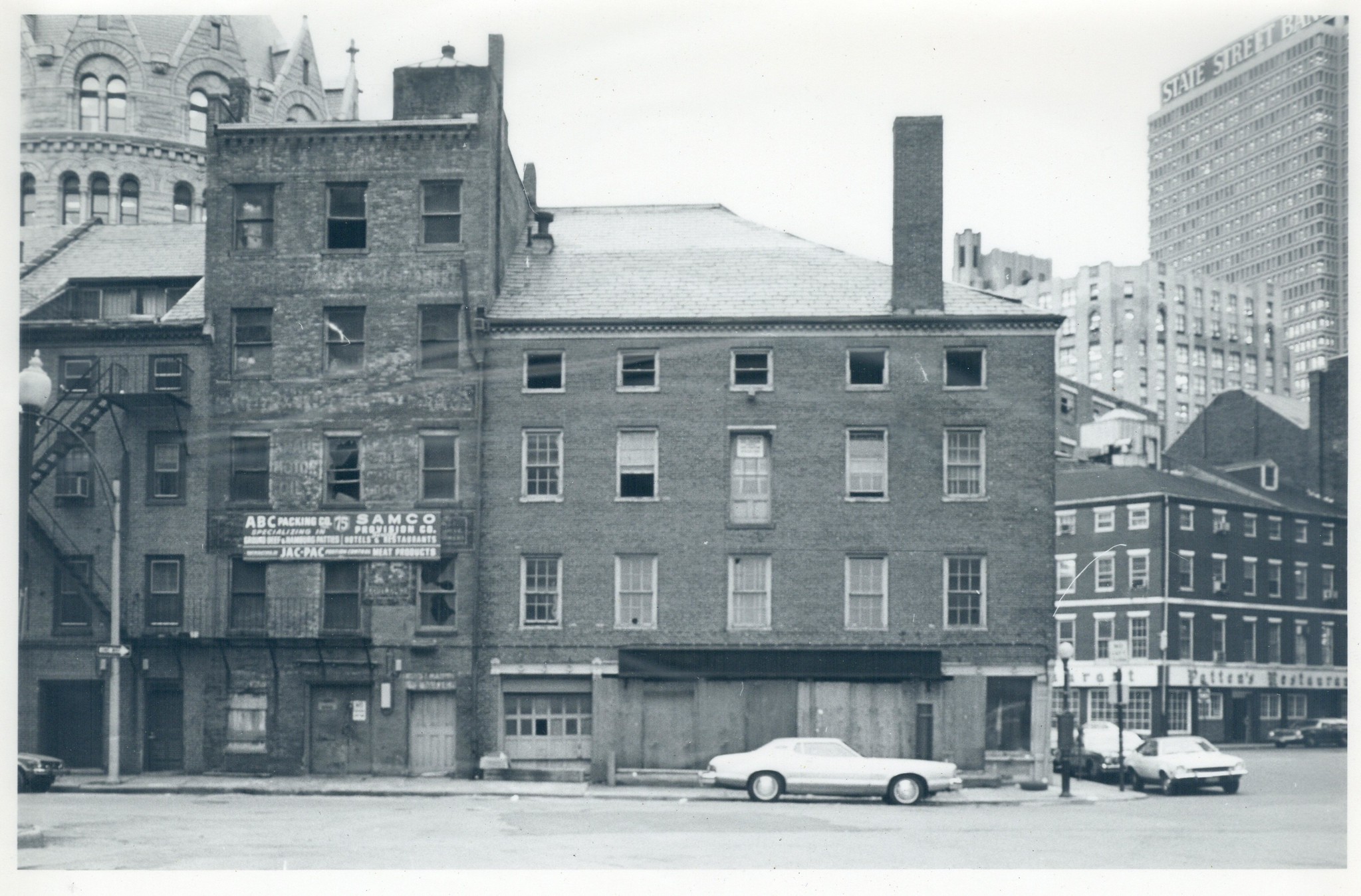
The Jenney building on Central Street, Boston, pictured here circa 1970s-‘80s, with its boarded up windows and street level storefronts, offered an all-too-typical example of urban blight as the city maintained rent control for more than two decades. Will Massachusetts voters elect to return to this by approving rent control mandates on the November ballot? Image: CC BY-SA flickr-City of Boston copyright.
For more details about St. Paul’s policy and its unenviable aftermath, see the related companion article, “St. Paul, Minn., Tried Rent Control; Here’s What Happened.” Surely, after reading about the Minnesota city’s struggles to rebalance its economy and offset rent control’s damages, no one in Massachusetts would still blacken the ballot oval in favor of rent control here, we assume.
But the Massachusetts rent control 2026 proposal has a few important similarities to the St. Paul law that put us in that state’s footsteps leading up to the election. And, if a majority of voters were to approve the initiative in November, we would be forced to grapple with some of the same economy-depressing issues as the Minnesota state capital. Except, in our case, those issues would be statewide, and therefore their harms multiplied.
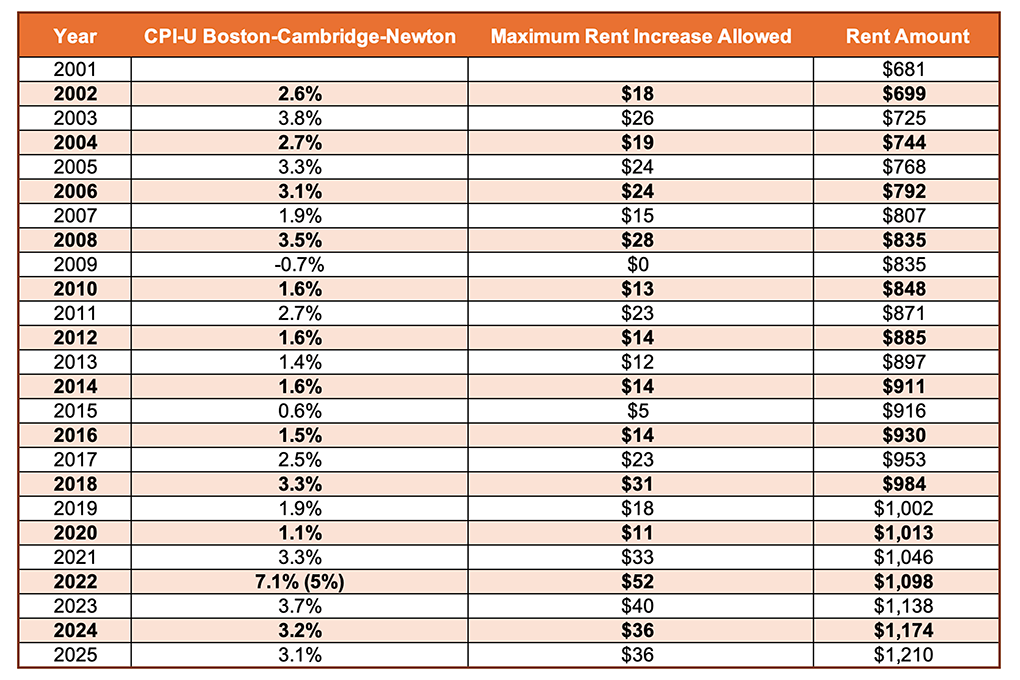
This chart tracks the maximum rent increases that would be allowed for a two-bedroom apartment in Worcester if the Massachusetts rent control 2026 proposal had been in place during this century. Starting in 2001, with monthly rent of $681 and raising it each year the maximum allowed by the rent control proposal – either the rate of inflation or 5%, whichever is less – yields a monthly rent by 2025 of $1,210, nearly 40% below the market rate of $2,000, estimated by Zillow. Image: MassLandlords
Most Restrictive Rent Control in the Nation
St. Paul’s is by now a well-studied case of the nation’s most restrictive rent control policy. Its main feature is a 3% hard cap on rent increases within a 12-month period, with no consideration for inflation.
The Massachusetts rent control 2026 proposal isn’t far off. In a way, the Massachusetts initiative is even more restrictive than the St. Paul policy. The Massachusetts proposal would restrict rent increases to 5% or the inflation rate (italics added) measured in a Consumer Price Index (not plus inflation), whichever is less, in a 12-month period. The proposal doesn’t specify which CPI it would reference among numerous national, regional and specific CPIs, such as CPI-U (urban consumers) vs. CPI-W (wage earners).
That means, in most years, the 5% hard cap would not be employed because usually inflation, as an average, remains below 5%. For a recent example, we could refer to the national CPI inflation measure for 2024, which was 2.9%.
More likely, the state would use the CPI-U for Boston-Cambridge-Newton, which is often referenced to measure the state’s inflation. According to U.S Bureau of Labor Statistics, average inflation over all of this century (2000 to 2025) was about 2.6% per year. If that average trend were to continue, under the rent control 2026 proposal, rent increases would typically be held somewhere under 3% a year. Yes, we recently had a high-inflation year in 2022, with its 7.2% average. Every other year since 2000, this CPI-U has measured inflation below 5%. (In a year like 2009, when inflation was negative, averaging -0.7% for the year, we presume the rent control 2026 initiative’s structure would not allow any rent increases).
Effectively, the Massachusetts proposal would limit rent increases, on average, to a level below that of even St. Paul’s. Meanwhile, Boston property owners continue to shoulder a large percentage of the city’s expenses. Boston hiked tax rates 13% for residential property owners for FY2026, the second year of double digit increases. The average single-family homeowner has seen a 34% increase in taxes from 2023 to 2026 (10% per year), according to data shared by Mayor Michelle Wu in a letter to real estate organizations, including Realtor.com.
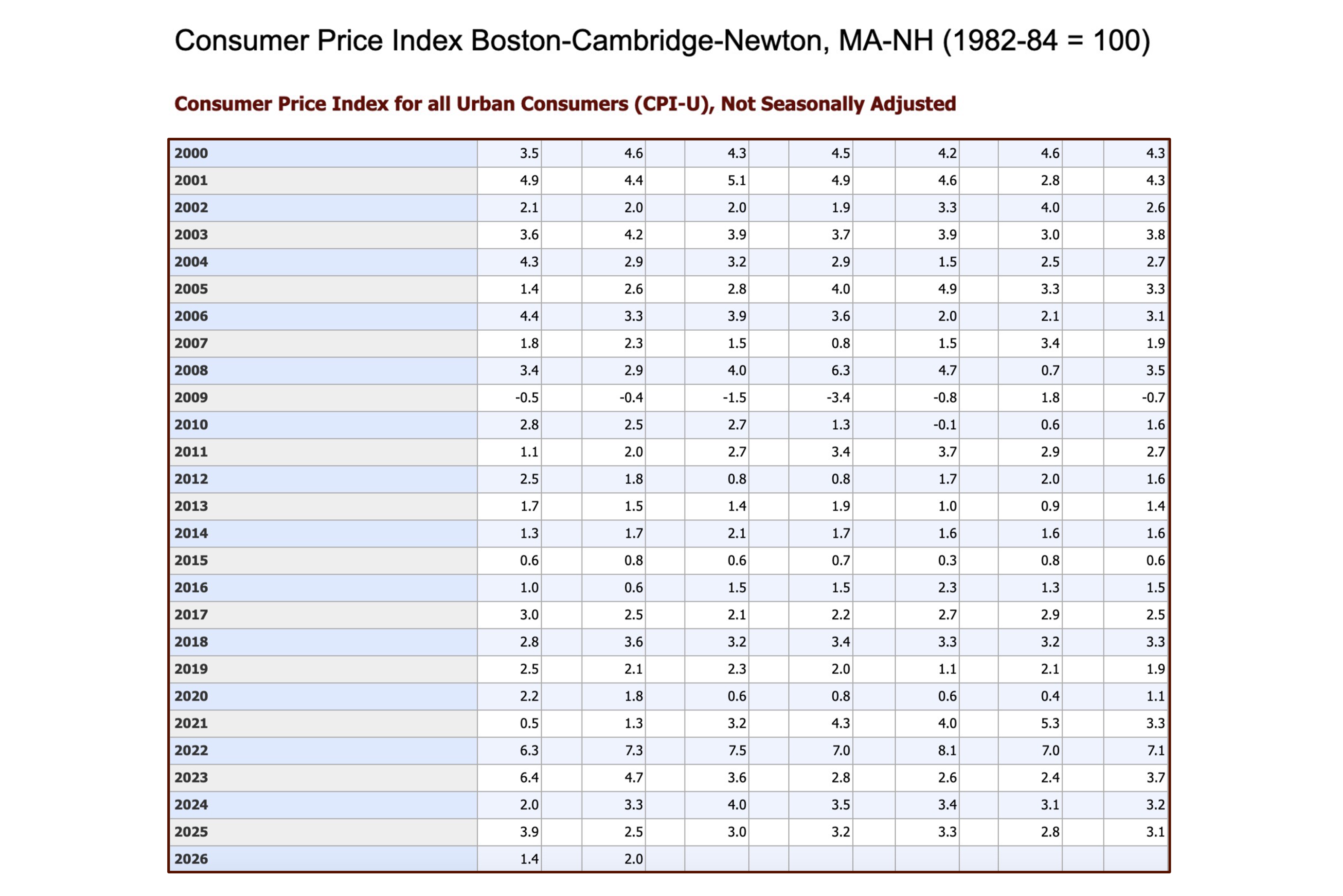
This table shows inflation averages from 2000 to 2026, as measured by the Consumer Price Index (CPI-U) for Boston-Cambridge-Newton, which is frequently used as a metric for the state’s inflation. Table columns display two-month averages, with a yearly average in the far-right column. Image: U.S. Bureau of Labor Statistics
Annual Revenue Losses Built In
In following St. Paul’s inauspicious path, Massachusetts is the first state facing a rent control policy in the restrictive neighborhood of the Minnesota capital’s citywide law. If passed, the Massachusetts version of rent control would be, by a good measure, the most restrictive statewide policy in the nation – well below Oregon’s 7%-plus-CPI with a 10% cap, and California’s 5% plus CPI.
A key component of those states’ policies is their allowance for increases above inflation. This component has been disastrously omitted from the proposed Massachusetts and actual St. Paul rent control policies. Including inflationary increases in a rent control policy at least allows for approximate increases. ecause inflation is measured primarily on regional and nationwide bases, it’s not by itself an ideal metric for reflecting local housing markets.
A majority of economists have long agreed that rent control is unwise as economic policy. But to enact rent control and not allow margin above inflation is a cruel and shortsighted way of harming the businesses of people who provide housing. It also reflects a misunderstanding or ignorance of the costs associated with running a rental business.
While the Massachusetts policy would limit rent increases somewhere between 1% and 5% in any given year, depending on inflation, home and building insurance rates are increasing well above that range. Real estate tax rates for most municipalities also increase faster than inflation. The median property tax increase across all Massachusetts communities was 4.2% from 2025 to 2026, a full point above the state’s 3.1% inflation averaged for the year. Unfortunately, this statewide rent control policy would likely further accelerate annual property tax increases, to make up for lost tax revenues as a result of decreased property values.
You can see where this is headed, and where we are headed if we approve this rent control initiative. Rental property owners would already be losing more revenue each year to insurance and tax increases before considering building maintenance, improvements and other overhead costs.
With that formula, we all know what happens to many rental buildings. No improvements. Only code-required maintenance, if that. A return to dilapidated rentals, boarded up blocks and urban blight.
What Would Your Business Look Like Under This Rent Control Proposal?
Imagine, for a minute, what your rental business might look like right now if Massachusetts had already had the proposed rent control policy in place this century. Rent increases would be limited to annual inflation rates.
As an illustration, consider a two-bedroom apartment in Worcester. Fair market rent for a two-bedroom apartment in Worcester in 2001 was $681, according to a Worcester Municipal Research Bureau report (p.4). Increasing the rent at the rate of inflation each year, as allowed in this imaginary scenario (except 2022, which would cap rent increases at 5%), the same Worcester two-bedroom’s rent in 2025 would be $1,210. That’s nearly a whopping 40% below the market rate for an average two-bedroom apartment ($2,000) estimated by Zillow. If you don’t realize how little margin there is on rental operations, you might think 40% is acceptable. But it represents more than $9,000 lost per year in comparison to market rate. That’s $237,000 lost over 25 years (without considering investment interest). Is that acceptable?
The equation of this rent control proposal – holding increases to inflation (or as much as 5% in high inflation years, which would mean a nearly 3% loss off the top in years like 2022) while taxes, insurance and upkeep continue to increase at a faster rate – damns housing providers to annual losses.
Could you operate your rental business on 40% less revenue? That’s where we will be in a few years if we don’t defeat the rent control 2026 initiative.
Another Rent Control Impact: Lower Property Values
As St. Paul knows, and as anyone in Massachusetts might recall from rent control here last century, the policy negatively impacts property values for everyone, not only rent-controlled properties.
As property values recede, property tax revenues logically decline, forcing municipalities to either raise individual tax bills (always popular) or slash public services. St. Paul’s rent control policy resulted in a reduction in controlled property values of 7-13%, according to an analysis of rent control impacts by the D.C. Policy Center, and an overall 5% drop in average property values citywide.
When Boston, Cambridge and Somerville retained rent control in the 1980s and experienced property value declines and tax revenue reductions, all other non-rent-controlling towns and cities had to subsidize that policy for those three cities. This is due to a formula that balances state aid to municipalities.
The current policy proposal would be much worse because it would apply to every city and town, which would all see depressed property values and lower tax revenues. More than 350 towns and cities, from North Adams to Plymouth, will be forced to make tough decisions: Raise property taxes, in effect distributing the cost of rent control among property owners; or cut services and jobs and accept more potholes, slower trash removal, denser classrooms, strained police and fire departments, etc.
Vacancy Decontrol, Rent Reset
Like the St. Paul law when it was first enacted, the Massachusetts proposal would also not allow vacancy decontrol, with a particularly malign retroactive clause resetting rents to their Jan. 31, 2026, rate. No market adjustments between tenancies. Only losses against inflation year after year.
St. Paul quickly adjusted that mistake. It’s another facet of this rent control 2026 proposal that would drive a good percentage of housing providers out of business, either because they were forced out, no longer able to keep up with costs, or because they left voluntarily rather than run a losing business.
Rent Control Helps a Few Renters
It has to be acknowledged: Rent control – even the restrictive model proposed for the Massachusetts ballot – will help a few people. Whoever happens to be living in rent-controlled housing at the time the policy takes effect would benefit with below-market rates as long as they live there. But their benefit is only limited to lower rent. Even renters in controlled housing will have to deal with lower-quality rentals over time, as landlords cannot afford upkeep.
And if you don’t have a rent-controlled apartment, your rent is likely to increase at a faster-than-typical pace because fewer rental units will be available as more housing providers convert to condos, sell out of the market or leave their units empty.
See our reference rentcontrolhistory.com for pictorial explanations of how rent control benefited Massachusetts controlled unit renters in the 1970s and ’80s, at an increased cost for everyone else.
According to a report by the Center for State Policy Analysis at Tufts University (commissioned by the Greater Boston Real Estate Board), the proposed rent control policy would affect about 70% of the 1.03 million rentals across the state, exempting owner-occupied buildings with four or fewer rentals and new housing for up to 10 years. So potentially, a little over 700,000 rentals would fall under the law, benefiting some 1.03 million people (family members, roommates, friends) living in rental housing, or about 14.3% of the state’s population.
That leaves approximately 6 million people enjoying fewer public benefits, paying more in real estate taxes and higher rents in order to benefit a little over 1 million renters. The math doesn’t make sense. It would be more economical and efficient – and cheaper – to simply subsidize rents for people who qualify, and build a lot more housing.
Lesson for Massachusetts: Vote NO on Rent Control
Will Massachusetts voters assign our state to a similar future as St. Paul, and force us to revisit our depressed housing past of the 1970s-’80s-early ’90s? It’s a choice: Build toward the future or recede back to the past? Or can we make it clear to enough voters that a duplicate of St. Paul’s experience is not what we want across our state?
We are doing all we can to explain the many downsides (and deceptions) of the rent control 2026 ballot initiative so Massachusetts voters can make informed choices.
If we are to avoid St. Paul’s fate, we will need assistance from our members and others who recognize the shortsightedness of this rent control proposal. Share our articles with your circles. Help educate Massachusetts residents on this issue. And help us spread the word by donatingnd volunteering for our campaign to defeat rent control 2026 at the ballot box.