Rent Control Ballot Initiative Shouldn’t Have Been Approved; We Are Fighting It
| . Posted in News - 0 Comments
By Eric Weld, MassLandlords, Inc.
In response to a disastrous rent control ballot initiative erroneously approved by the attorney general in August 2025 for the November 2026 election ballot, MassLandlords is amassing a rent control challenge on multiple levels in several arenas.
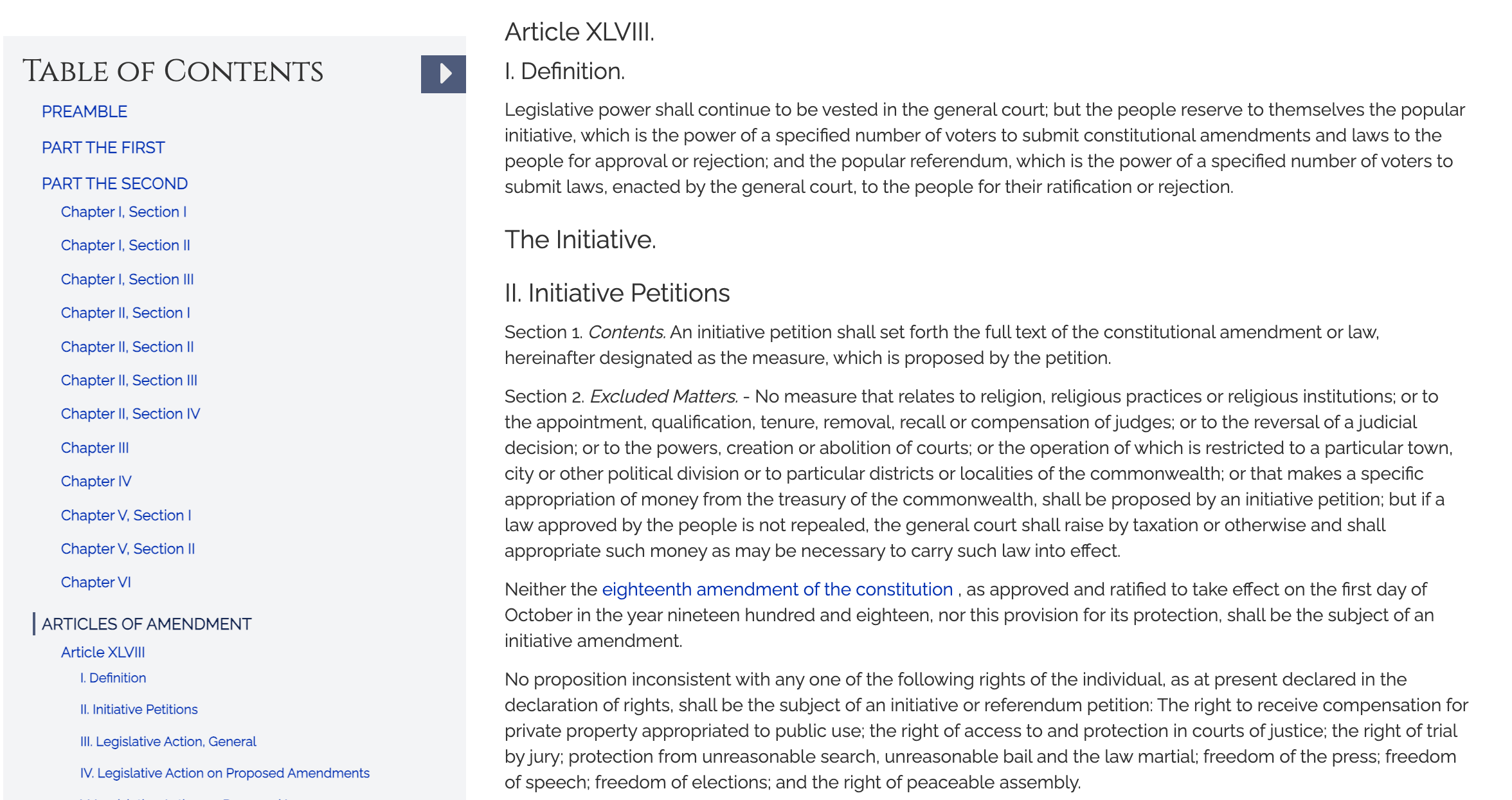
MassLandlords will submit an amicus brief to the legal challenge against the rent control ballot initiative, brought forth by the Greater Boston Real Estate Board, centering on Amendment Article 48 of the state constitution. The article states that no initiative petition can preempt “the right to receive compensation for private property appropriated to public use” (see final paragraph). The current rent control ballot initiative proposes to replace that constitutional right with a version of rent control that does not include compensation for owners of controlled rental property. Image: Mass.gov.
To recap, the rent control proposal is a statewide mandate with no local option to opt in or out. It will prevent us keeping pace with inflation, eliminate all renovation and have no vacancy decontrol. The next tenant will pay the same rent as the previous tenant until your once-per-year increase of either 5% or a given year’s inflation percentage based on an unspecified Consumer Price Index, whichever is less.
We are calling on each of our members to contribute $500 to support this fight that is in all our interests (tenants included!). We estimate that amount equals roughly 1% of monthly revenue over a three-month span, calculated as an average across our membership. Please give to this effort now, so we can take steps to define the disaster of rent control and push back against the loud voices of rent control advocacy. Timing is very tight, but if we begin now, we can mount an effective campaign against a return to rent control before ballot approval in June and, if necessary, all the way to November.
Contribute to our general fund by credit card or ACH authorization: https://masslandlords.net/stop-rent-control/.
Our Multifront Anti-Rent Control Strategy
With your assistance and contributions, we plan to challenge this rent control ballot initiative on several fronts:
- Our powerful resource rentcontrolhistory.com has already been seen by more than 600,000 viewers and was instrumental in blunting the last attempt at a rent control ballot in 2023. We plan to make this eye-opening website more visible by translating it into more languages and advertising on social media, billboards and lawn signs across the state.
- We will contribute an amicus brief to litigation by the Greater Boston Real Estate Board pointing out the unconstitutionality of this rent control proposal. See our legal arguments below.
- We will lobby the legislature to replace this flawed rent control policy with a much fairer, alternative form of voluntary rent control that would correctly compensate housing providers. We have a 20+-page white paper drafted.
- We will continue and seek to expand our position as the “go to” voice across media on rental real estate, especially our representation of small and mom-and-pop rental property owners. Executive Director Doug Quattrochi has been quoted and cited in more than 100 news stories in the past five years, and is fielding numerous queries about rent control.
- We want to expand our MassLandlords team of eight full-time equivalent seasoned employees, to include a long-awaited community organizer to run local political events. We recently added a full-time manager of Marketing and Public Relations. These positions will strengthen our ability to organize against rent control and educate voters on its many harms.
Lies and Deception From Rent Control Advocates
This rent control initiative petition should not have been approved by the attorney general, for several reasons.
“An Initiative Petition to Protect Tenants by Limiting Rent Increases” calls for the deletion of General Laws Chapter 40P. This is a law that prohibits this version of rent control statewide, enacted via referendum in 1994.
MGL Chapter 40P currently allows for Massachusetts municipalities to implement rent control of any limit (inflation, 5% or even a total rent freeze) as long as towns and cities fairly compensate property owners the difference between the market value of their rentals and the controlled rent amount. We have no problem with that, and will lobby the state legislature to consider this structure in replacement of the proposed ballot initiative.
But advocates of this rent control initiative petition apparently do not want voters to know that it would replace the provisions of MGL Chapter 40P, including rental property owners’ right to receive fair compensation. The attorney general’s office asked petitioners if the initiative summary should include the fact that it would replace the existing Chapter 40P. Most voters would base their votes on the ballot summary. Andrea Park, an attorney with the Massachusetts Law Reform Institute (MLRI), who is representing the petitioners, said it should not.
“Referencing G.L. 40P in the summary would create confusion for voters…summarizing the language in ‘plain English’ would be…necessarily partisan,” she wrote.
Plain English is partisan now?
The ballot summary omission of the petition’s intention to replace an established law, MGL Chapter 40P, creates an unfair and misleading ballot question. Most voters would be casting their ballots based on incomplete and unfairly excluded information. If rent control was the kind of thing that voters in 1994 determined should be compensated, then what does this program really cost?
Violation of the State Constitution
The summary’s unfairness aside, the legal case against the ballot initiative centers around the petition’s violation of Amendment Article 48 of the state constitution. Article 48 governs the rules around citizen referendums and initiatives for new laws, such as the rent control initiative currently in process. Massachusetts Fiscal Alliance, a nonprofit committed to raising public awareness about benefits of fiscal responsibility and government accountability, first made the case against the unconstitutionality of the ballot initiative during the attorney general’s certification process.
Article 48 includes a clause that makes it illegal for a referendum or initiative to gain approval for the ballot if it infringes upon certain stated existing rights. Section 2 of the article states in part: “No proposition inconsistent with any one of the following rights of the individual…shall be the subject of an initiative or referendum petition: ...The right to receive compensation for private property appropriated to public use.”
When lawyers argue about appropriating property for public use, they often talk of regulatory takings or eminent domain. In arguing before the attorney general, MLRI said that there is too high a bar for rent control to be considered a regulatory taking. That’s not true, but even if it were, regulatory takings and eminent domain are not the only kinds of appropriations for public use. When voters enacted Chapter 40P, they decided that rent control was an appropriation for public use and that it merited compensation.
Furthermore, a key tenet of appropriation of private property for public use, such as eminent domain, is “just compensation” to the owner. Yet, for some reason, any notion of compensation to property owners is not considered or mentioned in this rent control petition.
Quoting the exact language of the ballot initiative (but not the summary), it states that it would amend the state’s General Laws by “striking out chapter 40P and inserting in place thereof the following chapter: Chapter 40P. Limiting Rent Increases,” which would take away rental property owners’ rights to receive compensation.
In attempting to delete rental property owners’ right to compensation, then, the ballot text is a clear violation of Article 48. In hiding this from voters, MLRI is being manifestly unfair.
Violation of Lenders’ Contracts
The legal case against the rent control initiative also includes another Article 48 violation. The 1998 case Dimino v. Secretary of the Commonwealth protects the security interests of contracted bondholders. In the case, the Supreme Judicial Court overturned the attorney general’s approval of a petition that would have eliminated the collection of tolls on the Massachusetts Turnpike, which would have jeopardized the security interests of bondholders and potentially breached existing contracts.
The same situation is in play now. Forcing rent increase limits on rental property owners, at or below inflationary increases, would inevitably reduce property values, as happened during rent control in the 1970s through 1994 in Cambridge, Boston and Brookline. Reducing controlled rental properties’ values could impact the security interests of mortgage lenders. Commercial lenders issued their mortgages on the basis of an assumption that rents could be increased at or above costs. The ballot initiative invalidates these security interests, another uncompensated appropriation in violation of Article 48 of the constitution.

If rent control returns to Massachusetts via the latest rent control ballot initiative, boarded up buildings like this Southie eyesore will once again become commonplace. Help us fight a return to urban blight. Image: public domain
If Rent Control Passes, We Will All Pay Much More Forever
The rent control initiative making its way onto the 2026 ballot will lock all rental property owners in Massachusetts into sub-market rents permanently, with a cap of 5% or no more than a given year’s inflation rate. The initiative does not specify which Consumer Price Index it would reference, but if it used the commonly referenced Bureau of Labor Statistics CPI-U (the Consumer Price Index for All Urban Consumers), and we referred to the year January 2024 to January 2025 as an example, rent increases would be capped at 3%. A maximum 5% rent increase would be allowed only in years when the referenced CPI measures inflation higher than 5%.
If this scheme had been in effect during the stagflation of the 1970s and ’80s, rents today would be half of what they are, but costs would be the same. Just for fun, calculate half of your current rents and imagine running your business on that amount year after year. Hundreds of thousands of buildings would be boarded up across the state, just like last time. Or, perhaps this system would have been repealed after it became apparent how destructive it is to housing, just as rent control was repealed already, in 1994.
Over time, after years of falling behind under the proposed system, many housing providers would leave the business, reducing the rental stock. Others would opt not to keep their rentals in good order, allowing dilapidation over revenue loss, resulting in a return to urban blight. Municipal tax revenues would suffer, impacting schools and public services. Rents of non-controlled properties would shoot up because they would be more valuable.
At the same time, overall property values would fall – not only rent-controlled properties but also properties near them. This spillover effect of rent control’s negative impacts on surrounding properties was studied and chronicled in two academic analyses of housing values in Cambridge following the repeal of rent control there: “Housing Market Spillovers: Evidence from the End of Rent Control in Cambridge, Massachusetts,” lead author David H. Autor, professor of economics, MIT, in National Bureau of Economic Research, 2012; and “Out of control: What can we learn from the end of Massachusetts rent control?” by David P. Sims, professor of economics at Brigham Young University, in Science Direct, Feb. 13, 2006.
We know from recent experience: rent control would make the housing crisis much worse. We know this because it is what happened last time rent control was in place. For a pictorial illustration of rent control’s impacts, see our website RentControlHistory.com.
Help Us Fight This Disastrous Policy
The reality is our multipronged strategy to fight this rent control proposal requires funding. But compared to what it will cost us all if rent control again becomes law in Massachusetts, this fight is necessary. Help us wage this broad challenge to rent control. Contribute $500 or more today. Compare that to the tens of thousands of dollars you may lose if you’re made to hold your rents at or below inflation every year.
We are obligated to pursue this fight, not only as advocates for rental property owners, but as supporters of better rental housing for all – tenants and housing providers.