
New Biodiversity Graphic Artwork Gives Visual Tour of MUC’s Mission
| . Posted in News - 0 Comments
By Eric Weld, MassLandlords, Inc.
A new, illustrative infographic recently published on the Massachusetts Urban Conservancy website treats viewers to an artful, mostly visual overview of the conservancy’s purpose, goals and direction.
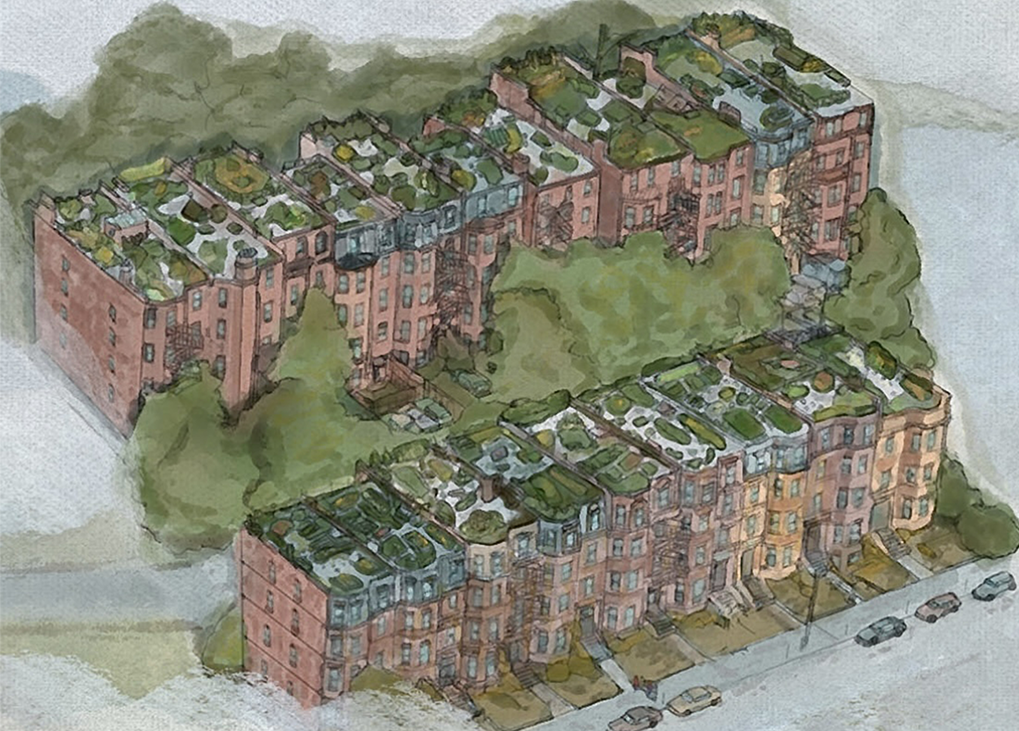
This excerpt from the MUC infographic depicts a series of green roofs atop apartment buildings. Green roofs, popular in many parts of the world, are an efficient way to cool surrounding outdoor temperatures. Green roofs can also be low-cost, and can be constructed to accommodate solar panels, multiplying their environmental power. Image: Derivative of Boston Back Bay Townhouses from Prudential Tower by Roger W cc by-sa
The Massachusetts Urban Conservancy, Inc. (MUC), is an offshoot of MassLandlords. It was incorporated in January 2025 to help restore biodiversity by transforming unused, unbuildable urban lots into healthy ecosystems and pollinator habitats. MUC also offers guidance for converting grass yards of residential and rental properties into self-sustaining, pollinator-friendly gardens with native plants and trees. MUC is organized and administered by MassLandlords personnel, with support and assistance from members and others not affiliated with the association.
MUC’s mission is to “prevent, forestall and mitigate the impacts of climate change by supporting urban areas to become denser and wild areas to become wilder.” Part of that work involves preventing and removing invasive species in urban land and planting more native plants. MUC also aims to provide access to healthy, diverse green spaces for school districts and residents in environmental justice communities, for enjoyment of nature and science, biology and ecology education.
Representing our mission through imagery has been a MUC goal since we launched the nonprofit. MUC’s mission of restoring and revitalizing nature is, after all, partly about aesthetic, so imparting our message and projecting our vision using visual appeal is essential.
But how do you capture 4.5 billion years of environmental evolution and statistical phenomena in a visual tableau?
“I felt an artistic approach might catch people’s attention in a more personal way than a standard infographic,” noted Jennifer Rau, the MassLandlords graphic artist who created the MUC infographic. “As a painter, I was excited to try digital painting for this project.”
A Biodiversity Museum Exhibit
The MUC infographic is a comprehensive overview of some of the ways in which human activity has, and is, compromising earth’s habitat and biodiversity. Our planet’s loss of biodiversity – in plant, animal and microorganism life on land, water and air – is rapidly threatening the planet’s natural resources that we use heavily for food, shelter, medicine and raw materials for nearly every aspect of human life.
The graphic begins with the title “Biodiversity Loss is the Wreckage of Our Past,” before escorting viewers, as they scroll down, through a succession of visually arresting images accompanied by explanatory placards.
One could view this graphic artwork as a museum exhibition. Rau even made the artistic choice to portray some of her illustrations inside museum-like picture frames. The effect is like viewing a collection of artworks floating in a sea littered with discarded junk.
“The components were initially set to be individual or free-standing paintings paired with gallery-style description panels,” Rau described. “Through the evolution of our project discussions, we decided to connect the images with a background in order to create a journey-type storyline that’s meant to be scrolled through slowly.”
The graphic journey is interrupted midway with the overarching declaration backstopping our work at MUC: “MUC aims to help preserve 4.5 billion years of biodiversity. Our survival on Earth depends on it.” The illustrations then pivot to a birds-eye view of landscapes, accompanied by more biodiversity statistics.
Focus on Cities
To tie the message together, the infographic ends with this fact: “By bringing biodiversity to people’s daily lives, MUC increases political support for conservation worldwide.”
At MUC, we realize if we are to succeed, as earth inhabitants, in restoring biodiversity and revitalizing the planet’s ability to sustain life, urban areas are an essential focus of that effort. Most (about 55%) people on earth live in cities. That’s projected to rise to 68% by 2050, according to the United Nations. Yet, our cities worldwide, and in Massachusetts, are losing biodiversity, and exacerbating species extinction, at a faster clip compared to rural and non-urban regions. People are falling out of touch.
MUC focuses on urban lands for a few reasons: 1) to demonstrate the value and benefit of nature and green space to urban and environmental justice community residents, and achieve large-scale buy-in to support this vital agenda; 2) to help improve the lives of urban residents by enhancing air and water quality, adding shade and trees’ cooling capabilities, and lowering costs of living; and 3) to contribute to a broad effort of creating habitat continuity. As it is, animal and plant habitats are fragmented across much of Massachusetts, often interrupted by urban clusters lacking greenery and places for animals to stop, forage, mate and make their homes. Species populations are negatively impacted by this fragmentation. A statewide series of small, environmentally restored, biodiverse pockets would help build back a connected network of habitats and support a multiplicity of animal and plant species.
MUC Mission in Pictures
We hope that viewers of our new infographic come away with at least a visual understanding of what we are attempting at MUC: to raise awareness of humans’ impacts on the planet’s natural resources and underscore the importance of working together to restore nature, biodiversity and animal habitats.
If you are inspired by our infographic or other information on the MUC website, let us know your feedback, at info@muc.bio, or join us in our efforts to bring more biodiversity – and better environmental quality – to our state, our rental properties, and our planet.