
Why Would a Landlord Raise the Rent 100%?
| . Posted in News - 0 Comments
Douglas Quattrochi, Executive Director, MassLandlords
Several times at the State House hearing on rent control March 17, speakers asked us to believe that anyone who raises the rent by “100, 200, whatever percent” would be motivated by “excessive profit at anyone's expense and greed.” This is not true. See our other essay, “Why ‘Greed’ Needs to Leave the Debate.”
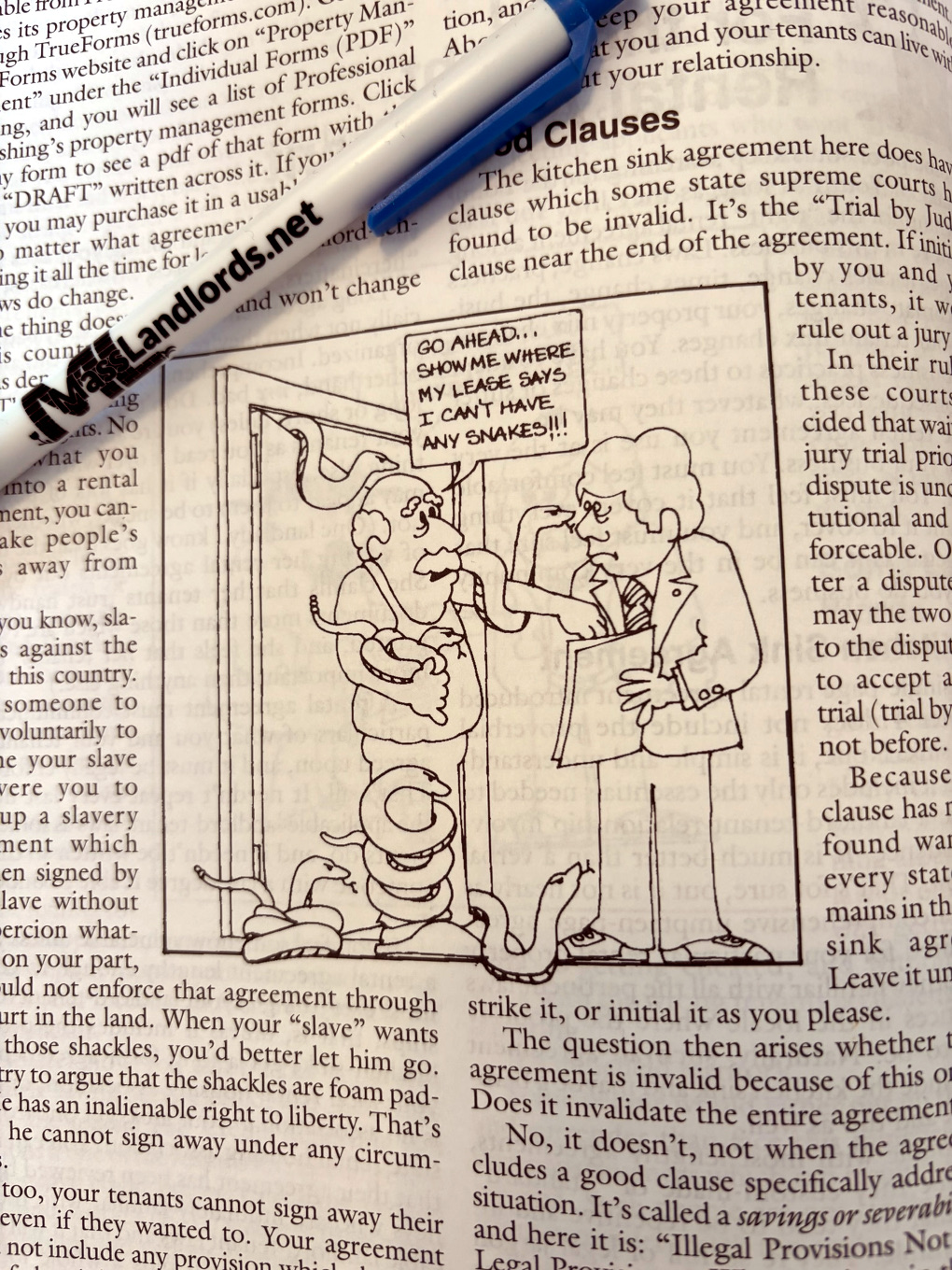
This illustration from Leigh Robinson’s 1975 “Landlording” shows the pain of a landlord caught in a mess where the law, symbolized by their rental agreement, offers no protection. What are they to do when they didn’t bank on the cost of a snake-ravaged apartment or the resulting liability? (Image: Fair Use, Leigh Robinson, “Landlording,” 1975)
But suppose a landlord did raise the rent 100% purely for the sadistic joy of it. Should they be a landlord? No. Would there be any remedy under existing law? Yes, and in fact it has already been applied to landlords for far smaller rent increases.
General Law Chapter 93A says that an unfair practice in the conduct of a trade or business is unlawful. This is a powerfully broad law. Courts have powers of equity to decide all cases where the law is not clear. They use it often with 93A.
Chapter 93A empowers judges to award triple damages, as well as attorneys’ fees and court costs. It requires that before court, the injured party send a demand letter to the person in the wrong. Nine times out of ten, this shakes the apple from the tree.
If the case does end up in court, judges enforce the law. Chapter 93A is used regularly all over Massachusetts. It is the primary mechanism for legal services to earn their wages. Legal services use Chapter 93A to help renters with security deposit cases, retaliation cases and much more, all day every day. A 100% rent increase without justification is already actionable under 93A on threat of triple damages and attorneys’ fees. Any rent increase at all, however small, within six months of a renter calling the code department, unionizing, or asserting any right under law is also presumed unlawful retaliation per General Law Chapter 186, Section 18, which stacks with Chapter 93A. (It would be up to the landlord to prove it was not retaliation.) There is lots of case law on this for mobile home rent increases (going back before mobile home regulations). The law works for residential tenancies, as well. There are innumerable cases across both the courts and the MCAD for retaliatory rent increases of even small amounts, and many more off-the-record settlements.
Renter advocates are quick to sidestep any mention of this powerful consumer protection law. They seek to take advantage of the general layperson’s willingness to believe that a landlord can set whatever rent they want. If this were true, then rents would be arbitrarily high everywhere.
If I am renting an apartment for $1,500 now, why not $3,000? Why stop there, let’s go to $6,000. Why, even, stop there? “A million dollars!” I would cackle all the way to the bank.
We must at some point accept that market forces exist. They direct what the rents will be. The market does not permit an apartment already at fair market rent to be raised 100%. No one would rent it. The market does not permit an apartment already at fair market rent to be raised even 3% sometimes. As Massachusetts has seen an exodus of residents through outward migration, rents in some markets have held steady or been lowered 2% recently.
Whenever a renter describes what seems like a large rent increase, it’s vital to ask three questions.
- What was the starting rent?
- What was the condition of the apartment?
- Is there any reason the landlord might want the renter to leave?
The sad reality is that any or all of these factors will be dispositive as to why this large increase was levied.
The Starting Rent Might Be Half Market, or Less
It is often the case that long-term landlords who have paid off their mortgage stop raising the rent on renters. They’ve been successful and they’re paying a little back into the community. The result after decades is rent that is well below market.
That landlord will eventually age out of their ownership of the property. When this happens, the new landlord will not have the same financial freedom. They will likely have a mortgage at prevailing interest rates. The property will be reassessed upwards for tax purposes based on the new sale price after decades of inflation. And they will have entered into ownership on the fair expectation that they can get fair market rent for the units. The possibility of a rent increase is the reason the property changes hands and doesn’t remain unwanted and unmaintained forever after.
Long-term renters in such a building will be caught in the “helping trap.” They were helped for a long time. But now their rent is unrealistically low, half of market. They have built their home finances around an incorrect view of what rent truly costs. They cannot easily move (who can?). The safety net is full of holes, so they call City Life Vida Urbana to stage a picket against their large rent increase. They will eventually either leave or pay more rent, while City Life gets another day in the sun. But economics remains the same.
Rent that is half of fair market value can be raised 100% and still be fair market rent after. The problem is not that markets exist but that renters, especially immobile renters, have an inadequate safety net on change of ownership.
If a renter says they got a large rent increase, ask what their starting rent was and what fair market rent for their apartment is.
The Apartment Might Need Serious Work, Including Decarbonization
It should go without saying that Massachusetts housing stock today is not the housing stock we need in the future. It is in many places below the minimum standards of human fitness. The law mandates that apartments be safe. Also, we are morally and legally obligated to decarbonize our structures entirely by 2050. None of this is free.
We can’t even meet our existing renovation obligations, it seems: After 50 years of having a nation-leading deleading law on the books, still ~90% of apartments do not have a certificate of deleading compliance. We are hopelessly undercapitalized.
Repairs can be done as patchwork or in one fell swoop, as part of a major renovation. Patchwork repairs are more expensive and only kick the can down the road. Major renovations are cheaper in the long run. But once a wall is torn down to repair the leaking plumbing behind it, the old wall and pipe are never coming back. The new wall and plumbing will be much more expensive to rent than the old ones.
I myself raised the rent significantly on a renter. When I bought the building I owner-occupy, the upstairs was a lead paint death trap. It was below the permissible minimum standards of fitness in other ways, with broken cast iron in the walls, sanitary leaks in several places, and amateur electrical wiring. It needed substantial renovation. A kid was living there in all that lead. Their guardians were paying half rent. The previous owner’s husband had died, leaving an unwilling wife-turned-landlord in over her head with a purse empty for funeral expenses and advancing years. I said to the renters, “Fixing your apartment piecemeal will take market rent. Or leave and I will do it up fully for the next renter.” They left.
It turns out no amount of market rent could have fixed that apartment. I had too little money to renovate. I borrowed lots more from family and poured more into this place than it has netted overall. The rent doubled between that lead-hazard state and the next renter, but the apartment was now lead-safe, leak-free, and correctly wired.
This could never have happened if the proposed ballot initiative for rent control had been in effect. I was an owner occupy, so you would think I’d be exempt. But this exemption applies only so long as the building remains owner-occupied. I could never sell out to an investor at full price because the rents would have to be reset down based on the pre-renovation index date. A non-owner occupy could only charge pre-renovation rents. I never would have bought it. All other investors would have passed on it, as well. The rent never would have come close to market. That apartment today would still be dangerous. The previous owner would have left the keys on the countertop. The bank would have foreclosed and then evicted the renters. It would be a boarded-up wreck, just like the hundreds of properties we’ve cataloged that were boarded up in Boston under rent control in 1985.
The problem is not rent increases. The problem is that modernizing buildings piecemeal requires much more money than large renovations, long-term, and in both cases they are enormously expensive.
A second problem is that renters have so little choice in the market due to constrained supply that they would choose to live in unsanitary conditions as their best realistic option. When a renter says they got a 100% rent increase, ask if their apartment was in bad shape. It very well could have been.
There Might Be Unresolvable Conflict Between Landlord and Renter
Even in my situation, where the renters and I were not in legal conflict, there are many situations where landlords and renters are perpetually at odds. It is not uncommon for me to hear a landlord say, “Now they’ve moved in their friend and they’re bringing over bad characters. My other renters are afraid. They’d never testify. I’m just going to raise the rent and hope they leave.”
Is that how it should be? No. Is it likely to work? Maybe. It should be easier for landlords to enforce behavioral standards between residents, including maintaining respect, distance, and civility. No one should be uncomfortable or afraid in their home. But that is not the world we live in. The reality is that renters like all people run the spectrum from good to bad, and there’s a long tail of “very bad” that landlords are powerless to stop. One of the few eviction cases during the pandemic was when a renter leaned out their window and shot their neighbor. The guy running up and down the halls with a chainsaw wasn’t stopped because, the court found, the chainsaw wasn’t on.
The law in Massachusetts gives landlords only three options to bring an eviction case and none of them are very likely. Ninety percent of cases do not result in an order for forced move-out. A typical bad case will take a year and tens of thousands of dollars. There are too few good options.
A renter need not even be all that bad. A renter who is merely trying the landlord’s patience on issues like noise, trash, cleanliness, access, or late payment might find themselves facing a large rent increase merely because they’ve abused the privilege of living at below-market rent for long enough. We can choose to hold rent below market for people who follow the rules, and we can insist on full market rent for the renter who takes down the smoke alarms and smokes in a no-smoking apartment. It’s a rare housing court judge who will evict a renter for smoking, no matter how bold, underlined, and all caps the prohibition may appear in a lease. How are we to help the neighbors when the courts will not help us?
Large rent increases sometimes arise because the landlord has no good option and is throwing everything at the wall to see if something sticks. If a renter says they got a large increase, ask if maybe they might have done something they shouldn’t have.
Conclusion
Large rent increases are not the norm, but they are not necessarily a sign of unfairness, greed or other nefarious purpose. There are already strong protections for unfair rent increases under Chapter 93A. Rent control is not necessary, and is actively harmful to maintaining housing stock for the reasons mentioned.
100% rent increases are rare and can be unfair. You have rights in Massachusetts. Help may be available.