
MassLandlords Assumes Leadership of Massachusetts Rental Housing Association
. Posted in News - 0 Comments
By Eric Weld, MassLandlords, Inc.
MassLandlords recently took over the nonprofit Massachusetts Rental Housing Association (MRHA), a 42-year-old organization that had languished with inactivity in recent years. Along with the subsumption of MRHA, MassLandlords will also occupy the organization’s state-appointed seat on the advisory committee of the Childhood Lead Poisoning Prevention Program (CLPPP).
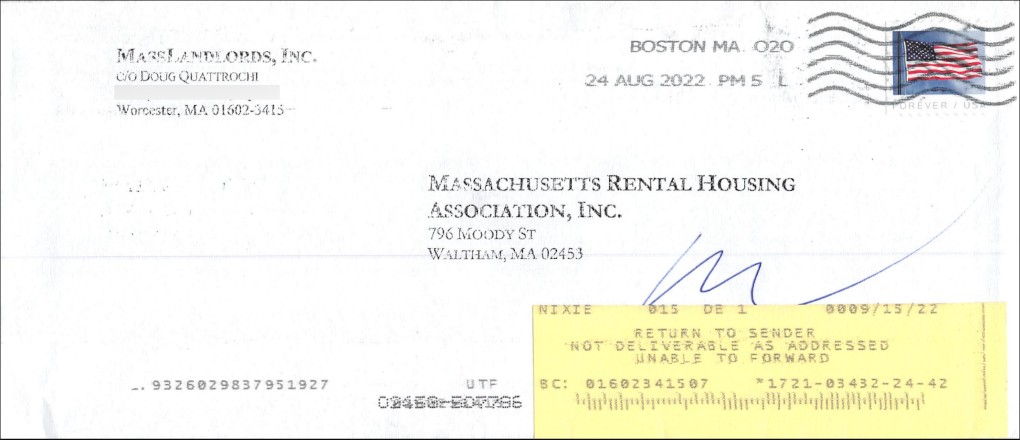
We made several attempts over years to contact Massachusetts Rental Housing Association (MRHA), to inquire about its status, current leadership and the prospect of combining efforts, all unsuccessfully. When we mailed a letter of inquiry to its most recent registered address and the letter was returned to us undeliverable, it was the latest sign that the once-robust statewide association had dwindled. Image: MassLandlords, Inc.
The CLPPP is a state governmental program that works to eliminate sources of lead poisoning and helps coordinate care for children diagnosed with lead poisoning. MRHA was assigned the committee membership as part of the law establishing the CLPPP, M.G.L. Chapter 111, Section 190.
At a meeting of the MRHA Board of Directors on Dec. 8, 2025, MassLandlords Executive Director Doug Quattrochi was named new MRHA president.
MRHA, a 501(c)(6) nonprofit like MassLandlords, had all but ceased activity over the past decade. The organization had failed to file annual reports with the state attorney general, as required for nonprofits incorporated with the state. MRHA leadership had become amorphous and nonresponsive. The nonprofit was involuntarily dissolved June 30, 2025.
MRHA has not accepted new members, nor has it collected dues, since 2017. Its membership has lapsed over the past nine years. It may be possible, however, to reengage and restore the organization’s membership under MassLandlords’ organization and leadership.
MRHA Brand Advantage?
The subsumption of MRHA by MassLandlords offers a couple positional advantages.
The seat on the CLPPP advisory committee will give MassLandlords direct influence to shape policy around lead protection, remediation and management in homes and rentals. Lead and lead poisoning remain outsized problems in Massachusetts, inordinately affecting children in households with lead in many detrimental ways. MassLandlords has been effective in changing state lead policy in recent years, including helping to double the tax credit for lead remediation. Quattrochi, as MRHA president, will assume the CLPPP committee seat.
The MRHA brand offers another benefit to multiply our lobbying power and advocacy for smart housing policy. MRHA, established in 1983, once had a statewide presence. It was instrumental in advocating against rent control in the 1980s and influenced other rental housing policies. MassLandlords can revive and use the positive MRHA brand for public relations, marketing and lobbying initiatives.
In a state where “landlord” carries negative connotations in some corners, advocating from the position of another established organization not named MassLandlords could assist our efficacy.
MRHA History
MRHA was incorporated on Nov. 30, 1983, and certified by Secretary of State Michael Joseph Connolly. The organization’s first address was a PO Box in Southbridge.
For most its history, MRHA was largely volunteer-run with in-person meetings. And they were mostly effective. MRHA was a major factor, alongside the Small Property Owners Association (SPOA), in the 1994 repeal of rent control. Other legislative achievements include obtaining the lead paint advisory seat, and passing the water submetering law in 2004, before which it was never legal to charge for water. MRHA was a constant presence at the State House.
At its peak, MRHA was the kind of organization that could draw a thousand attendees to an event. They did just that with their conference and trade show in the early 2000s. (If you have information about this, please share! All we have to go on is word of mouth that the conference was a success.)
All of this did not last. The general trend in Massachusetts over the last several decades seems to be diminishing interest in volunteering and civic participation in clubs and professional associations. MRHA was no exception. By the 2010s, its volunteer leadership receded, leaving a vacuum of representation for landlords across the state.
The Worcester Property Owners Association (WPOA) broadened to statewide membership in 2013, welcoming abandoned MRHA members. Most importantly, MassLandlords was founded on dues increases, event tickets and the financial resources to adopt a “paid staff” model that would work even if volunteerism was in decline. In 2014, MassLandlords.net was launched by a restructured WPOA with a digital membership model and has continued to expand membership through the present.
As MassLandlords grew, the MRHA board was split on whether to integrate or remain independent. One board member, Ray Smalley, volunteered considerable time for both organizations. Smalley called the Dec. 8 meeting by inviting the last-listed officers visible on the Secretary of the Commonwealth’s website. Norm Neu, previous MRHA president, attended. Krystine Hetel and Sandy Depanian were either not reachable or decided not to attend.
At that meeting, motions were made to reinstate the MRHA and to appoint Quattrochi as sole director and president able to carry out this purpose. Both motions were passed unanimously and minutes were recorded. MassLandlords has started the process of revival with the Secretary of the Commonwealth and will seek to restore nonprofit status with the IRS as well.
In light of this history, with much of MRHA’s membership having moved to WPOA then to MassLandlords, the incorporation of MRHA by MassLandlords continues a statewide amalgamation of small landlord chapters that began 43 years ago.